
Table of Contents
- What the Average Cost of Professional AC Repair Actually Covers
- Typical HVAC Diagnostic Fee
- Labor Costs vs. Parts and Materials
- Common AC Repair Issues and What They Cost
- AC Refrigerant Leak Repair Cost: What Drives the Price
- Compressor Replacement and Other High-Ticket Repairs
- Signs Your AC Needs Professional Repair (Don’t Wait)
- Repair vs. Replace: A Decision Matrix for Older Systems
- Hidden Costs of Cheap Repairs, Financing, and Seasonal Pricing
- Frequently Asked Questions
Last Updated: September 18, 2026
What the Average Cost of Professional AC Repair Actually Covers
The average cost of professional AC repair is not a single number. It is the sum of three charges: a diagnostic fee, labor, and parts.
This guide from Anthony & Son Indoor Air Quality, LLC breaks down what each line item means, which repairs sit at the low end, and which ones push a bill into four figures. The U.S. Department of Energy’s guidance on home cooling makes one point clear: a system that is repaired correctly and maintained on schedule costs far less over its life than one patched repeatedly.
Typical HVAC Diagnostic Fee
An HVAC diagnostic fee is the flat charge a technician collects to inspect your system and identify the fault, typically covering travel, inspection, and a written repair estimate. Some contractors waive it if you approve the work.
That fee is not a scam.
Ask upfront whether the diagnostic fee is credited toward the repair if you approve the work. Most reputable HVAC contractors apply it. If the answer is no, ask why before you book the visit.
Labor Costs vs. Parts and Materials
Labor and parts are billed separately, and the split matters more than the total. Labor is a flat rate or hourly plus a service call fee; parts are billed at cost plus markup or bundled into the flat rate.
| Cost Component | How It’s Billed | What It Covers |
|---|---|---|
| Diagnostic fee | Flat fee per visit | Travel, inspection, written estimate |
| Labor | Flat rate or hourly | Technician time, testing, installation |
| Parts and materials | Cost plus markup | Capacitors, motors, coils, refrigerant |
| Emergency surcharge | Flat add-on | After-hours or weekend dispatch |
Common AC Repair Issues and What They Cost
Most AC repairs fall into a handful of recurring categories, and knowing which one you’re facing tells you roughly where the bill will land. A capacitor failure is a quick, low-cost fix. A compressor replacement is the opposite.
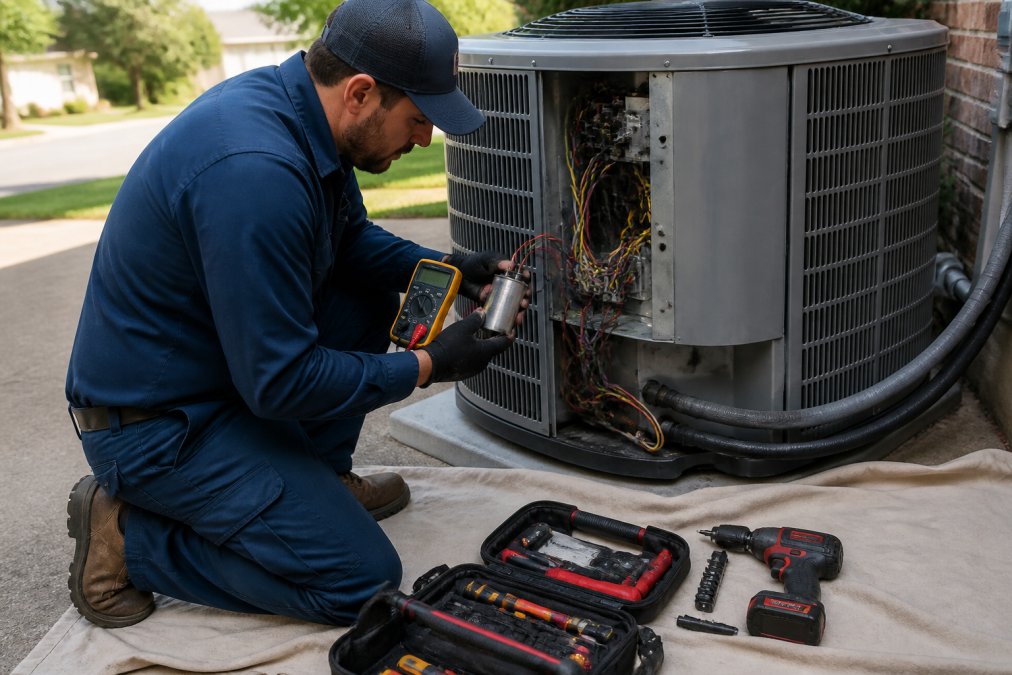
Capacitor failure, blower motor, and electrical components
Capacitor failure is the most common cause of an AC that hums but won’t start. The capacitor stores and releases the charge that starts the compressor and condenser fan; when it fails, the system won’t start or trips the breaker.
Condensate drain line clogs and evaporator coil problems
A clogged condensate drain line is the most preventable repair on this list. The drain carries condensation away from the air handler. When algae and debris block it, water backs up, and the system shuts down on a safety switch or leaks into your ceiling.
Ignoring a slow condensate drain clog is one of the most expensive mistakes homeowners make. A drain that backs up into drywall or a finished ceiling turns a simple line clearing into a water damage claim.
AC Refrigerant Leak Repair Cost: What Drives the Price
The AC refrigerant leak repair cost is driven by three things: whether the leak can be found, where it is, and whether the system uses older refrigerant. A leak in an accessible line set is straightforward; one inside an evaporator coil often means replacing the coil.
If a contractor offers to ‘top off’ your system without performing a leak search, treat that as a red flag. You are paying for refrigerant that will escape again, and the underlying fault remains.
How leak repair pricing breaks down
| Cost Element | What It Covers | What Moves the Price |
|---|---|---|
| Leak detection | Electronic detector, UV dye, pressure test | Accessibility, leak size, number of visits |
| Access and disassembly | Opening the air handler or line set | Coil vs. line set location |
| Parts | Coil, line set section, Schrader valves | Part availability, system age |
| Refrigerant | Recharge to factory charge | Refrigerant type, pounds required |
| Labor | Brazing, evacuation, recharge, testing | Flat-rate job pricing |
The repair-vs-replace math on a leaking coil
A leaking evaporator coil on a system 12 or more years old is the classic tipping point: the coil is a specialty part, the recharge is substantial, and opening the air handler is significant labor. When the combined cost approaches half the cost of a new system and the outdoor unit is near the end of its service life, replacement usually wins on total cost of ownership.
Compressor Replacement and Other High-Ticket Repairs
Compressor replacement is the single most expensive common AC repair, and on an older system it often tips the decision toward replacement. The compressor is the heart of the condenser unit, and replacing it means recovering refrigerant, cutting it out, brazing in a new one, and recharging. That sequence explains the bill: refrigerant recovery, a specialty part, skilled brazing labor, a full evacuation and recharge, and a verification run.
The 50% rule, applied
The framework most HVAC practitioners use is the 50% rule: if the repair exceeds 50% of the cost of a new system and the unit is more than 10 years old, replacement is usually the better financial decision. It is a starting point, not a verdict, because two factors change the math.
| Repair Scenario | Typical Decision Path | Key Factor |
|---|---|---|
| Compressor failure, under 10 years, in warranty | Repair | Parts warranty offsets most of the cost |
| Compressor failure, under 10 years, out of warranty | Get both quotes | Repair may still win on total cost |
| Compressor failure, 10-15 years | Weigh both | 50% rule plus efficiency gain |
| Compressor failure, 15+ years | Replace | Second failure likely, efficiency gap large |
| Evaporator coil, under 8 years | Repair | Coil often under parts warranty |
| Evaporator coil, 12+ years | Replace | Coil plus recharge approaches half of new |
The hidden cost of a cheap compressor fix
The rule of thumb that holds up in practice: if a single repair costs more than half of what a new system would cost, and your unit is more than ten years old, get quotes for both before you commit. If the part is still under warranty, the math often flips back toward repair.
Before approving any high-ticket repair, ask three questions: What is the all-in cost? Is the part under warranty? How old is the outdoor unit? The answers, not the size of the quote, tell you whether you are buying time or funding a system past its useful life.
Signs Your AC Needs Professional Repair (Don’t Wait)
The signs your AC needs professional repair are usually obvious before the system fails completely. Catching them early separates a cheap fix from an emergency replacement.
- Warm air from the vents while the system runs
- Repeated breaker trips when the AC starts
- Water pooling near the indoor air handler
- A grinding or screeching noise from the outdoor condenser unit
- Ice on the refrigerant lines or the evaporator coil
- A sudden jump in energy bills with no change in usage
Repair vs. Replace: A Decision Matrix for Older Systems
Repair is usually right on a system under ten years old with an isolated fault. Replacement wins when the repair is major, the unit is old, and a second failure is likely within a year or two.
Use this matrix before you approve a big-ticket repair:
| Your Situation | Recommended Path | Why |
|---|---|---|
| Under 10 years old, minor part failure | Repair | Low cost, system has years left |
| Under 10 years old, compressor failure | Get both quotes | Warranty coverage may change the math |
| 10-15 years old, first major repair | Weigh both | Repair buys time, not longevity |
| 15+ years old, any major repair | Replace | Second failure is likely soon |
| Any age, repeated repairs this season | Replace | You’re funding a losing system |
Hidden Costs of Cheap Repairs, Financing, and Seasonal Pricing
The lowest quote is rarely the lowest total cost. Cheap repairs hide their expense in callbacks, undersized parts, and no warranty coverage on the work.
Schedule your tune-up in spring or fall, not during a heat wave. You’ll get a wider scheduling window, no emergency surcharge, and a technician who isn’t rushing between calls.
Frequently Asked Questions
What is the average cost of an AC service call?
A service call typically includes a diagnostic fee, which covers the technician’s time to inspect the system and identify the problem. In many markets, that fee ranges from modest to moderate and is sometimes credited toward the repair if you approve the work. The total cost of professional AC repair then depends on parts, labor, and whether the visit is routine or emergency. Ask upfront whether the diagnostic fee is waived when you proceed with the repair.
What common AC problems lead to the highest repair costs?
Compressor replacement, evaporator coil leaks, and refrigerant line repairs tend to be the most expensive because they involve major components, longer labor times, and refrigerant handling. Capacitor failure, thermostat calibration, and condensate drain line clogs are usually far cheaper to fix. If your system is over 12 years old and the estimate approaches half the cost of a new unit, replacement often makes more financial sense than repeated repairs.
Does a professional HVAC technician charge by the hour or by the job?
Both models exist. Many HVAC contractors use flat-rate pricing, where the price for a specific repair is set before work begins, so you know the total upfront. Others bill hourly labor plus parts and materials. Flat-rate pricing makes it easier to compare estimates, but always confirm what is included: refrigerant recharge, system inspection, and warranty coverage on parts and labor can vary widely between contractors.
How do I know if my AC needs a refrigerant recharge or a full leak repair?
A refrigerant recharge alone only helps if the system is low due to a slow leak that has been located and sealed. If a technician simply adds refrigerant without finding the freon leak, the system will lose it again within months. Proper AC refrigerant leak repair cost includes leak detection, repair or replacement of the affected component, and a recharge. Ask for the leak location and repair method in writing before approving the work.