
Table of Contents
- Average Cost to Upgrade to Energy Efficient HVAC Systems
- SEER2 Rating Explained: What Efficiency Levels Cost
- Heat Pump Installation Cost vs. Traditional AC and Furnace
- The Energy Efficient Home Improvement Credit: How It Lowers Your Cost
- Hidden Installation Costs That Change Your Upgrade Price
- How to Pay for Your Energy Efficient HVAC Upgrade
- Final Verdict: Is the Upgrade Worth the Cost?
- Frequently Asked Questions
Last Updated: September 5, 2026
The cost to upgrade to energy efficient HVAC equipment is one of the most common questions we hear from homeowners, and the honest answer is that it depends heavily on your home, your current system, and the efficiency level you choose. This guide from Anthony & Son Indoor Air Quality, LLC breaks down the real numbers behind an energy efficient HVAC upgrade, the federal incentives that lower your out-of-pocket expense, and the financing paths that make the project manageable.
Average Cost to Upgrade to Energy Efficient HVAC Systems
Most homeowners find that the cost to upgrade to energy efficient HVAC systems lands in a wide range because the final price depends on the size of the home, the type of equipment selected, and the complexity of the installation.
The single biggest variable is system sizing. A contractor must perform a load calculation that accounts for square footage, insulation levels, window quality, and local climate to determine the HVAC capacity you actually need. An oversized unit wastes money and short-cycles, while an undersized unit runs constantly and drives up energy bills.
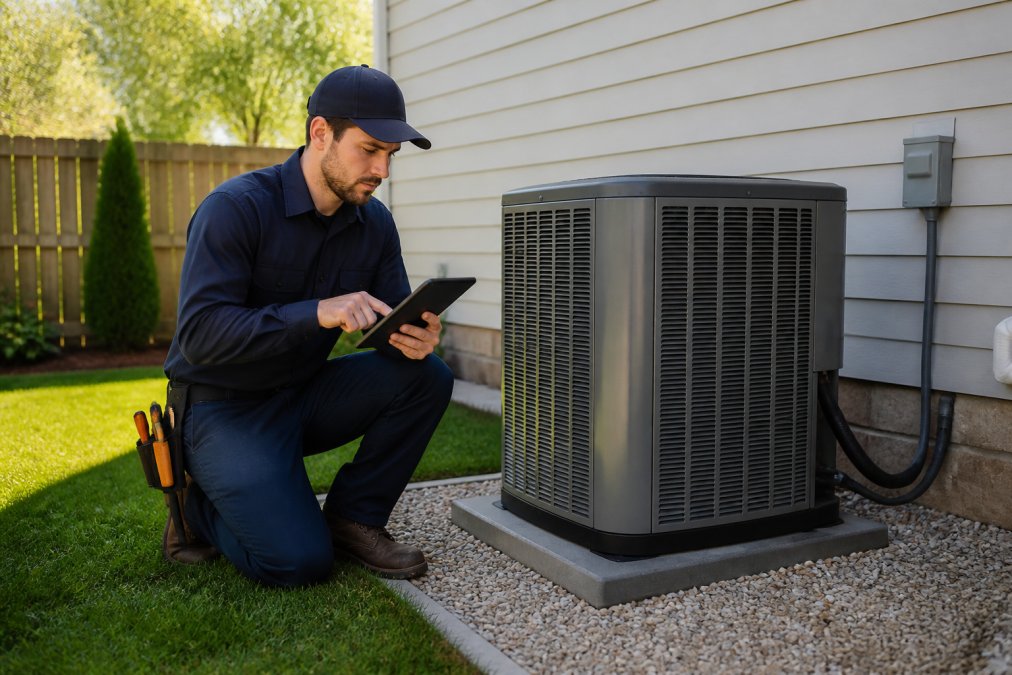
Never accept a price quote based solely on square footage. A proper load calculation is the difference between a system that runs efficiently for 15 years and one that fails prematurely or costs you hundreds in wasted energy each year.
SEER2 Rating Explained: What Efficiency Levels Cost
SEER2 rating is the current federal standard for measuring air conditioner and heat pump cooling efficiency, replacing the older SEER metric in 2023. It is the ratio of cooling output to energy input over a typical season, tested under more realistic conditions that account for static pressure.
Higher efficiency equipment costs more at purchase but saves more on monthly utility bills. Entry-level systems meeting the minimum federal standard carry the lowest upfront installation cost, while premium units with the highest SEER2 and HSPF2 ratings can add significantly to the equipment price. The U.S. Department of Energy efficiency standards requires new systems to meet specific minimum ratings, and anything above those minimums is where you buy back savings over the HVAC system lifecycle.
The sweet spot for most homeowners is one efficiency tier above the federal minimum. That level typically delivers the best balance between a reasonable upfront cost and measurable monthly savings without the premium price of top-tier equipment.
Heat Pump Installation Cost vs. Traditional AC and Furnace
The cost comparison between a heat pump and a traditional AC plus furnace setup is not a single number, it is a function of where you live.
Climate Zones Change the Math
The United States spans multiple climate zones, and the Department of Energy’s climate zone map is the reference point contractors use when sizing equipment. Homes in the southern tier, where winters are short and mild, can typically rely on a standard air source heat pump as the sole heating and cooling system. The installation cost is often lower than a dual-system setup because you are buying one piece of equipment instead of two.
Homes in the middle latitudes, where winter temperatures regularly drop below freezing, face a different calculation. A standard air source heat pump loses heating capacity as outdoor temperatures fall, so the practical choice is often a cold-climate heat pump, designed to maintain full heating output down to around 5°F or lower, or a hybrid configuration with a gas furnace backup.
The Hybrid Configuration Cost Breakdown
A hybrid system, sometimes called a dual-fuel system, uses the heat pump as the primary heating source during mild weather and switches to the furnace when temperatures drop below the point where the heat pump loses its efficiency advantage. The equipment cost runs higher than a heat pump alone because you are purchasing both units.
The operating economics, however, can favor the hybrid in regions where natural gas is inexpensive relative to electricity. The heat pump handles the majority of the heating season at high efficiency, and the furnace only kicks in during the coldest days. The crossover temperature, typically between 30°F and 40°F, is where the cost per unit of heat delivered by electricity equals the cost per unit delivered by gas.
Regional Utility Rates Drive the Payback Period
Your local electricity and natural gas rates are the single biggest factor in how quickly a heat pump pays for itself. In regions where electricity rates are high and gas rates are low, a traditional gas furnace may remain the lower-cost option. Conversely, in areas with low electricity rates or where homes rely on expensive electric resistance heating, a heat pump upgrade can cut heating costs by 30 to 50 percent.
The U.S. Energy Information Administration state electricity profiles publishes average residential electricity and natural gas prices by state, and comparing those numbers against your current system’s efficiency gives you a rough sense of the payback period before you ever call a contractor.
The right question is not “heat pump or furnace?” but “what configuration delivers the lowest lifetime cost in my specific climate and with my local utility rates?” A cold-climate heat pump may be the answer in one region, a hybrid system in another, and a high-efficiency gas furnace in a third. The contractor’s job is to run those numbers with you, not to sell you a one-size-fits-all solution.
| System Type | Equipment Cost Range | Best Climate | Operating Cost Driver |
|---|---|---|---|
| Standard Air Source Heat Pump | Moderate | Mild winters (southern tier) | Electricity rate |
| Cold Climate Heat Pump | Higher | Cold winters (northern tier) | Electricity rate, low-temperature performance |
| AC + Gas Furnace | Moderate to high | Cold winters with cheap natural gas | Natural gas rate |
| Hybrid Heat Pump + Furnace | Highest | Variable winters with both fuels available | Crossover temperature, dual fuel rates |
A common pattern among homeowners in colder regions is to install a cold-climate heat pump and keep the existing furnace as a backup rather than replacing both systems at once. This staged approach spreads the cost across multiple years.
The Energy Efficient Home Improvement Credit: How It Lowers Your Cost
The Energy Efficient Home Improvement Credit is a federal incentive that directly reduces the cost to upgrade to energy efficient HVAC equipment by allowing you to claim a credit on your federal income tax. It applies to qualifying heat pumps, heat pump water heaters, and other specified equipment installed in your primary residence.
The credit is not a deduction that lowers taxable income; it is a dollar-for-dollar reduction of your tax liability, which makes it more valuable than an equivalent deduction. To claim it, you need the manufacturer’s certification statement and your tax liability must be sufficient to use the full credit in the year of installation. The IRS guidance on Energy Efficient Home Improvement Credit spells out the qualifying equipment categories, the credit limits, and the documentation you must keep with your tax records.
Confirm that the specific model you are considering qualifies for the credit before you purchase. Manufacturers publish qualification statements for their equipment, and [your HVAC](/signs-hvac-needs-replacement/) contractor should be able to point you to the right documentation for your tax preparer.
Hidden Installation Costs That Change Your Upgrade Price
Beyond the equipment and standard labor, several hidden installation costs can raise your total project price significantly. Older homes, in particular, often require ductwork modification, an electrical panel upgrade, or both, and these line items are frequently the source of surprise bills.
- Ductwork modification: Leaky, undersized, or damaged ducts reduce system performance and must be repaired or replaced.
- Electrical panel upgrade: New high-efficiency systems may draw more power than an older panel can supply.
- Refrigerant line replacement: Matching new equipment to old lines can void the warranty and hurt efficiency.
- Permit and inspection fees: Local jurisdictions require permits for HVAC replacement, adding a modest but unavoidable cost.
- Old equipment removal and disposal: Hauling away the old unit carries a fee that some quotes omit.
The U.S. Environmental Protection Agency refrigerant regulations also require proper handling and disposal of old refrigerants, which adds a compliance step to every legitimate replacement job. A reputable contractor includes these costs in the initial quote rather than revealing them later.
How to Pay for Your Energy Efficient HVAC Upgrade
The upfront cost of an energy efficient HVAC upgrade is a barrier for many households, but the financing landscape extends far beyond the contractor-offered payment plan.
Low-Interest Green Energy Loans
A growing number of state energy offices and local housing finance agencies administer loan programs specifically designed for energy efficiency improvements. These loans typically offer interest rates well below what a standard personal loan or credit card would charge, and some carry zero-interest terms for qualifying households. The Database of State Incentives for Renewables and Efficiency catalogs these programs by state, and it is worth searching for terms like “energy efficiency loan” or “HELP loan” in your state before you commit to a contractor’s financing offer.
A common pattern is a loan amount capped between $10,000 and $30,000 with repayment terms of five to ten years. Many programs do not require perfect credit, and some tie the interest rate to your income level.
PACE Financing: Property Assessed Clean Energy
PACE financing is a different mechanism entirely. Instead of a traditional loan, the cost of your HVAC upgrade is attached to your property tax assessment and repaid over a period that can stretch 15 to 20 years. Because the repayment is tied to the property rather than your credit score, PACE can be accessible to homeowners who would not qualify for conventional financing.
The trade-off is significant. PACE assessments stay with the property, so if you sell the home before the assessment is paid off, the new owner assumes the remaining payments. This can complicate a future sale, and some mortgage lenders are cautious about properties with PACE liens. The interest rates also tend to be higher than dedicated green energy loans.
Manufacturer Promotions and Seasonal Discounts
HVAC manufacturers run promotional financing throughout the year, often offering zero percent APR for 12 to 24 months on qualifying systems. The deferred interest that accrues during the promotional window can be added to your balance if you do not pay in full by the deadline. If you can clear the balance within the promotional period, these offers are genuinely free money.
Stacking the Savings
A realistic payment strategy combines multiple sources. The federal Energy Efficient Home Improvement Credit reduces your tax liability, utility rebates cut the equipment cost, and a green energy loan covers the remaining balance at a favorable rate. Apply the rebate to the purchase price first, then finance the reduced balance, and use the tax credit the following spring to make an extra principal payment.
Before signing any financing agreement, ask the lender for the total cost of the loan including all fees and the APR, not just the monthly payment. Compare that figure against the projected annual energy savings from your new system to determine whether the upgrade pays for itself within a reasonable timeframe.
Your contractor should be able to walk you through the financing options they offer, but you are not limited to those choices. A few hours of research into state and local programs can save you hundreds or thousands of dollars.
Final Verdict: Is the Upgrade Worth the Cost?
The cost to upgrade to energy efficient HVAC is justified for most homeowners because the monthly energy savings, the federal tax credit, and the improved comfort typically offset the higher purchase price over the payback period. A system that runs efficiently for 15 years or more reduces your carbon footprint, stabilizes your energy bills, and increases your home’s resale value.
The upgrade is not worth it, however, if your current system is relatively new and functioning well. In that case, regular maintenance and targeted repairs are the smarter financial move. The decision hinges on the age and condition of your existing equipment and whether you plan to stay in the home long enough to capture the savings.
The right contractor makes the difference between a smooth project and a costly headache. Anthony & Son Indoor Air Quality, LLC provides honest assessments of whether you need a full replacement or just a repair, and our licensed and certified technicians handle everything from system sizing to installation with transparent pricing. We serve homeowners across Maryland, Washington, DC, and Northern Virginia.
Deciding whether the cost to upgrade to energy efficient HVAC makes sense for your home requires accurate information about your current system, your home’s specific needs, and the incentives available to you. Anthony & Son Indoor Air Quality, LLC offers fully certified technicians who perform proper load calculations, explain your options without pressure, and stand behind their workmanship. Contact us today for a straightforward assessment and a clear picture of what your upgrade will actually cost.
Frequently Asked Questions
What is the $5000 rule for HVAC?
The $5000 rule is a simple guideline some contractors use to recommend replacing rather than repairing an HVAC system. It suggests that if the cost of a repair is more than $5,000, or roughly the age of your system in years multiplied by the repair cost exceeds $5,000, replacement is the better investment. For example, a 10-year-old system needing a $600 repair hits the threshold. This rule helps you avoid pouring money into an aging unit that will likely need more repairs soon.
Is there a tax credit for high efficiency HVAC in 2026?
Yes, the Energy Efficient Home Improvement Credit is available through 2032. For 2026, you can claim 30% of the cost for qualifying heat pumps, heat pump water heaters, and biomass stoves, up to $2,000 annually. High-efficiency furnaces and central air conditioners that meet specific efficiency standards may qualify for smaller credits. You must have sufficient tax liability to claim the credit, and it applies only to the equipment and installation labor costs for eligible upgrades.
How much does a new HVAC system cost for a 2000 square foot home?
A new HVAC system for a 2,000 square foot home typically requires a 3 to 4 ton unit. The total cost depends on your choice of equipment, efficiency rating, and installation complexity. Upgrading to a high-efficiency system with a higher SEER2 rating will cost more upfront than a standard model. To get exact pricing for your home, you need a load calculation and an on-site assessment from a licensed contractor.
How much can I save on energy bills by upgrading to a high-efficiency HVAC system?
Upgrading from an older, low-efficiency system to a high-efficiency model can reduce your heating and cooling energy use by 20% to 40%. The exact savings depend on your current system’s age and condition, your home’s insulation, and local climate. A system with a higher SEER2 rating uses less electricity for cooling, which directly lowers monthly costs. Over the system’s 15-year lifespan, these savings often offset a significant portion of the upfront installation cost.
This article was written using GrandRanker