
Table of Contents
- The 30-90 Day Rule: How Often to Change AC Air Filters
- Signs of a Clogged Air Filter You Should Never Ignore
- MERV Rating Explained: Why Higher Isn’t Always Better
- The Impact of Dirty Filters on Energy Bills and HVAC Strain
- Seasonal Maintenance Schedules and Smart Home Integration
- How to Choose the Right Filter Size and Type for Your System
- Disposal and Environmental Impact: What to Do With Old Filters
- Conclusion: Building a Filter Replacement Routine That Works
- Frequently Asked Questions
Last Updated: September 24, 2026
The 30-90 Day Rule: How Often to Change AC Air Filters
The short answer: change most AC air filters every 30 to 90 days. This guide from Anthony & Son Indoor Air Quality, LLC breaks down where your home falls in that range, it depends on your pets, your allergies, and how hard your system works.
Standard Replacement Frequency for Most Homes
For a typical home with no pets and no allergy sufferers, change your filter every 90 days, the standard cycle for a 1-inch disposable filter.
Here’s how the timeline usually breaks down:
- 1-inch fiberglass or pleated filters: every 30 to 60 days
- 1-inch high-efficiency pleated filters: every 60 to 90 days
- 2-inch to 4-inch media filters: every 90 to 180 days
- 5-inch and thicker media cabinets: every 6 to 12 months
When to Change More Often: Pets, Allergies, and Seasonal Factors
Homes with pets or allergy sufferers should shorten that cycle, the 90-day rule isn’t universal.
Change your filter more often if you have:
- One or more pets: every 30 to 45 days, because pet dander loads the filter fast
- Allergy or asthma sufferers in the home: every 30 days during peak pollen season
- A home near construction or heavy dust: every 30 days until the work is done
- A system running nonstop: every 30 to 45 days in peak summer or winter
Write the install date directly on the filter frame with a marker. When you check it later, you’ll know exactly how long it’s been in service instead of guessing. It takes five seconds and removes all the doubt.
Signs of a Clogged Air Filter You Should Never Ignore
A dirty filter rarely announces itself. Instead, it shows up as small problems that snowball. Learning the signs of a clogged air filter early can save you a repair bill.
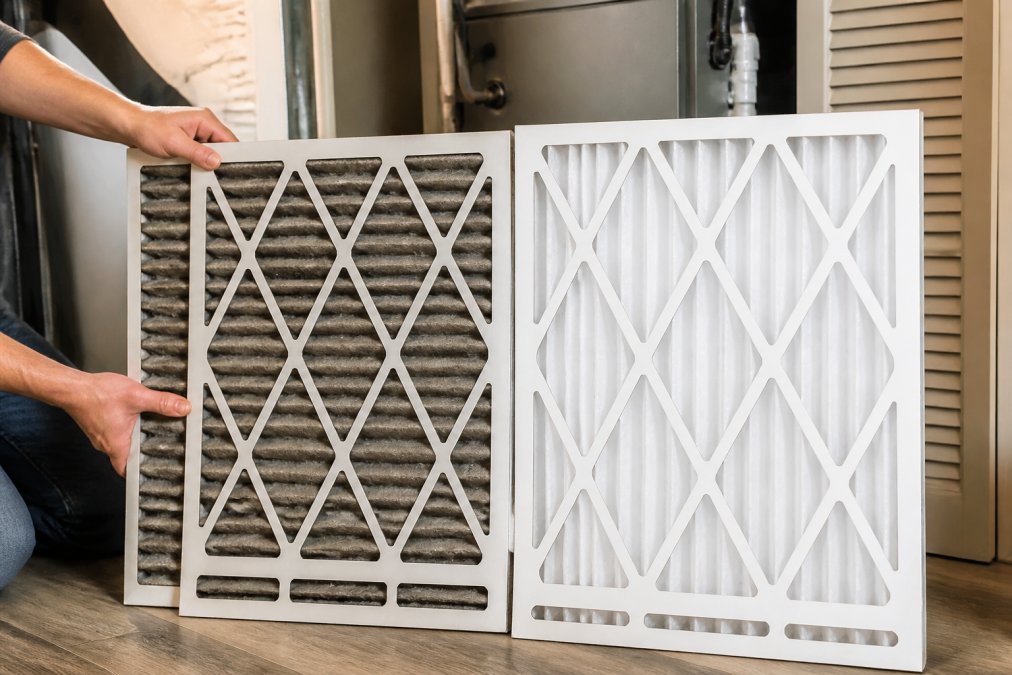
Watch for these warning signs:
- Rising energy bills with no change in habits
- Weak airflow from your vents
- A system that runs longer to reach the same temperature
- Dust settling on furniture just days after cleaning
- A musty or stale smell when the air kicks on
- More frequent allergy symptoms indoors
- A blower motor that sounds strained or cycles oddly
How to Check Your Filter in Under Two Minutes
Checking your filter is a two-minute job:
- Turn off your system at the thermostat for safety.
- Find the filter slot. It’s usually near the air handler or in a return-air grille.
- Slide the filter out and note the airflow arrow direction.
- Hold it up to a light. If you can’t see light through it, replace it.
- Check the color. Light gray is fine. Dark gray or matted means it’s done.
- Slide in a new filter with the arrow pointing toward the air handler.
If you’re unsure where your filter lives or what size it takes, a technician can show you during a routine visit.
MERV Rating Explained: Why Higher Isn’t Always Better
The MERV rating (Minimum Efficiency Reporting Value) is a 1-to-20 scale, set by ASHRAE Standard 52.2, measuring how well a filter captures airborne particles in specific size ranges. Higher numbers trap smaller particles like pet dander, fine dust, and smoke, but higher isn’t automatically better.
The Mechanism: Static Pressure and the Blower Curve
Every air handler is designed to move a certain volume of air (cubic feet per minute, or CFM) against a certain resistance, called static pressure and measured in inches of water column (in. w.c.).
- Longer runtimes to reach the thermostat setpoint
- Higher amp draw on the blower motor as it tries to compensate
- A colder evaporator coil in summer, which can drop below dew point and freeze
- A hotter heat exchanger in winter, which shortens its life
What Actually Determines Your System’s Limit
The filter slot’s thickness is the first clue, but not the whole story: a 1-inch slot can’t accept a 4-inch media filter, and a 1-inch pleated MERV 13 has far less surface area than a 4-inch MERV 13, so the thin one creates much more resistance at the same rating.
To find your real limit:
- Check the owner’s manual or the data plate on the air handler. Many list a maximum allowable total external static pressure (often around 0.5 in. w.c. for residential systems, but verify yours).
- Look at the filter grille or cabinet. A 4-inch or 5-inch media cabinet is a signal the system was designed for a thicker, higher-MERV filter.
- Ask a technician to measure static pressure with a manometer during a tune-up. This is the only way to know for certain whether a filter upgrade is safe.
- Start conservative. If you can’t verify, stay at or below the MERV rating the manufacturer recommends.
MERV Ratings at a Glance
| MERV Rating | Captures | Best For |
|---|---|---|
| 1-4 | Large dust, lint, pollen | Basic equipment protection |
| 5-8 | Mold spores, pet dander, larger particles | Most homes with 1-inch slots |
| 9-12 | Fine dust, auto emissions, lead dust | Allergy sufferers, thicker filters |
| 13-16 | Bacteria, smoke, virus carriers | Systems rated for the resistance |
For most homes with a 1-inch slot, MERV 8 to MERV 11 hits the sweet spot. Homes with a 4-inch or 5-inch media cabinet can often run MERV 11 to MERV 13 because the added surface area offsets the denser media. The mistake is dropping a MERV 13 into a 1-inch slot on a system designed for MERV 8.
If your system ices up in summer or the blower sounds strained after a filter upgrade, the filter is the first thing to check. A MERV rating that’s too high for your equipment can cause the same symptoms as a clogged filter, because it is, functionally, a permanently clogged filter.
The Bottom Line on MERV
Match the filter to the system, not the marketing. A MERV 8 changed on schedule outperforms a MERV 13 left in too long, without stressing your blower motor. For higher filtration, upgrade to a thicker media cabinet rather than cramming a dense 1-inch filter into a slot that can’t handle it.
The Impact of Dirty Filters on Energy Bills and HVAC Strain
A dirty filter costs you money two ways: your system works harder and longer.
Running a system with a completely clogged filter can freeze your evaporator coil in summer. That turns a cheap filter swap into a costly repair. If your AC stops cooling and you haven’t checked the filter, check it first.
Seasonal Maintenance Schedules and Smart Home Integration
A filter replacement cycle works best tied to something concrete, the seasons, your runtime hours, or both. Match the schedule to how hard your system actually works in your climate.
A Climate-Based Filter Calendar
The 30-to-90-day rule assumes an average workload. Your actual workload depends on annual runtime hours, which vary dramatically by region.
Hot, humid summers with mild winters (heavy AC, light heating):
- March: replace filter before cooling season starts
- May, July, September: check monthly during peak AC use; replace every 30-45 days if you have pets
- November: replace filter, then check every 60-90 days through the mild winter
Cold winters with moderate summers (heavy heating, moderate AC):
- September: replace filter before heating season
- November, January, March: check monthly during peak heating; replace every 30-45 days if you burn candles, use a fireplace, or have pets
- May: replace filter, then check every 60-90 days through the mild cooling season
Year-round moderate climate (system runs most of the year):
- Treat every month as a check month. A system that runs 10-12 months a year loads a filter faster than one that runs six.
Dusty or wildfire-prone regions:
- During wildfire season or high-pollen weeks, drop to a 30-day cycle regardless of the calendar. Smoke and pollen load filters fast.
Why Runtime Hours Beat Calendar Dates
A filter doesn’t care what month it is, it cares how much air has passed through it. A system running 2,000 hours a year loads a filter roughly twice as fast as one running 1,000, which is why a calendar reminder alone can mislead.
Building the Routine
A simple system that works:
- Write the install date and filter size on the frame with a marker.
- Set a smart thermostat reminder based on runtime hours if your model supports it, or a 60-day calendar reminder if it doesn’t.
- Check the filter visually at each reminder, hold it to a light. If you can’t see through it, replace it.
- Tie a filter change to a seasonal task you already do, like switching the thermostat between heat and cool, or scheduling a tune-up.
- Log each change in your phone’s notes app or the thermostat app so you can spot patterns, if you’re replacing every 30 days, something in your home is loading the filter faster than normal.
If your smart thermostat doesn’t track runtime, many utility company apps and some HVAC manufacturer apps do. Check what your equipment’s app already offers before buying a separate monitor.
When to Call a Technician
If your filter loads up faster than your schedule predicts, or you notice weak airflow, rising bills, or a strained blower despite regular changes, the filter may not be the root cause. Undersized ductwork, a dirty evaporator coil, or a failing blower motor can all mimic filter problems. A technician can measure static pressure and airflow to tell you which one you’re dealing with.
How to Choose the Right Filter Size and Type for Your System
Getting the size wrong is the fastest way to wreck your airflow: too small and air bypasses the filter, too large and it won’t seat properly, leaking unfiltered air around the edges.
Here’s how to get it right:
- Read the old filter. The size is printed on the frame, like 20x25x1.
- Measure the slot if the print is worn off.
- Match the thickness exactly. Don’t force a 2-inch filter into a 1-inch slot.
- Check your system’s MERV limit before upgrading.
- Pick the type that fits your needs: disposable for simplicity, media for longer life, HEPA only where the system supports it.
The best filter is the one that fits your slot, matches your system’s airflow capacity, and gets changed on time. A cheap filter changed often beats an expensive one left in too long.
Disposal and Environmental Impact: What to Do With Old Filters
Most used filters go straight into the trash, and that adds up: a typical home replaces four to six filters annually, and multiplied across a neighborhood the waste is significant.
Here’s how to handle disposal responsibly:
- Disposable fiberglass filters usually can’t be recycled. Bag them and trash them.
- Pleated filters are sometimes accepted at recycling centers. Check locally.
- Washable filters can be rinsed and reused, cutting waste sharply.
- Some brands run mail-back recycling programs for their filter frames.
Conclusion: Building a Filter Replacement Routine That Works
The right replacement interval comes down to your home, not a single universal number. Start with the 30-to-90-day rule, then adjust for pets, allergies, and how hard your system runs. Check monthly, replace on schedule, and watch your energy bills and airflow for feedback.
Frequently Asked Questions
How long should an AC air filter last?
Most AC air filters last 30 to 90 days. A standard 1-inch fiberglass filter may need changing every 30 days, while thicker 4-inch media filters can go 60 to 90 days. Homes with pets, allergy sufferers, or heavy summer AC use should change closer to the 30-day mark. If you run your system daily in July and August, check the filter monthly.
Does a dirty air filter affect my AC?
Yes. A dirty filter restricts airflow, which forces your blower motor to work harder and can cause the evaporator coil to freeze. That leads to higher utility costs, reduced cooling, and potential system strain. In Maryland and DC summers, a clogged filter can turn a minor inefficiency into a mid-season breakdown. Changing it on schedule is the cheapest HVAC maintenance you can do.
Can a dirty air filter cause my AC to freeze up?
It can. When airflow drops, the evaporator coil gets too cold and condensation freezes on it. Ice blocks the coil, and your AC stops cooling. You might see ice on the refrigerant lines or notice the system running but not cooling. Turn the system off, let the ice melt, and replace the filter. If freezing happens again, call a certified technician to check refrigerant levels and airflow.
What is the $5,000 rule for AC?
The $5,000 rule is a rule of thumb some homeowners use: if a repair costs more than $5,000 or exceeds half the cost of a new system, replacement may make more sense. It is not an official standard. For older systems with repeated breakdowns, a technician can compare repair costs against a new unit’s efficiency and warranty. Always get a written estimate before deciding.