
Table of Contents
- Quick Comparison: Bypass, Fan-Powered, and Steam Humidifiers
- How a Whole House Humidifier Works With Your Forced Air System
- Bypass vs Fan-Powered Humidifier: Which Fits Your Ductwork?
- Whole House Humidifier Sizing Guide for Home Square Footage
- Installation Compatibility and DIY vs Professional Setup
- Whole House Humidifier Maintenance Tips and Long-Term Costs
- Health, Air Quality, and Smart Home Integration
- Frequently Asked Questions
Last Updated: September 12, 2026
Quick Comparison: Bypass, Fan-Powered, and Steam Humidifiers
Choosing the right whole house humidifier starts with understanding the three main types and where each one fits. The target humidity for most homes sits between 30% and 50% relative humidity, and the unit type determines how precisely you can hold that range through a dry winter (the EPA).
| Type | How It Moves Moisture | Best For | Watch Out For |
|---|---|---|---|
| Bypass | Furnace blower pushes air through a bypass damper and evaporative pad | Standard forced air systems with flexible ductwork space | Needs furnace blower running to work |
| Fan-powered | Built-in blower motor pulls air across the pad | Tight installations, homes needing higher moisture output | More moving parts, slightly higher energy consumption |
| Steam | Boils water and injects steam into the plenum | Large homes, hydronic heat, precise set point control | Highest energy consumption, dedicated power circuit |
This guide from Anthony & Son Indoor Air Quality, LLC walks through sizing, compatibility, and long-term costs so you can choose with confidence.
How a Whole House Humidifier Works With Your Forced Air System
A whole house humidifier is a unit mounted on your heating and cooling system that adds moisture to the air before it circulates through every room. It connects to your water supply and your ductwork, so the same furnace or air handler that heats your home also distributes humidity.
The process is straightforward. Water flows onto an evaporative pad or into a steam canister. As air moves through the ductwork, it picks up moisture and carries it into living spaces. A hygrometer or humidistat monitors relative humidity and signals a solenoid valve to open or close the water supply.
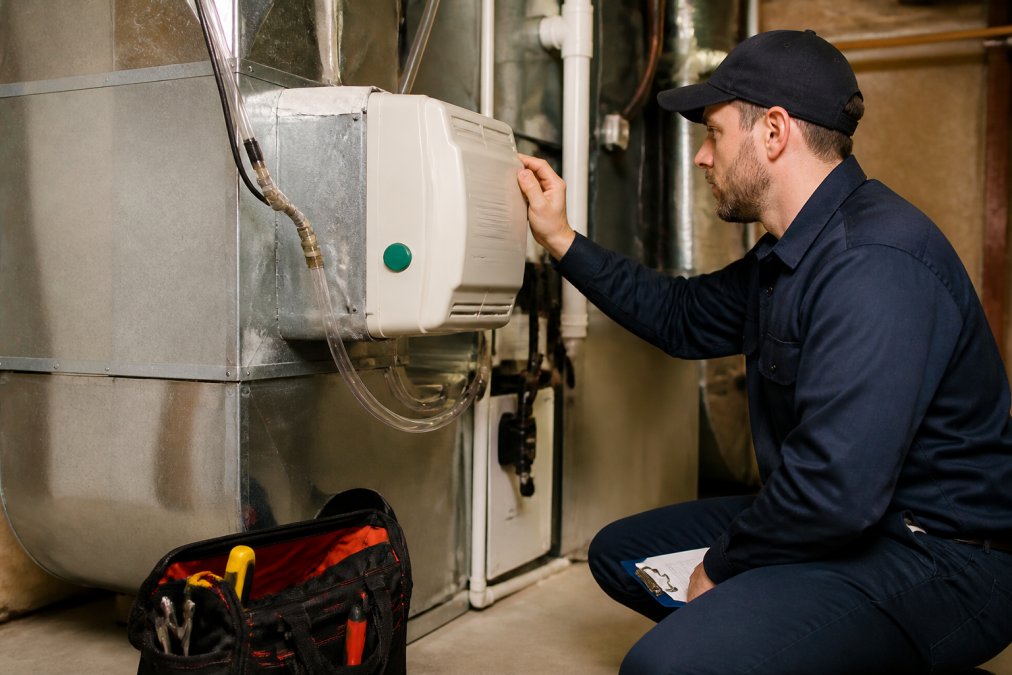
Forced air systems are ideal for this setup because the blower motor already moves air through the home. Furnace integration means the humidifier runs only when the heat runs, which keeps energy consumption reasonable. Homes with hydronic heat or no ductwork cannot use a duct-mounted unit and typically need a steam model with its own blower.
Bypass vs Fan-Powered Humidifier: Which Fits Your Ductwork?
The bypass vs fan-powered humidifier decision usually comes down to ductwork space and how much moisture output you need. A bypass unit uses a smaller duct that routes air from the supply plenum, through the evaporative pad, and back to the return. It relies on the furnace blower to create that airflow, so it only humidifies when the heat is on.
Fan-powered units add a blower motor that pulls air across the pad independently. That makes them a better fit when there is no room for a bypass duct, or when you want humidity to rise faster. The trade-off is more moving parts to maintain and slightly higher energy consumption.
If your furnace runs short cycles in mild weather, a bypass unit may not keep up. A fan-powered model can humidify on its own schedule, which matters in homes with tight, well-insulated envelopes.
Whole House Humidifier Sizing Guide for Home Square Footage
Sizing a whole house humidifier comes down to two numbers: conditioned square footage and grain capacity. Grain capacity measures how many grains of moisture the unit adds per hour, and manufacturers publish recommended ranges based on square footage and climate. Get this wrong and you either fight winter dryness all season or push indoor humidity high enough to fog windows and feed mold. Proper moisture management extends beyond the central system to localized ventilation, where selecting the right bathroom fan for moisture prevents the localized condensation that whole-house units cannot address.
Start With Conditioned Square Footage
Measure only the space your HVAC system actually conditions. Exclude the garage, unfinished basement, crawlspace, and attic. If you have a finished basement on its own zone, count it. High ceilings, open floor plans, and large window walls increase the effective volume you are trying to humidify, so round up rather than down.
Match Grain Capacity to Climate and Tightness
Manufacturers typically publish grain-per-day (GPD) ratings, and the recommended capacity climbs as the outdoor climate gets colder and drier. A common pattern looks like this:
| Home Size (conditioned) | Mild/Damp Climate | Mixed Climate | Cold/Dry Climate |
|---|---|---|---|
| Up to 1,500 sq ft | 8-10 GPD | 10-12 GPD | 12-14 GPD |
| 1,500-2,500 sq ft | 10-12 GPD | 12-14 GPD | 14-17 GPD |
| 2,500-3,500 sq ft | 12-14 GPD | 14-17 GPD | 17-20 GPD |
| 3,500-4,500 sq ft | 14-17 GPD | 17-20 GPD | 20-24 GPD |
| 4,500+ sq ft | 17+ GPD | 20+ GPD | 24+ GPD |
These ranges are starting points, not gospel. Two homes of identical square footage can need very different capacity depending on how tightly they are sealed.
Adjust for Air Infiltration and Envelope
Add capacity if any of the following apply:
- The home was built before modern air-sealing standards and has not been weatherized
- There is significant air infiltration around doors, windows, or rim joists
- The home has a large open foyer, vaulted ceilings, or a wall of windows
- The HVAC system runs short cycles in mild weather (a bypass unit may not keep up)
Subtract capacity if the home is tightly built, recently air-sealed, or has an ERV/HRV that already manages moisture.
A Worked Example
A 2,200 sq ft home in a cold, dry climate with average envelope tightness lands in the 14-17 GPD band. If that same home has an older, leaky envelope and a two-story foyer, bump to the 17-20 GPD band. If it was built in the last decade with spray foam and a tight envelope, the 12-14 GPD band may be plenty.
Why a Load Calculation Beats a Chart
Sizing charts assume average conditions. A qualified technician can run a load calculation that accounts for your specific envelope, window area, insulation values, and climate design temperature. That calculation is the difference between a humidifier that holds 35-45% relative humidity all winter and one that either can’t keep up or overshoots into condensation.
If you are between two grain-capacity bands, size up rather than down. A slightly oversized unit can be dialed back with the humidistat; an undersized unit cannot be dialed up past its maximum output.
Oversizing is not free. A unit that is too large for the home can push indoor humidity above 50%, which promotes condensation on cold windows, mold growth in exterior wall cavities, and moisture damage to wood trim (the EPA). Size up only one band, not two.
Installation Compatibility and DIY vs Professional Setup
Installation compatibility depends on your furnace, plenum space, and access to a water line and drain. Most forced air systems can accept a humidifier, but the details matter: static pressure, plenum dimensions, and whether the unit needs a dedicated power circuit.
Here is where DIY gets risky. Cutting into ductwork, wiring a solenoid valve, and tapping a water line are all tasks that can void warranties or create leaks if done incorrectly. A steam humidifier also needs a dedicated circuit and a drain for condensate, which is beyond most homeowners’ comfort level.
A poorly sealed humidifier install can leak water into the furnace cabinet, causing rust and eventual component failure. The repair often costs more than the original installation would have.
Professional installation from a certified technician ensures the unit is sized correctly, sealed properly, and wired to code. Anthony & Son Indoor Air Quality, LLC handles both residential and commercial installations and can confirm whether your existing system is compatible before any work begins.
Whole House Humidifier Maintenance Tips and Long-Term Costs
Most guides stop at the purchase price. The real decision is total cost of ownership (TCO): what you pay up front, what you pay every heating season, and what you pay in water, electricity, and service over the life of the unit. Here is how to think about it.
The Recurring Maintenance Tasks
Whole house humidifier maintenance comes down to four recurring tasks:
| Task | Frequency | Why It Matters |
|---|---|---|
| Replace water panel / evaporative pad | Once per heating season (more often in hard-water areas) | Restores moisture output, prevents mold and mineral buildup |
| Clean scale from canister or pad frame | Every 1-2 months | Keeps airflow and evaporation efficient |
| Inspect solenoid valve and water line | Start of each heating season | Prevents leaks and water waste |
| Check humidistat calibration | Annually | Ensures accurate set point control |
Steam units add a descaling step and, in hard-water areas, may need a canister replacement mid-season. Bypass and fan-powered units are simpler but still need pad changes.
What Drives Annual Operating Cost
Three variables drive what you actually spend each season:
- Water consumption. Evaporative units (bypass and fan-powered) use more water than steam because some water runs to drain rather than evaporating. Steam units use less water but more electricity.
- Electricity. Bypass units draw almost nothing beyond the furnace blower. Fan-powered units add a small blower motor. Steam units run a heating element and are the most electricity-intensive by a wide margin.
- Consumables. Pads, canisters, and occasional valve replacements. Pads are inexpensive and seasonal; steam canisters cost more and may need replacement more than once per year in hard-water areas.
A common pattern: bypass units have the lowest annual operating cost, fan-powered units sit in the middle, and steam units have the highest. The trade-off is control and capacity, steam gives you the tightest set point control and works without a furnace blower running.
A Simple TCO Framework
Rather than guess at dollar figures, build a TCO estimate from your own inputs:
- Up-front cost: unit price plus installation labor and any electrical or plumbing work
- Annual consumables: pads or canisters multiplied by how often you replace them
- Annual utilities: check your utility rate for water and electricity, then estimate usage from the unit’s published specs
- Service: budget for one professional tune-up every few years, plus occasional valve or canister replacement
- Lifespan: divide total up-front cost by expected years of service to get an annualized figure
Add those lines together and compare across the three unit types. The cheapest sticker price rarely wins once you run the math over a 10-year horizon.
DIY vs Professional Installation: A Decision Rubric
Some homeowners can handle a bypass unit install. Others should not touch it. Use this rubric:
You can likely DIY if:
- You are installing a bypass unit on an accessible, standard forced-air plenum
- There is already a nearby water line and drain
- You are comfortable cutting and sealing sheet metal and wiring a low-voltage solenoid
- Your furnace manufacturer’s warranty does not require professional installation to stay valid
Hire a licensed technician if:
- You are installing a steam unit (dedicated 240V circuit, condensate drain, and often a permit)
- Your plenum is tight, irregular, or has limited clearance
- You need a new water line run or a new drain
- Your system is a heat pump, dual-fuel, or has a variable-speed blower that needs specific humidifier settings
- You want the install warrantied and the unit sized correctly the first time
A poorly sealed humidifier install can leak water into the furnace cabinet, causing rust and eventual component failure. The repair often costs more than the original installation would have. Cutting into ductwork and tapping a water line without a permit where one is required can also create insurance and code issues.
The Unique Angle: TCO Beats Sticker Price
Most buying guides rank humidifiers by purchase price. That is the wrong metric. A unit that costs more up front but uses less water, needs fewer pad changes, and lasts longer can cost less per year of service. Run the TCO math for your home, your utility rates, and your climate before you decide.
The cheapest humidifier to buy is rarely the cheapest to own. Budget for annual pads or canisters, factor in water and electricity, and decide DIY vs professional based on the unit type and your comfort with ductwork, wiring, and plumbing, not on the sticker price alone.
Health, Air Quality, and Smart Home Integration
Indoor air quality improves noticeably when relative humidity stays in the 30% to 50% range (the CDC). Proper humidity reduces static electricity, keeps wood floors and furniture from drying out, and supports mold prevention by preventing condensation on cold surfaces. It also helps with winter dryness that causes dry skin, irritated throats, and cracked woodwork.
Smart home integration is changing how homeowners manage humidity. Many modern humidifiers pair with smart thermostats and apps, letting you adjust the set point from your phone and monitor relative humidity in real time. Some systems tie humidity control to outdoor dew point, which prevents window condensation automatically.
For commercial properties, humidity control affects tenant comfort and can reduce air quality complaints. Anthony & Son Indoor Air Quality, LLC works with property managers across Maryland, Washington, DC, and Northern Virginia to balance humidity, ventilation, and energy efficiency in mixed-use buildings.
Frequently Asked Questions
Which type of whole house humidifier is best?
There is no single best type. Bypass humidifiers cost less and have fewer moving parts, so they suit mild winters and homes with flexible ductwork space. Fan-powered units push more moisture into the air and work better in colder climates or finished basements. Steam humidifiers deliver the most precise humidity control but use more energy. Match the type to your climate, ductwork, and budget rather than chasing a universal winner.
What size humidifier do I need for a 2000 square foot house?
Sizing depends on grain capacity, not square footage alone. A 2,000 square foot home in a cold climate typically needs a unit rated around 12 to 17 gallons per day of moisture output. Check the manufacturer’s capacity chart against your home’s square footage, ceiling height, insulation, and window tightness. A unit that is too small runs constantly and never reaches the set point on your hygrometer.
Are whole home humidifiers worth the investment for indoor air quality?
They can be, especially in homes that drop below 30% relative humidity during winter. Low humidity causes dry skin, static shock, cracked wood floors, and more frequent respiratory irritation. A whole house humidifier keeps relative humidity in the 30% to 50% range, which supports comfort and helps with mold prevention by avoiding the opposite problem of excess moisture. The payoff depends on how dry your home actually gets.
How often do whole house humidifiers require professional maintenance?
Most units need a water panel or evaporative pad replaced once per heating season, and a full cleaning at the start of fall. Steam canister models may need more frequent service because mineral buildup shortens canister life. A qualified HVAC technician should inspect the solenoid valve, bypass damper, and drain line annually. Skipping maintenance leads to water waste, lower moisture output, and potential mold growth inside the unit.
Dry winter air is hard on your home, your health, and your heating system, and picking the wrong humidifier just adds maintenance headaches. Anthony & Son Indoor Air Quality, LLC is a family-owned, certified HVAC team that installs and services whole house humidifiers sized to your home and ductwork, with transparent pricing and workmanship we stand behind. Get started with Anthony & Son Indoor Air Quality, LLC and enjoy balanced indoor humidity all winter.