
Table of Contents
- Why Cleaning Your Outdoor AC Condenser Coils Matters
- Signs of Dirty AC Condenser Coils You Should Not Ignore
- Tools and Safety Gear You Need Before You Start
- Step-by-Step: How to Clean Outdoor AC Condenser Coils
- How to Choose an AC Condenser Coil Cleaner Spray
- How Often to Clean AC Coils (and What Changes the Schedule)
- High-Rise and Restricted-Access Units: When to Call a Pro
- Troubleshooting Problems After Cleaning
- Frequently Asked Questions
Last Updated: September 29, 2026
Why Cleaning Your Outdoor AC Condenser Coils Matters
Cleaning your outdoor AC condenser coils is one of the simplest ways to protect your cooling system, and it takes most homeowners under an hour. At Anthony & Son Indoor Air Quality, LLC, we tell every customer the same thing: dirty coils make your system work harder for less cooling.
Signs of Dirty AC Condenser Coils You Should Not Ignore
The clearest sign of dirty AC condenser coils is a system that runs constantly but never quite cools the house. If your thermostat says 72 but the rooms feel like 78, airflow restriction is often the cause.
Watch for these warning signs:
- Energy bills climbing with no change in use
- Weak airflow from vents
- The outdoor unit feels hot or shuts off early
- Visible dirt, fuzz, or bent fins on the coil
- Strange musty smells when the AC starts
Tools and Safety Gear You Need Before You Start
You do not need a truck full of equipment to clean condenser coils. A few basic tools and one safety habit will get the job done.
What you’ll need:
- Work gloves and safety glasses
- A soft bristle brush or vacuum attachment
- A garden hose with a spray nozzle
- A fin comb for bent fins
- A no-rinse or spray coil cleaner
- A screwdriver for the fan cage
Never touch the disconnect box or open the electrical panel without cutting power first. Skipping this step risks shock, and it is the single most common mistake we see homeowners make.
Step-by-Step: How to Clean Outdoor AC Condenser Coils
This is the process our technicians follow, scaled down for a homeowner with basic tools. Set aside 45 to 60 minutes.
Step 1: Cut the Power at the Disconnect Box
Turn off the AC at the thermostat first. Then open the disconnect box near the outdoor unit and pull the fuse block or flip the switch. This removes power to the unit so you can work safely.
Step 2: Clear Debris and Remove the Fan Cage
Pull leaves, grass, and twigs away from the base. Unscrew the top fan cage and lift it off carefully. Do not pull hard on the wires connected to the fan motor.
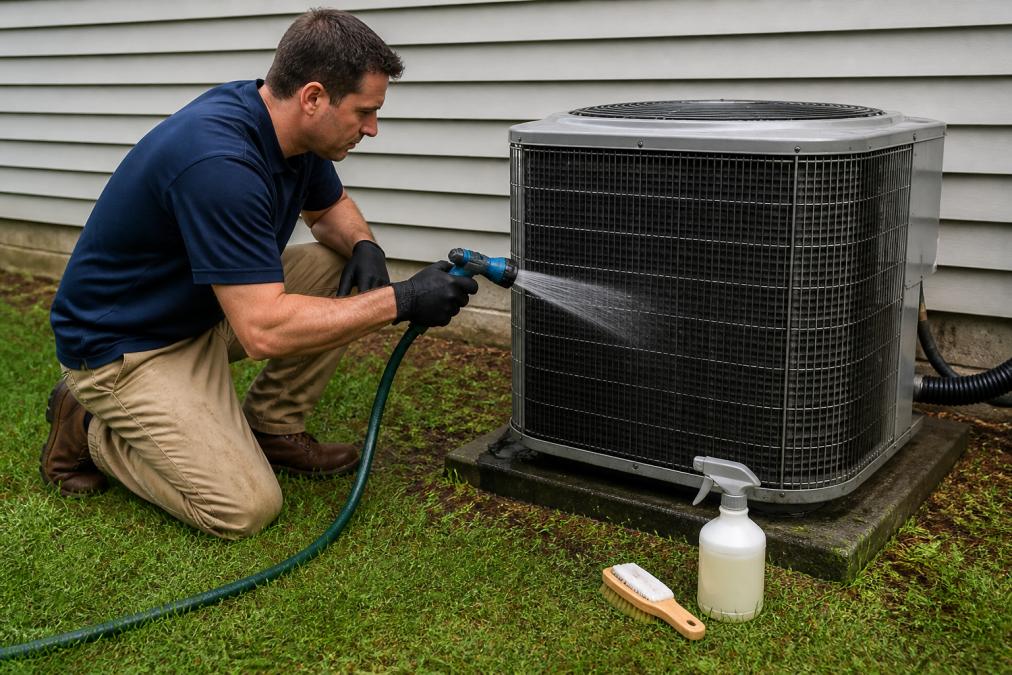
Step 3: Rinse, Apply Coil Cleaner Spray, and Rinse Again
Rinse the coil fins with a garden hose from the inside out. Spray on your coil cleaner and let it sit for the time listed on the label. Then rinse again until the water runs clear. A garden hose works better than a pressure washer here, since high pressure can bend fins.
Step 4: Straighten Bent Fins and Reassemble
Run a fin comb gently down the coil to straighten bent fins. Straight fins move air better. Reattach the fan cage, restore power, and run the system for a few minutes to confirm it works.
How to Choose an AC Condenser Coil Cleaner Spray
The best AC condenser coil cleaner spray depends on three things most guides ignore: the coil’s fin design, how heavy the buildup is, and what the runoff will touch. Get those wrong and you can etch aluminum fins, kill landscaping, or void a warranty.
Know Your Coil Type Before You Buy Anything
Outdoor condensers use one of two fin designs, and they do not tolerate the same cleaning approach.
- Tube-and-fin coils are the traditional design. Copper tubes run through closely spaced aluminum fins. These are durable and forgiving. A garden hose, a soft brush, and most consumer coil cleaners are fine.
- Micro-channel coils look like a flat, single slab with narrow parallel channels instead of a comb of fins. They are common on newer, higher-efficiency units. Micro-channel coils clog faster, hold water differently, and bend or corrode more easily. Many manufacturers specify a low-pressure rinse only and prohibit certain acidic cleaners.
Using a pressure washer or a harsh acid cleaner on a micro-channel coil can flatten the channels and permanently reduce capacity. When in doubt, rinse with a garden hose at household pressure and use a manufacturer-approved cleaner only.
Match the Cleaner to the Buildup
- Light dust and pollen: plain water rinse is often enough. If you want a product, a no-rinse foaming cleaner is the safest choice.
- Heavy grease, cottonwood fuzz, or matted lint: a foaming or self-rinsing coil cleaner designed for outdoor condensers. These lift debris so water carries it away.
- Mold or biological growth: a cleaner labeled for organic buildup. Rinse thoroughly so residue does not sit on the fins.
Read the Label for These Specifics
- Fin compatibility: must say safe for aluminum fins. Some indoor evaporator cleaners are alkaline or acidic in ways that damage outdoor coils.
- Dilution ratio: concentrates are cheaper per use but only if you mix them correctly. Too strong can etch fins; too weak does nothing.
- Dwell time: most foaming cleaners need 5 to 15 minutes of contact time before rinsing. Rinsing too early wastes the product; letting it dry on the coil can leave residue.
- Rinse requirement: no-rinse formulas still benefit from a light rinse in dusty environments.
- Plant and runoff safety: if the unit sits near a garden, lawn, or storm drain, choose a biodegradable formula and pre-wet surrounding plants, then flush them with plain water after.
Buy a cleaner labeled for outdoor condenser coils specifically. Products marketed only for indoor evaporator coils may be too aggressive for outdoor fins or leave residue that attracts more dirt.
Environmental Trade-Offs Worth Knowing
Traditional coil cleaners rely on surfactants and mild acids that break down grease and biological film quickly. Biodegradable and plant-safe formulas trade a little cleaning speed for lower runoff risk. For most homes with light-to-moderate buildup, a biodegradable foaming cleaner plus a thorough water rinse performs close to a conventional product. For heavy grease near a commercial kitchen exhaust or a dryer vent, a stronger conventional cleaner may be the practical choice, just manage the runoff.
How Often to Clean AC Coils (and What Changes the Schedule)
Most homes need a coil cleaning once a year, ideally in spring before cooling season starts. But “once a year” is a starting point, not a rule. The right interval depends on what is landing on your coil and how fast it packs in.
Why Frequency Varies So Much
Condenser coils release heat by moving air across closely spaced fins. Anything that coats those fins acts as insulation and blocks airflow. The two failure modes are different:
- Surface film (pollen, dust, oily residue) builds gradually and cuts efficiency over weeks.
- Physical blockage (cottonwood fluff, grass clippings, dryer lint, pet hair) can mat across the coil in days and choke airflow almost completely.
A Simple Decision Framework
Check your coil visually once a month during cooling season. It takes about two minutes with a flashlight.
- Fins look clean and you can see light through them: leave it alone.
- A light, even dust film: plan a cleaning within the next few weeks.
- Visible matting, fuzz, or debris bridging the fins: clean now, not later.
- Coil looks clean but the system still runs long: the problem is likely not dirt. Move to troubleshooting.
Factors That Shorten the Interval
- Trees and pollen: cottonwood, pine, and heavy spring pollen can clog a coil in two to three weeks during peak season.
- Pets that shed: hair pulled into the outdoor unit accumulates faster than most owners expect.
- Dryer vents, lawn mowers, and leaf blowers nearby: these blow lint, clippings, and dust directly into the coil.
- Construction or unpaved roads: fine dust coats fins continuously.
- Coastal or humid climates: salt air and biological growth accelerate buildup.
- Older, less efficient units: wider fin spacing tolerates dirt longer; newer high-efficiency and micro-channel coils clog faster and need more frequent attention.
Factors That Lengthen the Interval
- A shaded, debris-free location with no nearby trees or vents.
- A unit raised on a pad with clear airflow on all sides.
- Regular filter changes indoors, which reduce the dust load reaching the outdoor coil.
A Practical Schedule
- Spring: full cleaning before the first sustained warm spell.
- Mid-summer: visual check; clean if matted.
- Fall: clear leaves and debris from around and under the unit before winter.
- Monthly during cooling season: two-minute visual check.
Treat the annual cleaning as a baseline, not a ceiling. If your coil looks dirty at the monthly check, clean it, waiting for the calendar costs you efficiency and equipment life.
If you are unsure whether your coil needs cleaning, a quick photo taken with your phone flashlight aimed through the fins is often enough for a technician to tell you over the phone.
High-Rise and Restricted-Access Units: When to Call a Pro
Condenser units on roofs, balconies, or tight side yards are not safe for most homeowners to clean. If reaching the unit means a ladder, a roof edge, or a narrow ledge, stop and call a professional.
Troubleshooting Problems After Cleaning
| Problem | Likely Cause | Fix |
|---|---|---|
| Unit won’t turn on | Power not restored | Check disconnect box and breaker |
| Weak airflow | Fan cage not seated | Reseat cage and screws |
| Water pooling | Drain line clogged | Clear the drain line |
| Loud noise | Debris in fan blades | Power off and remove debris |
| Still not cooling | Refrigerant issue | Call a licensed tech |
If your system still underperforms after a thorough coil cleaning, the problem is usually not dirt. It is refrigerant, a failing compressor, or a thermostat issue that needs a trained eye.
That’s why we always recommend a professional tune-up when DIY cleaning does not fix the problem. Anthony & Son Indoor Air Quality, LLC offers preventative maintenance that covers coils, refrigerant levels, and airflow in one visit.
Frequently Asked Questions
How often should you clean the coils on your outside AC unit?
Most homes need outdoor condenser coils cleaned once a year, ideally in spring before cooling season. If you live near trees, construction, or a busy road, plan on twice a year. Homes with pets or heavy pollen should also check coils monthly and rinse when debris is visible. Regular cleaning protects heat transfer, keeps energy efficiency steady, and helps prevent compressor strain during peak summer demand.
Is it better to clean AC coils with water or coil cleaner?
Both have a place. A garden hose alone removes loose dirt, grass clippings, and dust from the coil fins, which handles most routine maintenance. When you see greasy buildup, pollen film, or stubborn grime, an AC condenser coil cleaner spray breaks down the residue so water can carry it away. Use a no-rinse cleaner only if the label says it is safe for your coil type, and always rinse unless directed otherwise.
Is it safe to use a pressure washer on AC condenser fins?
No. Pressure washers bend the thin aluminum fins that make up the coil, and bent fins restrict airflow and reduce heat transfer. Once fins are crushed, the coil cannot shed heat the way it should, and the compressor works harder. Use a garden hose with a spray nozzle on a gentle setting instead. If fins are already bent, a fin comb can straighten minor damage, but badly crushed coils usually need a professional.
What are the signs that my AC condenser coils need cleaning?
Watch for higher energy bills, weaker airflow from vents, longer cooling cycles, and the outdoor fan running constantly without reaching the thermostat setpoint. Visible dirt, cottony debris, or a mat of grass on the coil fins is a clear sign. On older systems, a frozen indoor coil or a humming compressor that will not start can also point to airflow restriction caused by a dirty outdoor unit.
Cleaning condenser coils is a job most homeowners can handle safely on a ground-level unit. But when access is tricky or the system still struggles after cleaning, it’s time to bring in help. Anthony & Son Indoor Air Quality, LLC brings certified technicians, honest assessments, and preventative maintenance plans that keep your system running efficiently year-round. Get started with Anthony & Son Indoor Air Quality, LLC and enjoy cooler rooms, lower energy use, and cleaner indoor air.