
Table of Contents
- Start With a Utility Bill Audit to Find Your Biggest Energy Drains
- Energy Efficient Thermostat Settings That Cut Cooling Costs
- The Benefits of Annual HVAC Maintenance for Summer Efficiency
- Signs Your AC Needs Repair Before It Drives Up Your Bill
- Seal Leaks and Cover Windows to Block Heat Transfer
- Use Ceiling Fans and Smart Home Tech to Lower Electricity Bills
- Regional Climate Strategies and the ROI of Energy-Saving Upgrades
- Frequently Asked Questions
Last Updated: October 3, 2026
Start With a Utility Bill Audit to Find Your Biggest Energy Drains
Learning how to lower electricity bills in summer starts with one honest look at your utility bill. A bill audit means reading your statement line by line to find where your home wastes energy, rather than guessing.
Here is what to pull from your last three summer bills:
- Total kilowatt-hours used for each month
- The rate you pay per kilowatt-hour
- Your peak demand charges, if your utility lists them
Then walk your home at the hottest part of the day. Note which rooms feel stuffy, which doors whistle, and which appliances run nonstop.
How to Read Your Bill for Peak Demand Charges
Peak demand is the highest amount of power your home pulls from the grid at one time, priced separately from total usage. Running the oven, dryer, and dishwasher at 5 p.m. on a 95-degree day spikes that number fast.
Shift heavy appliances to early morning or after 9 p.m. That single habit often trims the demand portion of your bill without touching your thermostat.
Most utility apps show hourly usage. Compare your highest-use hour against what was running in your home at that moment. The culprit is usually obvious within one week of tracking.
Energy Efficient Thermostat Settings That Cut Cooling Costs
The most energy efficient thermostat settings for summer are 78 degrees Fahrenheit while you are home and 85 degrees while you are away. The Department of Energy recommends this range for a mechanical reason: the wider the gap between indoor and outdoor temperature, the harder your AC works per degree of cooling.
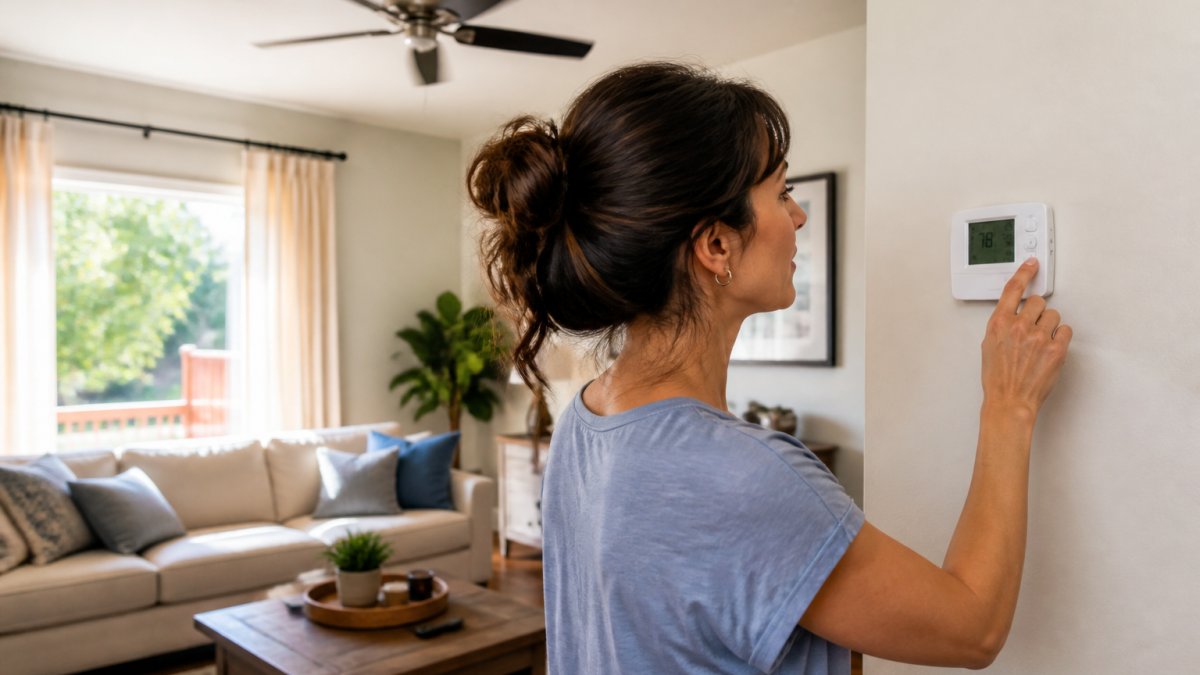
Why 78 Degrees Fahrenheit Works Better Than You Think
Your body adjusts to gradual temperature shifts within about a week, and humidity matters more than the number on the display. At 78 degrees with low humidity, most people feel comfortable; at 74 degrees with high humidity, many still feel sticky.
Fans make the higher setting easier. A ceiling fan moving air lets you feel comfortable at a higher thermostat setting while using a fraction of the power an AC draws.
- Set it to 78°F when home, 85°F when away
- Avoid big swings; the system works harder to recover
- Use a programmable or smart thermostat so you are not adjusting it by hand
How to Build a Summer Schedule That Matches Your Household
A setback only saves money if it runs long enough to matter. A common pattern is a 7- to 8-hour away window on weekdays, with a shorter or no setback on weekends.
Here is a schedule structure most households can adapt:
- 6:30 a.m. – 8:00 a.m.: 78°F while everyone gets ready
- 8:00 a.m. – 4:30 p.m.: 85°F while the house is empty
- 4:30 p.m. – 10:00 p.m.: 78°F during peak home hours
Programmable thermostats handle this automatically. Smart thermostats add geofencing, using your phone’s location to start cooling before you walk in, so you are not paying to cool an empty house just to avoid walking into a hot one.
The Payback Math on a Smart Thermostat
A smart thermostat is one of the few upgrades with a short, predictable payback period. The device typically runs from roughly $100 to $250 depending on model and features, and many utility rebate programs offset part of that cost.
The savings come from consistent setbacks you would not maintain by hand and reduced runtime from better scheduling. Most practitioners find the device pays for itself within one to two cooling seasons in a home that previously ran the AC on a fixed setting.
Check your utility’s rebate page before buying. Many programs list qualifying smart thermostat models and issue the credit as a bill adjustment, which shortens the payback period further.
When a Higher Setting Backfires
A setback is not free if your system cannot recover efficiently. In very humid climates, letting the house warm up too far lets moisture build, and the AC then spends extra runtime wringing it back out; a smaller setback paired with a dehumidifier holds comfort better. An older or undersized system can also trigger long recovery runs that erase savings.
The Benefits of Annual HVAC Maintenance for Summer Efficiency
The benefits of annual HVAC maintenance come down to one number: a dirty system costs more to run. A clogged air filter restricts airflow, forcing your AC to work longer to reach the same temperature.
Change or clean your air filter every one to three months during cooling season. If you have pets or allergies, check it monthly.
What a Tune-Up Actually Includes
A proper tune-up is not just a filter swap. It covers the parts that quietly drain efficiency:
- Cleaning the evaporator and condenser coils
- Checking refrigerant charge and looking for leaks
- Testing the capacitor and contactor
Our certified technicians at Anthony & Son Indoor Air Quality, LLC can handle all of this in a single visit, so you are not chasing problems one at a time.
Skipping maintenance does not just raise your bill. A system running with low refrigerant or a failing capacitor can burn out the compressor, which turns a tune-up into a full replacement.
Signs Your AC Needs Repair Before It Drives Up Your Bill
The signs your AC needs repair usually show up before a breakdown, and catching them early keeps money in your pocket. Watch for these:
| Warning Sign | What It Usually Means | What to Do |
|---|---|---|
| Weak airflow from vents | Clogged filter or duct leak | Check filter first, then call a tech |
| Warm air from vents | Low refrigerant or compressor issue | Stop running it, book a repair |
| Rising bills, same habits | System losing efficiency | Schedule a diagnostic visit |
| Frequent cycling on and off | Oversized unit or thermostat fault | Get it inspected |
| Strange noises or smells | Mechanical or electrical problem | Turn it off and call us |
If you see two or more of these at once, the system is telling you something. A repair now almost always costs less than the energy waste and eventual breakdown.
Seal Leaks and Cover Windows to Block Heat Transfer
Heat transfer is the movement of heat through your walls, windows, and gaps, and it works against your AC all day. Sealing leaks and covering windows blocks that flow before it starts.
Start with the cheap fixes:
- Add weatherstripping around doors and windows
- Seal gaps around pipes and vents with caulk
- Close blinds or curtains on sun-facing windows during peak hours
These steps cut the load on your system, which means it runs less to hold the same temperature.
Use Ceiling Fans and Smart Home Tech to Lower Electricity Bills
Ceiling fans and smart home devices help you lower electricity bills by letting you run the AC less, not by replacing it. A fan does not cool the air; it moves air across your skin so you feel cooler at a higher thermostat setting.
Smart thermostats add scheduling and remote control. You can cool the house before you arrive and ease off when you leave, without touching a dial.
- Run ceiling fans only in occupied rooms
- Set fans to spin counterclockwise in summer
- Use smart plugs to kill vampire power on idle electronics
Fans plus a higher thermostat setting beat a lower thermostat alone. You get the same comfort for less energy, and the savings compound all summer.
Regional Climate Strategies and the ROI of Energy-Saving Upgrades
Most guides treat summer heat as one problem. It is not. Humid heat and dry heat stress a home differently, and the fixes that pay off fastest depend on which one you live in. This section covers the climate-zone tactics and payback periods generic advice skips.
Match Your Strategy to Your Summer Climate
Humid summers. When the air is heavy with moisture, your AC spends a large share of its runtime removing water, not heat. That changes the priority order:
- Seal air leaks first, because humid outdoor air entering the home is a load your AC must dry
- Add a standalone dehumidifier to the muggiest zone, usually a basement or first floor, so the AC can run shorter cycles
- Fix duct leaks, which in humid climates can pull damp air from crawlspaces into living space
Dry summers. When humidity is low, evaporative cooling and shade do more work for you:
- Prioritize shade: exterior awnings, shade trees, and window film cut radiant heat before it enters
- Use a whole-house fan or window fan at night to pull in cool air and flush stored heat
- A wider thermostat setback is usually safe, because dry air does not hold the same moisture penalty
Mixed and shoulder seasons. Many households see both patterns within a single summer. Treat sealing and duct repair as universal, then add dehumidification or shading based on which discomfort you notice more.
The Payback Period for Common Upgrades
ROI here means payback period: how long an upgrade takes to earn back its cost through lower bills. The ranges below reflect common patterns, not guarantees, since your rates, home age, and usage drive the actual number.
- Air sealing and weatherstripping: lowest cost, often the fastest payback, frequently within a single season
- Smart thermostat: typically pays back within one to two cooling seasons, and utility rebates shorten that further
- Attic insulation: a multi-season payback, but it reduces load year-round, not just in summer
How to Prioritize When Your Budget Is Limited
Spend in order of payback, not visibility. A new condenser is the most visible upgrade and usually the slowest to pay back; sealing, a smart thermostat, and duct repair are less dramatic and typically return money sooner.
A simple decision path:
- Older home, uneven rooms: seal ducts and add insulation before replacing equipment
- Humid summers: pair a dehumidifier with your AC to cut runtime
- Long-term ownership: a high-efficiency system can pay back over several seasons
- Short-term ownership: focus on low-cost sealing and thermostat upgrades that transfer with the house
Fix the envelope before you upgrade the equipment. Sealing and duct repair lower the load every future upgrade has to carry, which makes each later dollar work harder.
Reading Your Own Bill to Confirm the ROI
You can verify whether an upgrade is paying off by comparing the same billing period year over year, not month over month. Weather swings make month-to-month comparisons misleading.
For a system that is sized and installed correctly for your home, our team at Anthony & Son Indoor Air Quality, LLC can assess your setup and recommend the fix that fits your budget, not the biggest one.
Frequently Asked Questions
What is the ideal thermostat setting for summer to save money?
The U.S. Department of Energy recommends setting your thermostat to 78 degrees Fahrenheit when you are home and higher when you are away. Each degree you raise it above 72 can save roughly 3 to 5 percent on cooling costs. A programmable thermostat automates these adjustments so you are not paying to cool an empty house. Pair it with ceiling fans to stay comfortable at higher temperatures.
Does running ceiling fans actually lower electricity bills?
Ceiling fans do not cool the air itself, but they move air across your skin, which makes you feel 4 to 6 degrees cooler. That means you can raise the thermostat setting by several degrees without discomfort. Fans use far less electricity than an air conditioner, so running them in occupied rooms reduces your overall energy consumption. Turn fans off when you leave the room; they only help when people are present to feel the breeze.
How often should I schedule HVAC maintenance to improve efficiency?
HVAC manufacturers and energy efficiency programs generally recommend a professional tune-up once a year for your air conditioning system. A technician cleans the coils, checks refrigerant levels, inspects the air filter, and tests electrical components. Skipping maintenance lets dirt and wear reduce efficiency by 5 to 15 percent, meaning your system runs longer to reach the same temperature. Annual service also catches small problems before they become expensive repairs.
How does humidity affect my air conditioning electricity usage?
Your air conditioner removes both heat and moisture from the air. When humidity is high, the system works harder and runs longer to reach your thermostat setting. A dehumidifier can reduce the load on your AC by handling moisture separately, letting you raise the thermostat a degree or two. Keeping indoor humidity between 30 and 50 percent also helps you feel comfortable at higher temperatures, which directly lowers your electricity usage.