
Table of Contents
- AFUE Rating Explained: The Number That Decides Everything
- How High Efficiency Furnaces Actually Work
- The Real Savings Math: Payback Period by Climate Zone
- Furnace Replacement Cost Estimate: Upfront Price vs Hidden Installation Costs
- Government Tax Credits for HVAC Upgrades and Utility Rebates
- Pros, Cons, and Lifespan: What High Efficiency Furnace Owners Report
- Frequently Asked Questions
Last Updated: September 13, 2026
AFUE Rating Explained: The Number That Decides Everything
If you’re weighing whether a high efficiency furnace is worth it, the AFUE rating is where every honest answer starts. AFUE (Annual Fuel use Efficiency) is the percentage of fuel a furnace converts into usable heat, with the remainder lost through venting and combustion. A 97% AFUE condensing furnace wastes roughly 3 cents of every heating dollar, while an 80% model loses about 20 cents. That gap is the entire argument, and it’s also where most homeowners stop asking questions too early. The U.S. Department of Energy guide to furnace efficiency sets the federal baseline at 80% AFUE for gas furnaces, and ENERGY STAR certification begins at 90% in the South and 95% in the North.
Here’s what the number doesn’t tell you: AFUE is tested under controlled lab conditions, not in your basement on a 15-degree January morning.
How High Efficiency Furnaces Actually Work
High efficiency furnaces are condensing units that capture heat twice, using a secondary heat exchanger to pull warmth from exhaust gases older furnaces send straight up the flue. That second pass is why a condensing furnace hits 95% to 98% AFUE while a standard unit tops out at 80%.
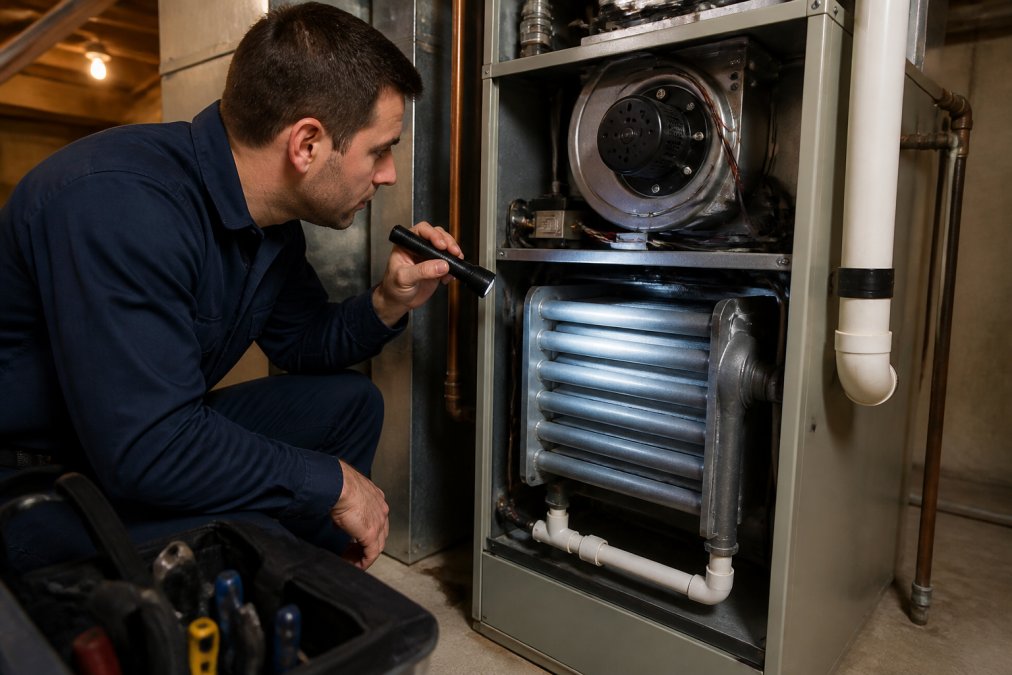
The mechanical differences that matter:
- Secondary heat exchanger in corrosion-resistant stainless steel, where acidic condensate forms
- Variable-speed blower motor that runs longer at lower output instead of cycling on and off
- Two-stage or modulating gas valve that matches heat output to actual demand
- Sealed combustion with PVC venting instead of a metal chimney
That last point trips up retrofits: a condensing furnace produces liquid condensate that must drain to a floor drain, condensate pump, or neutralizer. Without a nearby drain, installation labor climbs.
Condensing furnaces create acidic condensate that will corrode standard metal flues and improperly pitched drain lines. Skipping the neutralizer or drain upgrade is one of the most common installation shortcuts, and it can void your manufacturer warranty.
The Real Savings Math: Payback Period by Climate Zone
The payback period on a high efficiency furnace depends almost entirely on your region’s heating degree days and your cost per therm. Any contractor who quotes a number without asking about your climate zone is guessing.
A working framework:
| Climate Profile | Heating Degree Days | Annual Heating Load | Efficiency Gain vs. 80% AFUE | Payback Outlook |
|---|---|---|---|---|
| Mild (South) | Under 2,000 | Low | 90% AFUE unit | Long, often 12+ years |
| Moderate (Mid-Atlantic) | 4,000-5,500 | Medium | 95-97% AFUE unit | Moderate, roughly 6-10 years |
| Cold (Northeast/Midwest) | 6,500+ | High | 96-98% AFUE unit | Shortest, often 4-7 years |
The math is straightforward: multiply your annual heating spend by the efficiency difference. A household burning more fuel each winter captures more savings from every point of AFUE improvement. In mild climates, a 90% unit usually beats a 98% unit because the extra efficiency never gets used enough to justify the premium.
For Mid-Atlantic homeowners, heating degree days are meaningful but not extreme, so a 95% to 97% condensing furnace tends to pencil out, while a top-tier 98.5% modulating unit is more about comfort than payback.
Build Your Own Regional ROI Estimate
Two homes in the same metro can see payback periods three years apart because of three variables the table cannot capture: your actual cost per therm, your home’s heating load, and how much of the installation can reuse existing infrastructure. Here is a repeatable way to estimate your own number before you call a contractor.
Step 1, Find your heating degree days. NOAA publishes heating degree day data by weather station, and your utility’s efficiency program often republishes it by ZIP code. A 6,500 HDD climate runs roughly three times the heating load of a 2,000 HDD climate for a similarly sized, similarly insulated home.
Step 2, Find your cost per therm. Pull it off your gas bill, not a national average. Rates vary by utility and season, and the fixed monthly service charge does not scale with usage, so exclude it from the savings calculation.
Step 3, Estimate annual heating spend. A common rule of thumb is that heating accounts for roughly half of a typical home’s annual natural gas use in a cold climate and a smaller share in a mild one. Multiply your annual gas spend by that share to isolate the heating portion.
Step 4, Apply the efficiency delta. Replacing an 80% AFUE furnace with a 96% unit saves approximately 1 − (80 ÷ 96), or about 17% of your current heating spend; a 97% unit saves roughly 18%. The difference between a 96% and a 98.5% unit is smaller than most homeowners expect.
Step 5, Divide installed cost by annual savings. Use the full installed cost, not the equipment sticker price. That is where the hidden installation costs below change the answer.
Hidden Installation Costs That Move the Payback Line
A furnace replacement cost estimate that only covers the equipment is incomplete. The sticker price of a high efficiency furnace is the smaller half of the equation, and the installation line items are where budgets break.
- Venting conversion. A condensing furnace cannot share a metal flue with a standard unit. It needs PVC intake and exhaust, meaning a new sidewall or roof penetration and, in some homes, a longer run to meet manufacturer slope and length requirements.
- Condensate management. The furnace produces liquid condensate that must drain to a floor drain, condensate pump, or neutralizer. Without a nearby drain, expect a pump, a routed line, and a neutralizer to protect drain lines from acidic condensate.
- Electrical upgrades. Communicating control boards and variable-speed blowers often need a dedicated circuit or a grounded outlet near the unit that older installations do not have.
- Ductwork modifications. A variable-speed blower performs best at proper static pressure. Undersized or leaky ducts may need sealing, resizing, or a return-air upgrade to deliver the rated efficiency.
- Permits and inspection. Most municipalities require a mechanical permit and a final inspection, and some require a separate gas line or venting inspection.
A retrofit in an older home with a masonry chimney and no basement drain carries significantly more labor than a straight swap in a newer build with existing PVC venting. That hidden cost is the biggest reason two identical furnaces produce two different payback periods.
Ask your contractor for your home’s actual heating degree days and your utility’s current cost per therm before comparing models. Two houses on the same street can have different payback periods if one has duct leakage or poor insulation.
The single biggest predictor of installation cost is not the furnace model. It is how much of your existing venting, drainage, and ductwork can be reused. Get that assessed before you compare quotes.
Furnace Replacement Cost Estimate: Upfront Price vs Hidden Installation Costs
What drives the total:
- Equipment tier (80% single-stage vs. 97% modulating)
- Venting conversion from metal flue to PVC, plus a new roof or sidewall penetration
- Condensate management, including pump, drain routing, and neutralizer
- Ductwork modifications for a variable-speed blower and proper static pressure
- Electrical work for a communicating control board and dedicated circuit
- Permits and inspection required by your municipality
The single biggest predictor of installation cost is not the furnace model. It’s how much of your existing venting, drainage, and ductwork can be reused. Get that assessed before you compare quotes.
Government Tax Credits for HVAC Upgrades and Utility Rebates
Federal tax credits and utility rebates can meaningfully change the payback math, but the rules are specific and the amounts change. The ENERGY STAR federal tax credit information for HVAC equipment and the IRS guidance on energy efficient home improvement credits are the authoritative sources for current eligibility and dollar amounts, and you should verify both before you buy.
What generally qualifies:
- High-efficiency gas furnaces meeting minimum AFUE thresholds
- Associated air handlers and advanced blower motors in qualifying systems
- Certain smart thermostats and system controls
Utility rebates stack on top in many service territories, though they vary by provider and are frequently updated or capped. Keep the AHRI certificate, contractor invoice, and model and serial numbers.
Rebates and tax credits typically require the equipment to meet specific efficiency thresholds and be installed by a licensed contractor. A DIY or unpermitted installation will disqualify the claim, and you cannot recover it later.
Pros, Cons, and Lifespan: What High Efficiency Furnace Owners Report
Owners who switch to condensing equipment generally report lower winter utility bills and more even room-to-room temperatures, especially with modulating models and variable-speed blowers. The trade-offs are real: higher upfront cost, more complex components, and a genuine need for annual maintenance.
Pros:
- Lower operational expenses each heating season
- More consistent comfort with two-stage or modulating output
- Quieter operation from variable-speed blower motors
- Lower carbon emissions from reduced fuel consumption
Cons:
- Higher equipment and installation cost
- Condensate management adds a maintenance item
- Specialized components require a technician familiar with the platform
- Payback stretches out in mild climates
The Lifespan Question Nobody Answers Directly
A common industry claim is that high efficiency furnaces do not last as long as the simpler 80% units they replace, since more electronics, a secondary heat exchanger exposed to acidic condensate, and a modulating gas valve add failure points. The counterargument: that same complexity delivers the efficiency, and a properly commissioned condensing furnace with annual service routinely reaches the same service life as a standard unit.
What actually determines lifespan is not the AFUE rating. It is installation quality and maintenance discipline. The most common premature failures owners report fall into a few categories:
- Secondary heat exchanger corrosion from improper condensate drainage, wrong slope, or a missing neutralizer
- Inducer and pressure switch failures from debris, blocked intake, or short-cycling
- Control board failures from voltage spikes, moisture intrusion, or poor grounding
- Blower motor failures from dirty filters, high static pressure, or undersized ducts
- Ignition and flame sensor issues from lack of annual cleaning
A well-maintained high efficiency furnace commonly delivers a comparable or longer service life than a standard unit, but that depends on annual servicing, clean filters, and correct combustion tuning. Neglect maintenance and the efficiency advantage erodes, with repair bills arriving earlier than the warranty expires.
Maintenance and Repair Cost Reality
Annual maintenance on a condensing furnace costs more than on a standard unit because there are more items to inspect: the secondary heat exchanger, condensate trap and drain line, intake and exhaust terminations, and modulating gas valve. Most practitioners recommend a professional tune-up every year, plus filter changes every one to three months depending on filter type and household conditions.
Repair costs also skew higher on high efficiency models because parts are more specialized and fewer technicians are trained on every platform. Total cost of ownership is therefore the installed price plus fuel savings minus the maintenance and repair delta over the equipment’s life. For homeowners who stay long enough to capture the payback, that delta is usually small relative to fuel savings; for those who may sell within a few years, it can erase the advantage.
How to Compare Models Without Getting Sold
When you compare quotes, ask each contractor the same three questions: What is the measured static pressure of my existing ductwork? How will condensate be routed and neutralized? And what is the manufacturer’s parts and labor warranty on the heat exchanger and control board? The answers tell you more about real-world performance than the AFUE number on the spec sheet.
Models worth evaluating include the Trane XC95M modulating gas furnace with its communicating technology, the Carrier Infinity Series gas furnaces featuring adaptive heating control, and the Daikin DM97MC condensing furnace with its self-diagnostic control board. Each targets a slightly different priority, from maximum modulation to build durability.
Condensing furnaces create acidic condensate that will corrode standard metal flues and improperly pitched drain lines. Skipping the neutralizer or drain upgrade is one of the most common installation shortcuts, and it can void your manufacturer warranty.
Lifespan is a maintenance story, not an AFUE story. A high efficiency furnace that is commissioned correctly and serviced annually typically matches or beats a standard unit; one that is installed cheaply and neglected often does not.
Frequently Asked Questions
What are the downsides of using a high efficiency furnace?
The two most common complaints are higher upfront cost and more complex maintenance. Condensing units create acidic condensate that needs a drain line and pump, and the secondary heat exchanger must be cleaned regularly. Parts cost more when they fail, and not every technician is trained on modulating or communicating systems. In a mild climate with low heating degree days, the monthly savings may never offset the extra install and service cost.
Do high efficiency furnaces really save money on utility bills?
Yes, but how much depends on what you replace. Moving from an 80% AFUE furnace to a 97% AFUE condensing model cuts the fuel used per unit of heat by roughly 17-18%. If you currently spend $1,500 a year on natural gas heating, that math points to a few hundred dollars saved annually. Cold climates with high heating degree days see the fastest payback on a high efficiency furnace; mild climates see slower returns.
How does the AFUE rating impact the long-term value of a furnace?
AFUE, or Annual Fuel Utilization Efficiency, tells you what percentage of fuel becomes usable heat. A 97% AFUE furnace sends 97 cents of every dollar of gas into your home; an 80% model loses the rest through the flue. Over a 15-20 year lifespan, that gap compounds. Higher AFUE also usually means a condensing furnace with a variable-speed blower motor, which adds comfort and quieter operation along with the savings.
What tax credits or rebates are available for high-efficiency furnace installations?
Federal tax credits for HVAC upgrades, including the Energy Efficient Home Improvement Credit, have covered a percentage of qualifying furnace and heat pump costs in recent years, and many utility rebates stack on top of that. Rules, caps, and eligible AFUE thresholds change, so confirm current requirements before you buy. A certified installer can document the AFUE rating and model numbers you need to file.
Is it worth upgrading to a high-efficiency furnace in a mild climate?
Often no, unless your current furnace is failing or you want the comfort benefits. In mild regions with low heating degree days, the annual fuel savings on a high efficiency furnace may take decades to cover the price difference, especially once hidden installation costs like new venting or a condensate drain are added. Run a payback period calculation using your own gas bill and climate zone before deciding.
Deciding whether to upgrade comes down to your climate, your current fuel spend, and how much of your existing system can be reused. Anthony & Son Indoor Air Quality, LLC provides honest assessments, transparent pricing, and certified installation across Maryland, DC, and Northern Virginia, along with preventative maintenance that protects your investment season after season. Contact us today to find out what a high efficiency furnace would actually save in your home.