
Table of Contents
- The 50% Rule and Other Decision Frameworks for Repairing an Old Air Conditioner
- AC Repair vs Replacement Cost: A Side-by-Side Breakdown
- Signs Your AC Needs to Be Replaced (Not Just Repaired)
- Average Lifespan of a Central Air Conditioner: What the Data Says
- Refrigerant Phase-Out: How R-22 vs R-410A Affects Your Repair Decision
- How to Calculate Long-Term ROI: When Replacement Beats Repair
- DIY vs Professional Assessment: What You Can Check Before Calling a Technician
- Frequently Asked Questions
Last Updated: September 26, 2026
The 50% Rule and Other Decision Frameworks for Repairing an Old Air Conditioner
Deciding whether it’s worth repairing an old air conditioner comes down to one question: will the repair buy you enough reliable service to justify the money? The widely cited 50% rule offers a starting point, but it’s a filter, not a verdict. Most guides stop at the rule itself. The useful part is knowing how to calculate it correctly and which adjustments change the answer.
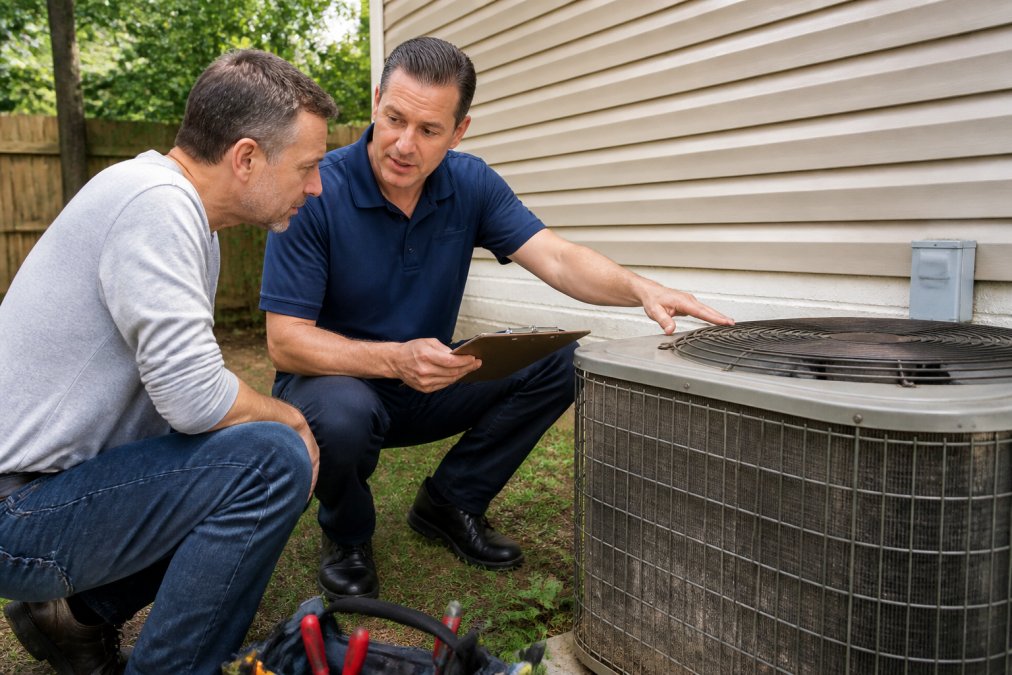
What the 50% Rule Actually Means
The 50% rule is a common guideline suggesting that if a repair costs more than half the price of a new system, replacement deserves serious consideration. The logic is straightforward: once you cross that threshold, you’re paying new-system money to extend the life of aging equipment.
How to Calculate the 50% Rule Accurately
Most homeowners run the rule against the wrong number. The comparison is not the repair invoice versus the sticker price of a new condenser. It is the repair cost versus the installed cost of a comparable new system, equipment, labor, line-set and ductwork modifications, permit, and disposal of the old unit.
- Remaining service life. Divide the repair cost by the number of years the repair is likely to buy, not by the full replacement cost. A $1,200 repair that buys two years is $600 per year of service. A $7,000 replacement that lasts 15 years is roughly $467 per year before energy savings.
- Energy savings over time. A new unit with a higher SEER rating lowers monthly operating cost. Subtract that annual savings from the replacement path’s annualized cost before comparing.
Other Decision Frameworks Worth Knowing
The 50% rule is not the only filter. Three others are useful when the numbers are close:
- The age-plus-severity test. A major component failure (compressor, evaporator coil, condenser coil) on a unit past 12 years points toward replacement. A minor failure (capacitor, contactor, thermostat, blower motor) on a unit under 10 years usually points toward repair.
- The repair-frequency test. Two or more repairs in a single cooling season, or three across two seasons, is a pattern. Patterns cost more than any single invoice.
- The refrigerant test. If the system uses R-22 and the repair involves refrigerant, the rule is often moot, see the refrigerant section below.
Ask your HVAC technician for three numbers, not one: the repair cost, the installed cost of a comparable new system, and the remaining expected service life of your unit. With those three figures you can run the adjusted 50% rule yourself in about two minutes.
Comparing a repair quote to the price of a condenser alone understates the replacement path. Installed cost, labor, line set, permits, disposal, is the correct denominator. Using the equipment-only price makes repair look cheaper than it is.
AC Repair vs Replacement Cost: A Side-by-Side Breakdown
The repair-versus-replace decision becomes clearer when you separate the costs into categories rather than comparing two lump sums. Minor repairs, major component failures, and full replacement carry very different financial profiles.
| Factor | Repair Path | Replacement Path |
|---|---|---|
| Upfront cost | Lower, varies by part | Higher, full system |
| Disruption | Minimal, same-day often | Multi-day install |
| Efficiency gain | None | New SEER rating |
| Warranty | Part only, if any | Full system coverage |
| Future repair risk | Rises with age | Resets to near zero |
| Best for | Newer units, minor faults | Aging units, major failures |
Signs Your AC Needs to Be Replaced (Not Just Repaired)
The clearest signs your AC needs to be replaced cluster around frequency and severity. One costly repair on an old unit is a warning. Repeated repairs on the same system are a pattern, and patterns are expensive.
Watch for these signals:
- Repairs happening more than once a season
- A refrigerant leak that keeps returning after recharge
- Short cycling, where the system turns on and off in short bursts
- Uneven cooling between rooms despite a working thermostat
- Rising utility bills with no change in usage habits
- Strange noises from the compressor or air handler
Recharging a leaking system without fixing the leak is money spent twice. The refrigerant escapes again, and you’re back to the same invoice next season, often with a compressor damaged by low charge.
Average Lifespan of a Central Air Conditioner: What the Data Says
The average lifespan of a central air conditioner is generally cited as 10 to 15 years, with well-maintained units in mild climates sometimes reaching the upper end. Age alone doesn’t condemn a system, but it changes how you weigh every repair.
Refrigerant Phase-Out: How R-22 vs R-410A Affects Your Repair Decision
Refrigerant type is one of the most overlooked factors in the repair decision, and it can quietly tip the scales toward replacement. Older systems often run on R-22, a refrigerant that has been phased out in the United States under the EPA phase-out of ozone-depleting refrigerants because of its environmental impact.
If your system runs on R-22 and needs a refrigerant-related repair, factor in both the repair cost and the likelihood of future leaks. This is where many homeowners find replacement becomes the more sensible path.
::: Aging cooling equipment often signals broader mechanical fatigue that necessitates a comprehensive evaluation of heating system replacement to avoid compounding maintenance expenses.
How to Calculate Long-Term ROI: When Replacement Beats Repair
Long-term ROI calculation is the angle most homeowners skip, and it’s the one that settles the question. Instead of comparing one repair bill to one replacement quote, compare total cost of ownership over the next several years, and find the year the two paths cross.
The Break-Even Framework
The break-even point is the year in which the cumulative cost of keeping the old system equals the cumulative cost of replacing it. Before that year, repair wins on cash outlay. After it, replacement wins.
To find it, you need four inputs:
- Remaining service life of the current unit (in years).
- Expected repair costs across that period, based on your service history, not a single invoice.
- Annual energy cost at the current SEER rating.
- Annual energy cost at the replacement SEER rating, plus the installed replacement cost.
A Worked Example
The numbers below are illustrative, not a quote. Plug in your own figures.
| Year | Repair Path (cumulative) | Replacement Path (cumulative) |
|---|---|---|
| 0 | $0 (no repair yet) | Installed cost of new system |
| 1 | First repair + year-1 energy | Year-1 energy (lower) |
| 2 | + second repair + year-2 energy | + year-2 energy |
| 3 | + third repair + year-3 energy | + year-3 energy |
| 4 | + fourth repair + year-4 energy | + year-4 energy |
| 5 | + fifth repair + year-5 energy | + year-5 energy |
How to Read the Result
- If break-even is inside your expected remaining service life, replacement usually wins on total cost of ownership.
- If break-even is beyond your expected remaining service life, repair is the cheaper path, provided the repair actually delivers that life.
- If the two are close, weigh the non-financial factors: warranty coverage, disruption, and the risk of a mid-season failure.
A common pattern is that homeowners focus on the upfront invoice and miss the compounding effect of rising repair frequency and flat-to-rising utility bills. The annualized view corrects for that.
What the Efficiency Gap Is Worth
SEER measures cooling output per unit of electricity. A higher SEER rating means less electricity for the same cooling. The gap between an older unit and a new high-efficiency unit shows up every month on the utility bill, which is why the replacement column in the table above climbs more slowly than the repair column.
Run the break-even calculation before you accept either a repair quote or a replacement quote. The answer is almost never obvious from the invoice alone, and the crossover year is the single most useful number in the decision.
DIY vs Professional Assessment: What You Can Check Before Calling a Technician
A DIY assessment can save you a service call, but it can’t diagnose refrigerant charge, compressor health, or electrical faults. Know where the line sits.
What you can safely check:
- Thermostat settings and batteries
- Air filter condition and airflow at vents
- Visible ice on the outdoor unit or refrigerant lines
- Breaker and disconnect switch status
- Obvious debris blocking the condenser coil
What requires a professional:
- Refrigerant pressure and leak detection
- Compressor and capacitor testing
- Drain line clearing and condensate issues
- Ductwork inspection for leaks and system capacity problems
Homeowners who want an honest repair-or-replace recommendation backed by actual measurements, not a sales pitch. We provide certified assessments across Maryland, Washington, DC, and Northern Virginia.
Frequently Asked Questions
What is the $5,000 rule for AC repairs?
The $5,000 rule is a quick guideline: multiply your system’s age by the repair cost. If the result exceeds $5,000, replacement usually makes more financial sense. For example, a 12-year-old unit needing a $500 repair gives you $6,000, which tips toward replacement. This rule is a starting point, not a final verdict. Always factor in your system’s SEER rating, warranty status, and how often it has needed repairs recently before deciding.
Is my 20-year-old HVAC unit still good to use?
A 20-year-old system can still run, but it is well past the average 15-year service life. Efficiency has dropped, repairs become more frequent, and parts for older units are harder to source. If your system uses R-22 refrigerant, repairs may cost more because that refrigerant is phased out. A professional assessment can tell you whether the unit has life left or whether replacement will save you money on utility bills.
How do I know if my AC compressor is failing?
Signs of compressor failure include the outdoor unit humming but not cooling, warm air from vents, frequent circuit breaker trips, and unusual clicking or grinding noises. Short cycling, where the system turns on and off rapidly, is another warning sign. Compressor replacement is one of the most expensive repairs for an old air conditioner, often making replacement the better choice if the system is already near the end of its average lifespan.
Does an old AC unit increase my monthly energy bills?
Yes. Older systems lose efficiency over time, and units from the early 2000s may have a SEER rating of 10 or lower. Modern systems achieve SEER ratings of 14 to 20 or higher. That gap means an aging unit can add noticeably to your utility bills each month, especially during peak summer cooling. Replacing an inefficient system often pays back through lower energy costs over several years.