
Table of Contents
- Preventative Maintenance Tips for Home Air Conditioning
- How Often to Change Your AC Filter
- Benefits of Annual HVAC Tune-Ups
- Step-by-Step Preventative Maintenance Tasks
- Signs Your AC Needs Professional Service
- Smart Home Integration and Error Codes
- Indoor Air Quality and Energy Efficiency ROI
- Frequently Asked Questions
Last Updated: September 28, 2026
Preventative Maintenance Tips for Home Air Conditioning
A well-maintained air conditioning system can last years longer than one that’s ignored until it breaks. This guide from Anthony & Son Indoor Air Quality, LLC covers the tasks you can handle yourself, the ones that require a licensed technician, and how to tell the difference before a small issue becomes a costly repair.
How Often to Change Your AC Filter
Change your AC filter every 30 to 90 days, depending on the filter type, your home’s dust levels, and whether you have pets. This is the single highest-impact preventative maintenance task a homeowner can do, and it takes about two minutes.
If you can’t remember the last time you changed the filter, that’s your answer. A filter that looks gray and matted on the intake side is already past due, and it’s been quietly raising your energy use for weeks.
Benefits of Annual HVAC Tune-Ups
An annual HVAC tune-up is a professional visit that cleans components, tests electrical and refrigerant systems, and verifies the unit operates within manufacturer specifications. Schedule one before cooling season starts.
The benefits compound over the life of the equipment:
- Longer service life. A system that runs within spec wears more slowly than one running hot or short-cycling.
- Lower utility bills. Clean coils and correct refrigerant charge let the system cool your home with less runtime.
- Fewer emergency calls. A technician catches a failing capacitor or a loose connection before it strands you in July.
- Preserved warranty coverage. Many manufacturers require documented annual maintenance to honor parts warranties, so skipping tune-ups can void coverage you already paid for.
Step-by-Step Preventative Maintenance Tasks
These are the tasks most homeowners can safely handle. Work through them at the start of cooling season, then repeat the simple ones monthly. If anything involves opening a panel, handling refrigerant, or working near live wiring, call a licensed technician.
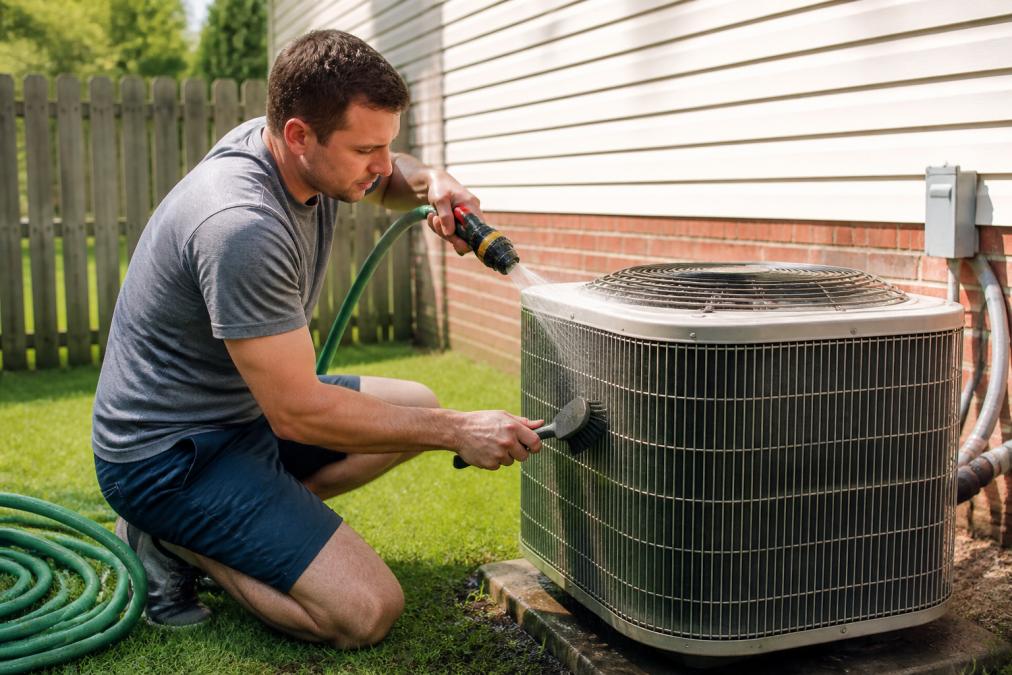
Clean Evaporator and Condenser Coils
The condenser coil sits in the outdoor unit and sheds heat; the evaporator coil sits indoors and absorbs it. Both collect dust, pollen, and grass clippings, and dirty coils are a leading cause of reduced cooling.
Inspect Electrical Connections and Lubricate Moving Parts
Loose electrical connections create resistance, and resistance creates heat, how a small problem becomes a burnt wire or failed contactor. With power off, a technician tightens connections at the contactor, capacitor, and disconnect.
Clear Debris and Check Refrigerant Levels
Clear leaves, grass, and dirt from around the outdoor unit and keep at least two feet of clearance on all sides. Restricted airflow forces the compressor to work harder and shortens its life.
Never add refrigerant to a system yourself, and never let anyone “top it off” without locating the leak. Topping off a leaking system masks the real problem, and the leak will return, often with a seized compressor behind it.
Signs Your AC Needs Professional Service
Call a professional when you notice any of these signals, each points to a problem that gets more expensive the longer it runs:
- Warm air from the vents while the system runs normally otherwise
- Ice on the indoor coil or refrigerant lines, which indicates an airflow or charge problem
- Short cycling, where the unit turns on and off every few minutes
- Strange noises, including grinding, squealing, or repeated clicking at startup
- Musty odors from the vents, which often point to moisture or microbial growth in the system
- Rising energy bills with no change in usage habits
- Water pooling near the indoor unit, a sign of a clogged condensate drain line or a full drain pan
Smart Home Integration and Error Codes
Smart thermostats and connected HVAC sensors have changed preventative maintenance. A connected thermostat logs runtime hours, filter-change reminders, and system faults a basic thermostat never records, but only if you keep its software current and sensors calibrated.
Smart Thermostat Maintenance Tasks
Treat the thermostat like the small computer it is. These tasks take minutes and prevent the most common “my AC is acting strange” calls that turn out to be a thermostat problem:
- Update firmware. Most manufacturers push firmware over Wi-Fi, but it only installs when the thermostat is powered and connected. Check the device menu or companion app every few months, and let the update finish before you walk away.
- Replace batteries annually. Many models use internal batteries as backup power. A weak battery can blank the screen, reset the schedule, or stop the unit calling for cooling while the display still looks normal.
- Recalibrate temperature and humidity sensors. Remote room sensors drift over time. Most apps include a calibration offset; compare the reading against a known-good thermometer in the same room and adjust.
- Reconnect after router or Wi-Fi changes. If you replaced your router or changed the network name, the thermostat may be offline without obvious warning. Offline thermostats lose remote scheduling and demand-response participation, which can affect utility rebate programs.
- Review runtime and cycle data. Unusually long runtimes on a mild day, or frequent on/off cycling, flag a problem worth investigating before it becomes a repair.
- Check scheduling and geofencing. After daylight saving time changes or a household schedule shift, verify the schedule and geofencing still match how the home is actually used. A schedule that fights your habits raises energy use without any equipment fault.
Common Error Codes and What They Usually Mean
Error codes vary by brand, so check your equipment manual or the manufacturer’s app for the exact definition. The categories below cover the faults homeowners most often see, and the first step that resolves or escalates each one.
| Code Category | What It Usually Means | First Step |
|---|---|---|
| Communication fault | Thermostat lost contact with the air handler or condenser | Check the breaker, then inspect low-voltage wiring at both ends |
| Pressure switch fault | Restricted airflow, blocked flue, or a draft inducer issue | Check the filter and return vents; if clear, call a technician |
| High-limit trip | System overheating from restricted airflow or a failing component | Shut the system down and call a technician |
| Sensor fault | Failed or disconnected temperature sensor | Reseat the sensor connection; replace if the fault returns |
| Drain pan or float switch fault | Condensate line clogged or pan full | Clear the drain line and empty the pan; recurring faults need a pro flush |
| Low-pressure or charge fault | Refrigerant charge or airflow problem | Do not add refrigerant; schedule a certified technician |
| Defrost or lockout fault | Heat pump stuck in defrost or a safety lockout | Power-cycle once; if it returns, schedule service |
Keep a simple log, date, code, weather, and what you did. A technician can diagnose a recurring fault far faster with three data points than with a vague description of “it stopped working last month.”
ENERGY STAR guidance on programmable and smart thermostats
Indoor Air Quality and Energy Efficiency ROI
Indoor air quality and energy efficiency are connected through the same components. A clean system moves air efficiently, and efficient airflow means the filter, coils, and ductwork are all doing their jobs. Neglect any one and both comfort and air quality suffer.
IAQ-Specific Maintenance Beyond Dust Removal
Standard filter changes handle dust, but they don’t address mold, microbial growth, or fine particulates. These components need their own maintenance rhythm:
- UV lights. Germicidal UV lamps in the air handler or coil area lose output over time even though they still glow. Most manufacturers recommend replacing the lamp roughly every 12 months; a lamp past its effective life runs on your electricity without doing its job.
- HEPA and high-MERV media filters. These capture far more than a standard filter, which also means they load faster. A high-MERV filter on a system not designed for the added resistance can choke airflow and freeze the coil. Check the filter’s pressure drop rating against your equipment’s spec, and replace on schedule rather than waiting for visible loading.
- Mold prevention in the evaporator and drain pan. The evaporator coil stays wet during cooling season, and standing water in the drain pan is a growth site. Keep the drain line flowing, confirm the pan drains fully after the system shuts off, and have the coil cleaned during the annual tune-up. Persistent musty odors usually mean moisture is sitting somewhere it shouldn’t.
- Ductwork and returns. Leaky or dirty ducts pull attic or crawlspace air into the living space. Sealing and cleaning ducts improves both the air you breathe and the efficiency of the system moving it.
- Ventilation balance. Modern tight homes need intentional fresh-air ventilation. Bathroom and kitchen exhaust fans should be checked for airflow and cleaned, and any energy recovery ventilator or fresh-air intake needs its filter serviced on schedule.
Estimating Your Maintenance ROI
Preventative maintenance is one of the few home investments with a predictable return: a system running with clean coils and correct charge uses less energy to reach the same temperature, so fewer runtime hours at a lower amp draw equals a smaller bill.
A practical way to estimate your own return:
- Find your cooling cost baseline. Pull two summer utility bills from before any maintenance and note the cooling portion, or use your utility’s usage dashboard if it separates heating and cooling.
- Estimate the efficiency penalty of neglect. A dirty filter, dirty condenser coil, or low refrigerant charge each forces longer runtimes. A system with a badly restricted filter or fouled coil runs noticeably longer to hit the same setpoint, the exact penalty depends on how dirty the system is and how hot the outdoor air is.
- Compare before and after. After a tune-up and a fresh filter, compare the same month’s usage year over year, adjusting for weather. A meaningful drop in runtime hours at the same outdoor temperature is your efficiency gain.
- Add avoided repair costs. The bigger return is often the repair you didn’t pay for, a failed capacitor, a seized compressor, or a frozen coil that could have been caught at the tune-up.
- Factor in equipment life. A system that runs within spec wears more slowly. Extending service life by even a few years spreads the replacement cost over more cooling seasons.
CDC guidance on indoor environmental quality
Frequently Asked Questions
What is included in a standard AC preventative maintenance check?
A standard check covers filter replacement, coil cleaning, electrical connection inspection, lubrication of moving parts, refrigerant level check, and thermostat calibration. Technicians also clear drain lines and test safety controls. This service keeps your system in peak condition and can extend its service life.
How often should you perform preventative maintenance on your home AC?
Schedule professional preventative maintenance once a year, ideally in spring before the cooling season. DIY tasks like changing the air filter should be done every 1-3 months depending on usage and pets. Regular maintenance improves energy efficiency and prevents costly breakdowns.
Can I perform AC maintenance myself or do I need a professional?
You can handle simple tasks like changing the air filter, clearing debris from the outdoor unit, and checking the thermostat. However, tasks involving refrigerant, electrical connections, and coil cleaning require a licensed HVAC technician. Attempting these yourself can void warranties and risk safety.
What are the benefits of annual HVAC tune-ups?
Annual tune-ups improve energy efficiency, lower utility bills, and extend equipment lifespan. They also reduce the risk of unexpected breakdowns, maintain indoor air quality, and keep your system running quietly. Many manufacturers require annual maintenance to keep warranties valid.