
Table of Contents
- Signs of a Bad Blower Motor You Should Not Ignore
- Common AC Blower Motor Problems and What Causes Them
- How to Test a Blower Motor With a Multimeter
- ECM Motor Faults and Smart Thermostat Integration Issues
- AC Blower Motor Replacement Cost: DIY vs. Professional Repair
- Preventative Maintenance That Extends Blower Motor Life
- When to Call an HVAC Technician
- Frequently Asked Questions
Last Updated: September 25, 2026
Signs of a Bad Blower Motor You Should Not Ignore
The most common sign of a failing blower motor is a grinding or squealing noise coming from the air handler. That sound usually means bearing wear, and it gets worse with every cycle. The ac blower motor pushes air through your whole home, so when it struggles, every room feels it.
Catch the warning signs early and you can often avoid a full system failure.
Noises That Point to Bearing Wear
Bearing wear announces itself before the motor dies. Listen for these sounds:
- Grinding or rumbling at startup
- Squealing that rises with fan speed
- Rattling from a loose blower wheel
- A humming motor that never spins up
Squealing points to dry or worn bearings. Grinding means metal is already touching metal. Both get worse fast once they start.
Weak Airflow and Fan Speed Problems
Weak airflow is the other big clue. Vents feel barely open even at full fan speed. Rooms never reach the thermostat setting. You may also notice:
- Air that feels warm when the AC is running
- Uneven temperatures room to room
- The system short-cycling or shutting down early
- A burning smell near the air handler
A clogged air filter is the first thing to check. A dirty filter restricts airflow, and airflow restriction overheats the motor. That leads to thermal overload, where the motor shuts itself off mid-cycle.
Never run the system with a clogged filter while you “get to it later.” Restricted airflow forces the motor to work harder, and repeated overheating can burn out the windings for good.
Common AC Blower Motor Problems and What Causes Them
The blower motor fails for a handful of predictable reasons, and most trace back to heat, dirt, or electrical faults. Knowing the cause helps you fix the right part instead of guessing.
The most frequent problems include:
- Bearing wear from age and lack of lubrication
- Capacitor failure that stops the motor from starting
- Relay or resistor faults that cut power to the motor
- Wiring harness damage from heat, rodents, or vibration
- Debris obstruction in the blower wheel or housing
- ECM motor faults in newer variable-speed systems
A common mistake is replacing the motor when the real culprit is a cheap capacitor or relay. Test the small parts first. They cost far less and often solve the problem.
How to Test a Blower Motor With a Multimeter
Most guides tell you to “test the motor” without telling you what a passing reading looks like. This section gives you information so you can decide whether the motor, capacitor, relay, or resistor is the failed part, instead of guessing and buying parts you do not need.
Testing takes about 30 minutes with basic tools. Always shut off power at the breaker and confirm the unit is dead with a non-contact voltage tester before you open the air handler.
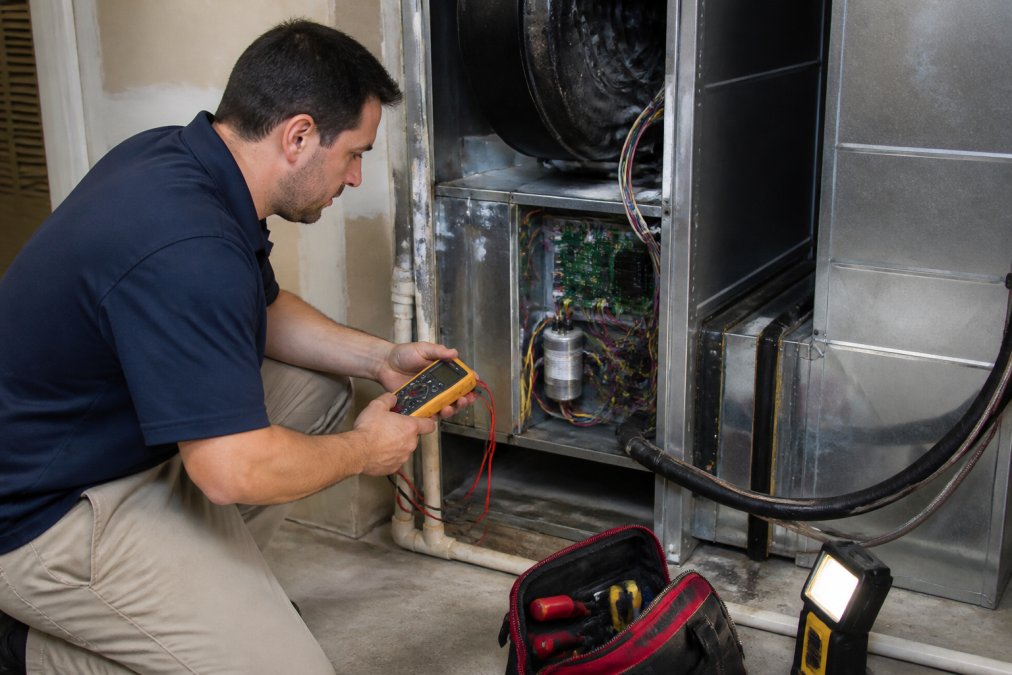
What you’ll need:
- Digital multimeter with ohmmeter, capacitance, and continuity settings
- Screwdriver set and nut driver
- Insulated gloves and safety glasses
- Camera phone to photograph wiring before removal
- Manufacturer wiring diagram (usually taped inside the panel)
Step 1: Cut the power. Flip the breaker and confirm the unit is dead with a voltage test at the line side.
Step 2: Open the air handler. Remove the panel to reach the blower housing and wiring harness.
Step 3: Inspect visually. Look for burnt wires, bulging or leaking capacitors, scorch marks on the control board, and debris packed into the blower wheel.
Testing the Capacitor: What a Good Reading Looks Like
A bad capacitor is the number one reason a blower motor hums but will not start. Discharge the capacitor first by shorting its terminals with an insulated screwdriver, then set your meter to the capacitance setting.
- Within ±6% of the rated µF: capacitor is good.
- More than 6% low: replace it. A weak cap causes the motor to draw higher amps, run hot, and eventually trip on thermal overload.
- Reading near zero or OL: the cap is open and the motor will not start.
- Bulging top or oily residue: replace it regardless of the reading.
Checking the Relay, Resistor, and Wiring Harness
The relay sends power to the motor, and the resistor controls fan speed on a PSC system. Test the relay for continuity when it should be closed, you should read near 0 ohms. An open reading (OL) on a relay that should be closed means it has failed.
Testing Motor Windings and Checking for a Short to Ground
Set the meter to the lowest ohm range. On a PSC motor, you will typically find three or four wires (common, high, medium, low). Measure between common and each speed tap. You should read a low, finite resistance, often in the range of a few ohms to a few dozen ohms, depending on motor size. The exact spec is on the motor nameplate or wiring diagram.
What the readings tell you:
- OL (open) between common and a speed tap: that winding is burned out. Replace the motor.
- 0 ohms or near-zero between two taps: shorted windings. Replace the motor.
- Any reading from a winding terminal to the motor case: short to ground. Replace the motor, do not run it.
Photograph the wiring harness before you disconnect anything. Reconnecting a multi-wire harness wrong is the most common DIY mistake, and it can damage the new motor the moment you power up.
Capacitors hold a charge even after power is off. Always discharge before touching the terminals. A charged 440V capacitor can deliver a dangerous shock.
Write down every reading as you go. A capacitor that reads 6% low, a relay that reads OL, and a winding that reads OL are three different repairs, and the numbers are what tell you which one to make.
ECM Motor Faults and Smart Thermostat Integration Issues
ECM motors use onboard electronics to control speed, which makes them efficient but harder to diagnose. When an ECM motor fails, it often throws a fault code instead of making noise. You may see the motor run at one speed only, or not at all.
- Thermostat firmware is current
- The C-wire connection is secure
- Fan settings match the equipment type
- The thermostat is set to the correct system mode
AC Blower Motor Replacement Cost: DIY vs. Professional Repair
This section gives you information so you can decide whether to pick up a wrench or pick up the phone.
| Repair | DIY Parts Cost | Professional Total Cost | DIY Difficulty |
|---|---|---|---|
| Air filter | $10-$40 | $75-$150 (with tune-up) | Easy |
| Run capacitor | $15-$50 | $150-$350 | Easy-Moderate |
| Blower relay | $20-$60 | $150-$350 | Moderate |
| Blower resistor | $25-$75 | $175-$400 | Moderate |
| PSC blower motor | $100-$250 | $400-$800 | Hard |
| ECM blower motor | $300-$700 | $800-$1,800+ | Very Hard |
| Control board | $150-$500 | $500-$1,200 | Hard |
Match the repair to the risk. Swap cheap parts yourself, but hand motor, ECM, and wiring jobs to a certified technician. Guessing on a motor can cost more than the original repair.
Preventative Maintenance That Extends Blower Motor Life
Regular maintenance is the cheapest way to avoid a mid-summer breakdown. A few habits add years to the motor’s life:
- Change the air filter every 1-3 months
- Keep the blower wheel and housing clean
- Schedule a yearly tune-up before peak season
- Listen for new noises each month
- Keep vents open and unblocked
When to Call an HVAC Technician
Call a technician when you see sparks, smell burning, or hear grinding that will not stop. These point to electrical fault or serious bearing wear that gets worse with every run. Also call if the motor tests fine but the system still fails.
Frequently Asked Questions
How do I know my blower motor is going bad?
Watch for weak airflow from vents, grinding or squealing noises, a burning smell, or the blower running at only one fan speed. These signs of a bad blower motor often trace back to bearing wear, a failing capacitor, or airflow restriction from a clogged air filter. If the motor hums but the blower wheel does not spin, the capacitor is a common culprit. Persistent symptoms usually mean the motor itself is failing and needs testing with a multimeter before replacement.
Can I run my AC with a bad blower motor?
Running your AC with a bad blower motor risks overheating the system and freezing the evaporator coil. Without proper airflow, the compressor works harder, which can trip the thermal overload or cause permanent damage. A short test run to confirm the fault is fine, but continued operation shortens equipment life. Shut the system down and address the AC blower motor issue before restarting.
What causes an AC blower motor to stop working?
The most common causes are a failed capacitor, a tripped thermal overload, a bad relay or resistor, ECM motor faults, and debris obstruction around the blower wheel. Wiring harness damage and electrical faults also stop the motor. On older systems, bearing wear and lack of lubrication seize the motor shaft. Checking each component with a multimeter isolates the exact failure.
How much does AC blower motor replacement cost?
AC blower motor replacement cost depends on the motor type (PSC versus ECM), whether the capacitor or relay needs replacing at the same time, and labor rates in your area. Anthony & Son Indoor Air Quality, LLC provides transparent quotes before any work begins, so you know the price upfront.
A failing blower motor rarely fixes itself, and the longer you wait, the more damage it does to the rest of your HVAC system. Anthony & Son Indoor Air Quality, LLC offers honest diagnostics, certified technicians, and preventative maintenance that keeps your system running year-round. From emergency HVAC repair to seasonal tune-ups, our family-owned team stands behind every job. Contact us today to schedule service and get your comfort back.