
Table of Contents
- Why Is My AC Blowing Warm Air? Start With These Quick Checks
- How a Dirty AC Filter Causes Warm Air and Frozen Coils
- Refrigerant Leak Symptoms Every Homeowner Should Recognize
- Dirty Condenser Coils, Blower Motor Problems, and Other Hidden Culprits
- AC Capacitor Replacement: When a Small Part Stops the Whole System
- Smart Thermostat Troubleshooting and Safety Precautions for DIY Repairs
- AC Repair Cost: DIY vs. Professional Service, What Makes Sense?
- When Your AC Is Still Blowing Warm Air After All the Checks
Last Updated: July 30, 2026
If your air conditioner is running but pushing warm air through your vents, you are dealing with one of the most common HVAC complaints homeowners face every summer. The answer almost always traces back to a handful of fixable causes. The team at Anthony & Son Indoor Air Quality, LLC has diagnosed this exact problem in homes in Maryland, Washington, DC, and Northern Virginia. Below, you will find a clear troubleshooting path from simple thermostat checks all the way to refrigerant leaks and capacitor failures.
Thermostat errors and dirty air filters account for the majority of ac blowing warm air calls. Start there before assuming the worst.
Why Is My AC Blowing Warm Air? Start With These Quick Checks
The fastest way to diagnose ac blowing warm air is to rule out the simplest causes first. Two checks take less than five minutes and resolve a surprising number of service calls.
Check Your Thermostat Settings First
Thermostat settings are the single most overlooked cause of warm air coming from a working system. Confirm two things immediately:
- The mode is set to COOL, not HEAT or EMERGENCY HEAT.
- The fan is set to AUTO, not ON.
When the fan is switched to ON instead of AUTO mode, the blower motor runs continuously, even between cooling cycles. During those off cycles, the system circulates unconditioned air through your ductwork, which feels warm at the vents. Switching to AUTO mode fixes this instantly. Set the temperature at least 5 degrees below the current room temperature.
If you recently had a power outage, your thermostat may have lost its settings or reverted to a default mode. Pull the thermostat off the wall, remove the batteries for 30 seconds, reinstall them, and reprogram your schedule before assuming a mechanical problem.
Inspect Your Circuit Breaker Panel
A split HVAC system has two separate electrical circuits: one for the air handler inside and one for the condenser unit outside. A tripped circuit breaker on the outdoor condenser side is a common reason why the air handler keeps blowing air but that air never gets cooled.
Go to your breaker panel and look for any breaker in the middle position or flipped to OFF. Reset it by pushing it fully to OFF first, then back to ON. If it trips again immediately, stop. A breaker that trips repeatedly signals an electrical issue that requires a licensed HVAC technician.
According to the U.S. Department of Energy’s home cooling guidance, a properly functioning central air system should maintain consistent cooling when electrical supply and thermostat settings are correct.
How a Dirty AC Filter Causes Warm Air and Frozen Coils
A clogged air filter is the most preventable cause of ac blowing warm air. When the air filter becomes packed with dust, pet dander, and debris, airflow through the system drops sharply. The evaporator coil gets starved of warm air, its temperature drops below freezing, ice forms on the coil surface, and now you have a frozen evaporator coil blocking airflow entirely. The result: your system runs constantly but only warm or room-temperature air comes out of your vents.
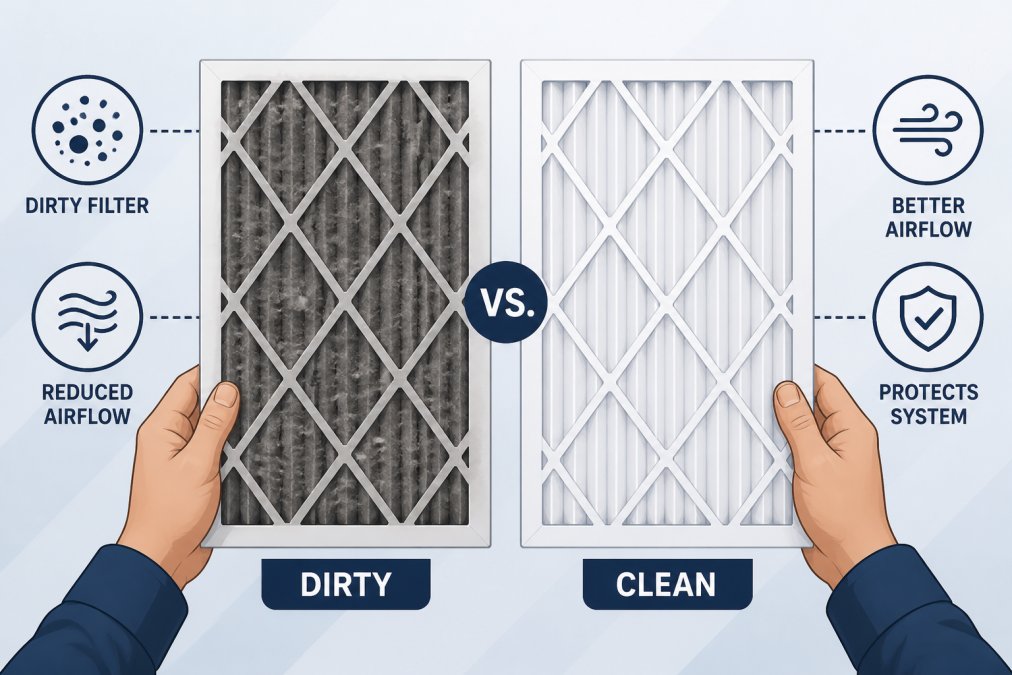
Check your filter by holding it up to light. If you cannot see light through it, replace it now. Most standard 1-inch filters need replacement every 30 to 90 days depending on household conditions. Homes with pets or residents with allergies often need monthly changes.
After replacing the filter, turn the system to FAN ONLY for two to three hours to let the frozen coil thaw completely. Do not run the AC in cool mode with a frozen coil. Once thawed, switch back to cooling and monitor whether cold air returns.
Running your system with a frozen evaporator coil puts serious strain on the compressor. Compressor failure is one of the most expensive repairs in HVAC. A dirty filter that causes repeated freeze-thaw cycles can shorten compressor lifespan significantly.
Refrigerant Leak Symptoms Every Homeowner Should Recognize
Refrigerant is the chemical compound that absorbs heat from indoor air at the evaporator coil and releases it outside at the condenser unit. Without adequate refrigerant charge, the cooling cycle cannot complete, and your AC blows warm air regardless of how hard it runs.
Common refrigerant leak symptoms include warm air from vents even though the system runs continuously, ice buildup on the refrigerant lines or evaporator coil, a hissing or bubbling sound near the indoor air handler or outdoor condenser unit, higher-than-normal energy bills with no change in usage habits, and longer run times without reaching the set temperature.
A refrigerant leak is not a DIY repair. Under EPA Section 608 regulations governing refrigerant handling, only certified technicians are legally permitted to purchase, handle, and recharge refrigerants. Attempting to add refrigerant yourself without finding and repairing the leak is pointless: the new charge will escape through the same leak.
If you suspect low refrigerant, schedule a service call. A certified technician will pressure-test the system, locate the leak, repair it, and recharge the system to the manufacturer’s specified level.
Dirty Condenser Coils, Blower Motor Problems, and Other Hidden Culprits
Some causes of warm air are less obvious but just as disruptive to your cooling cycle.
Dirty Condenser Coils and Airflow Restriction
The condenser unit outside your home releases the heat that was absorbed indoors. When condenser coils become coated in dirt, grass clippings, or cottonwood fluff, heat cannot escape efficiently. The system’s ambient temperature around the coil rises, the refrigerant cannot release heat properly, and cooling capacity drops.
Clear at least two feet of space around the condenser unit. Rinse the coil fins gently with a garden hose from the inside out. Do this annually as part of preventative maintenance. Avoid pressure washers, which bend the delicate aluminum fins and reduce airflow further.
Blower Fan and Motor Issues
The blower motor inside the air handler moves conditioned air through your ductwork. A failing blower motor or worn capacitor means less air volume reaches your vents, and what does arrive feels warmer because it spent too long in the ductwork.
Signs of blower motor trouble include weak airflow from all vents, a humming sound without airflow, or the system running but no air movement at all. This is a component replacement job for a technician.
Clogged Condensate Drain Line
Modern air conditioning systems have a safety float switch connected to the condensate drain line. When the drain line clogs with algae or debris, water backs up into the drip pan. The float switch trips and shuts down the cooling function to prevent water damage, while the blower continues to run.
Check the condensate drain pan under your air handler for standing water. A clogged line can often be cleared with a wet/dry vacuum at the drain outlet or a diluted vinegar flush through the access port.
AC Capacitor Replacement: When a Small Part Stops the Whole System
A capacitor failure is one of the most common reasons why is my ac blowing warm air on an otherwise functional system.
Capacitors are cylindrical components inside the condenser unit that provide the electrical start-up and run power for the compressor and condenser fan motor. When either fails, the compressor or fan motor cannot start or runs at reduced capacity. A failed run capacitor on the condenser fan motor is particularly deceptive: the compressor may still run, but the condenser fan sits still. Without the fan moving air across the condenser coils, heat cannot escape outside, and warm air comes out of your vents inside.
Signs of capacitor failure include the outdoor unit humming but the fan not spinning, the system starting briefly then shutting off, clicking sounds from the condenser unit on startup, and higher energy consumption without cooling improvement.
AC capacitor replacement is a relatively low-cost repair compared to compressor or coil work. However, capacitors store a lethal electrical charge even after power is disconnected. Do not open the condenser unit or touch capacitors without proper discharge training and equipment.
Smart Thermostat Troubleshooting and Safety Precautions for DIY Repairs
Smart thermostats introduce a specific category of configuration errors that older analog models never had. If your home runs a Nest, Ecobee, Honeywell Home, or similar device, the cause of ac blowing warm air may be entirely software-side.
Smart Thermostat-Specific Issues That Cause Warm Air
The most common smart thermostat problem is a missing or incorrectly wired C-wire. The C-wire provides continuous 24-volt power to the thermostat. Without it, some smart thermostats steal power from the heating and cooling wires, which can cause erratic system behavior.
Check these settings in your thermostat’s app or menu: confirm the system type is set to the correct system (central AC, heat pump, etc.); verify cooling lockout temperature is not set too high; check for schedule conflicts that prevent cooling; and look for software updates in the app.
According to Energy Star guidance on smart thermostat installation and compatibility, proper wiring and system-type configuration are the two most critical factors for reliable smart thermostat performance.
Safety Rules Before You Touch Anything
DIY troubleshooting is reasonable for basic checks. For anything involving electrical components, refrigerant, or internal system access, follow these rules:
- Turn off power at the breaker, not just at the thermostat, before opening any panel
- Never touch capacitors without verifying they have been properly discharged
- Do not handle refrigerant under any circumstances. EPA Section 608 violations carry significant civil penalties
- Wear safety glasses when cleaning condenser coils or condensate lines
- If a breaker trips repeatedly, stop and call a technician
AC Repair Cost: DIY vs. Professional Service, What Makes Sense?
The cost-benefit calculation for DIY versus professional AC repair depends entirely on what is actually wrong.
| Problem | DIY Feasible? | Professional Required? | Relative Cost |
|---|---|---|---|
| Thermostat setting error | Yes | No | Free |
| Dirty air filter | Yes | No | Low (filter cost only) |
| Tripped circuit breaker (single trip) | Yes | No | Free |
| Frozen evaporator coil (filter-related) | Partial (thaw only) | For root cause | Low to moderate |
| Clogged condensate drain | Yes | If persistent | Low |
| Dirty condenser coils | Yes (exterior rinse) | For deep cleaning | Low |
| Refrigerant leak and recharge | No | Yes (legally required) | Moderate to high |
| Capacitor replacement | No (safety risk) | Yes | Moderate |
| Blower motor replacement | No | Yes | Moderate to high |
| Compressor failure | No | Yes | High |
DIY makes sense for the top third of that table. Below that line, the combination of safety risk, specialized tools, and legal requirements makes professional service the only practical choice. Attempting refrigerant work without certification is not just risky, it is a federal violation.
Anthony & Son Indoor Air Quality, LLC serves residential and commercial customers across Maryland, DC, and Northern Virginia with transparent pricing and certified technicians who will tell you exactly what is wrong before any work begins.
When Your AC Is Still Blowing Warm Air After All the Checks
If you have worked through every item above and your system is still producing warm air, the problem almost certainly requires professional system diagnostics. The remaining candidates are not DIY territory: compressor failure, a failed reversing valve on a heat pump, cracked heat exchanger, or significant ductwork leaks.
Heat pump systems in cooling mode can be misdiagnosed. If the reversing valve sticks in heating position, the system blows warm air even though everything else appears functional. Ductwork leaks in unconditioned spaces like attics or crawl spaces can cause warm air at vents even when the system itself is working perfectly. A duct leakage test can quantify the problem. Oversized or undersized systems short-cycle or run continuously without reaching set temperature. If your system was recently replaced and has never cooled properly, system sizing may be the root cause.
As detailed in ASHRAE residential HVAC load calculation standards, proper system sizing based on Manual J load calculations is essential for consistent comfort and efficiency.
The throughline across every cause in this guide is the same: an AC system blows warm air when either the heat transfer process breaks down, airflow is restricted, or the electrical supply to a critical component fails. Most of the time, the fix is straightforward. The cases that are not straightforward require a certified technician with the right tools.
Start every warm-air diagnosis with thermostat settings and the air filter. These two checks resolve the majority of cases. If both are correct and the system still blows warm air, the problem is mechanical or electrical and warrants a professional service call.
Persistent warm air from your AC is a problem that worsens the longer it runs unchecked. Anthony & Son Indoor Air Quality, LLC brings fully certified technicians, honest diagnostics, and a commitment to transparent service to every call across Maryland, Washington, DC, and Northern Virginia. The team will identify exactly what is causing your system to fail before recommending any repair. Contact Anthony & Son Indoor Air Quality, LLC today to schedule a diagnostic visit and get your home back to comfortable.
Frequently Asked Questions
Why is my AC running but not blowing cold air?
When your AC is blowing warm air despite running, the most common culprits are incorrect thermostat settings, a dirty air filter restricting airflow, low refrigerant due to a leak, or a tripped circuit breaker cutting power to the outdoor condenser unit. Start by confirming your thermostat is set to 'Cool' mode and 'Auto' fan setting, then check your filter and breaker panel before calling an HVAC technician for a deeper system diagnostic.
What are the signs of a refrigerant leak in my HVAC system?
Common refrigerant leak symptoms include your AC blowing warm air despite running continuously, ice forming on the evaporator coil or refrigerant lines, a hissing or bubbling sound near the air handler or condenser unit, and noticeably higher energy bills. Refrigerant handling is regulated under EPA Section 608, so a certified HVAC technician must diagnose and recharge the system, this is not a DIY repair.
How often should I change my AC filter to prevent warm air problems?
Most HVAC manufacturers and technicians recommend changing a standard 1-inch air filter every 30 to 90 days, depending on household factors like pets, dust levels, and allergy sensitivities. Homes in the DC metro area with older ductwork may need more frequent changes. A dirty AC filter is one of the leading causes of airflow restriction, frozen evaporator coils, and ultimately warm air coming from your vents, so regular replacement is one of the easiest forms of preventative maintenance.
What does a bad AC capacitor do, and can I replace it myself?
A failing capacitor prevents the compressor or blower motor from starting properly, which can cause your AC to blow warm air or fail to turn on entirely. You may hear a clicking or humming sound from the condenser unit. While capacitor replacement is sometimes presented as a DIY task, capacitors store a dangerous electrical charge even when power is off. For safety, having a certified HVAC technician handle AC capacitor replacement is strongly recommended, especially in older systems.
How much does it cost to fix an AC blowing warm air?
AC repair cost varies widely depending on the root cause, a simple filter swap costs only a few dollars, while a refrigerant recharge, capacitor replacement, or compressor repair involves parts and labor that can differ significantly based on your system's age, brand, and the scope of work needed. Because pricing depends on a proper system diagnostic, contact Anthony & Son Indoor Air Quality, LLC directly for an accurate quote tailored to your specific situation.
Can I fix an AC blowing warm air myself, or do I need a professional?
Several basic checks are safe to do yourself: verifying thermostat settings, replacing a dirty air filter, resetting a tripped circuit breaker, and clearing debris around the outdoor condenser unit. However, anything involving refrigerant, electrical components like capacitors, or internal parts of the air handler requires a licensed HVAC technician. Attempting those repairs without proper training risks injury, equipment damage, and EPA violations. When in doubt, a professional service call is the safer and often more cost-effective choice long-term.
This article was written using GrandRanker