
Table of Contents
- Step 1: Start With a Home Energy Audit to Reduce Energy Bills
- Step 2: Maximize HVAC Efficiency and Smart Thermostat Settings
- Step 3: Seal Air Leaks and Upgrade Insulation
- Step 4: Practical Energy Saving Tips for Every Room at Home
- Step 5: Smart Home Devices for Energy Saving and Automation ROI
- Step 6: Energy Efficiency Upgrades That Pay for Themselves
- Step 7: Analyze Your Utility Bill and Shop Electricity Suppliers
- Step 8: Use Behavioral Psychology to Sustain Lower Energy Bills
Last Updated: July 31, 2026
Utility costs are one of the fastest-growing household expenses across the United States. At Anthony & Son Indoor Air Quality, LLC, we work with homeowners and property managers across Maryland, Washington, DC, and Northern Virginia, and the pattern is consistent: most households lose significant money to preventable inefficiencies. The eight steps below address the full picture, from a home energy audit to behavioral habit shifts. Real savings come from your thermal envelope, your HVAC system, and your rate structure, start there.
Step 1: Start With a Home Energy Audit to Reduce Energy Bills
A home energy audit is a systematic assessment of where your home loses energy and how your consumption compares to its potential efficiency. Completing an audit before making upgrades ensures you fix the right problems in the right order.
What to Look for During a DIY Walkthrough
A productive DIY walkthrough takes about two hours and covers the areas responsible for the majority of energy loss:
- Attic and basement: Check insulation depth and condition. Compressed, wet, or missing insulation dramatically reduces its R-value.
- Windows and doors: Hold a lit incense stick near frames on a windy day. Smoke movement signals air leaks.
- Utility bill analysis: Pull 12 months of bills and look for months where kilowatt-hour consumption spiked without an obvious weather explanation.
- HVAC registers: Uneven airflow between rooms suggests duct leakage or blockage.
Request your utility provider’s free Home Energy Report if available in your area. Many utilities offer year-over-year comparisons and neighbor benchmarking that pinpoint outlier consumption.
When to Call a Professional Auditor
A professional energy audit uses a blower door test to measure total air leakage and an infrared camera to locate thermal bridging invisible to the naked eye. According to the U.S. Department of Energy’s home energy audit guidance, professional audits identify energy savings opportunities that DIY walkthroughs routinely miss, particularly in older homes. For homes built before 1990, a professional audit is almost always worth the cost.
Step 2: Maximize HVAC Efficiency and Smart Thermostat Settings
Your HVAC system is the single largest driver of residential energy consumption, typically accounting for nearly half of a home’s total energy use. Optimizing it delivers more savings per dollar than any other category.
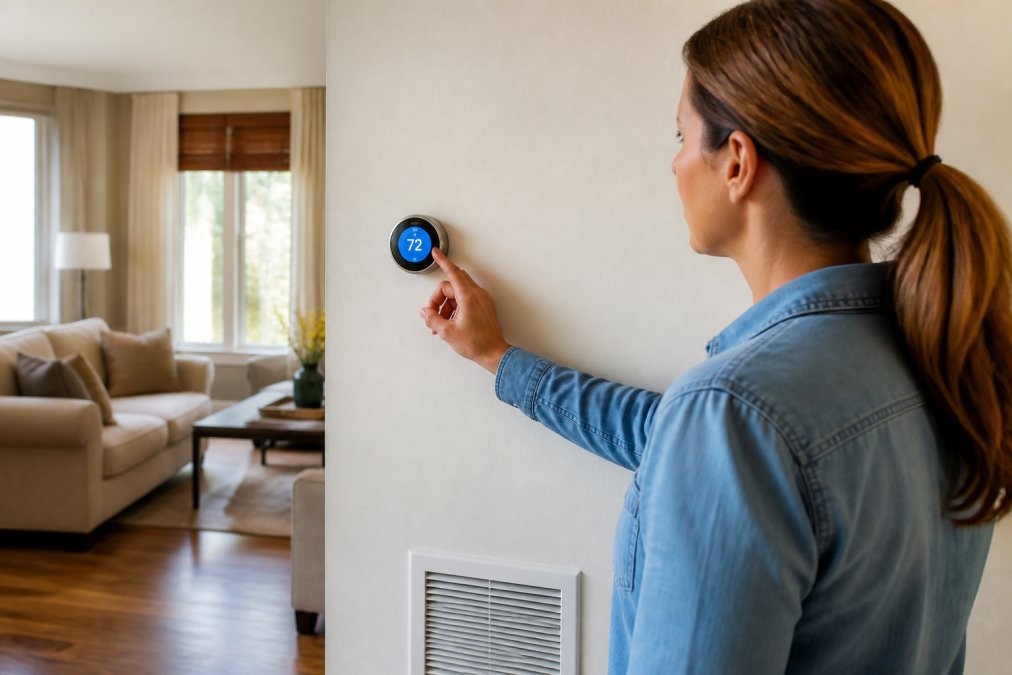
Thermostat Scheduling and Load Shifting
A smart thermostat is one of the most cost-effective single upgrades a homeowner can make. Load shifting means moving your heating or cooling activity away from peak demand hours when electricity costs more on variable-rate plans:
- Set back temperature by 7-10 degrees Fahrenheit during the 8 hours you’re at work or asleep
- Pre-condition the home 30 minutes before occupancy rather than running the system hard after you arrive
- Use geofencing features to avoid conditioning an empty house
HVAC Maintenance Tasks That Cut Kilowatt-Hour Consumption
A neglected HVAC system works harder to move the same amount of air, burning more kilowatt-hours for the same output:
- Replace air filters every 1-3 months depending on occupancy and pet presence
- Clear at least 18 inches of clearance around outdoor condenser units
- Schedule annual professional tune-ups before peak heating and cooling seasons
- Seal and insulate accessible ductwork in unconditioned spaces
Anthony & Son Indoor Air Quality, LLC’s certified technicians perform comprehensive HVAC maintenance covering all checkpoints.
Step 3: Seal Air Leaks and Upgrade Insulation
Most homeowners underestimate how much air leakage costs them. The collective gaps in a typical American home can add up to the equivalent of leaving a window open year-round.
Weather-Stripping, Caulking, and Thermal Envelope Basics
The thermal envelope is the boundary between conditioned interior space and the unconditioned outdoors. Every gap forces your HVAC system to compensate. The highest-priority sealing locations:
- Door frames and window frames: use V-strip weather-stripping for moving parts and paintable caulk for stationary gaps
- Attic hatch: add a foam gasket and insulated cover
- Penetrations for pipes, wires, and ducts: fire-rated caulk or foam
- Rim joists in the basement: a common overlooked source of significant heat loss
Insulation R-value measures thermal resistance. The EPA’s ENERGY STAR insulation recommendations specify target R-values by climate zone; homes in the Mid-Atlantic region typically need R-38 to R-60 in the attic to meet current standards. Many older homes fall well short.
Do not seal a home so tightly without addressing ventilation. Homes air-sealed without mechanical ventilation can develop indoor air quality problems including elevated CO2, moisture buildup, and VOC accumulation. Seal and ventilate together.
Step 4: Practical Energy Saving Tips for Every Room at Home
With the big systems addressed, room-by-room energy saving tips matter as a finishing layer.
Lighting: LED vs. CFL and Phantom Load Elimination
LED bulbs use a fraction of the energy of incandescent bulbs and last significantly longer than CFLs. For most households, a full LED conversion is a one-time project with a payback period measured in months.
Phantom load, also called standby power or vampire load, is the electricity drawn by devices plugged in but not actively in use. Common offenders include cable boxes, gaming consoles in standby mode, and chargers left plugged in without devices attached.
Smart power strips cut phantom load by cutting power to a group of devices when the primary device is off. For a home office setup, a smart strip on the monitor can cut power to speakers, external drives, and chargers automatically.
Water Heating and Cold Water Wash Habits
Water heating is the second or third largest energy expense in most homes. Two adjustments deliver outsized savings: lowering the water heater thermostat to 120 degrees Fahrenheit and switching laundry to cold water wash cycles. Most modern detergents work effectively in cold water, so this habit costs nothing in cleaning performance.
Step 5: Smart Home Devices for Energy Saving and Automation ROI
Smart home automation is where energy saving tips meet genuine return on investment. The barrier to entry has dropped considerably, and payback periods on well-chosen devices are shorter than most homeowners expect.
Which Smart Devices Deliver the Fastest Payback
| Smart Device | Primary Benefit | Best For |
|---|---|---|
| Smart thermostat | HVAC load shifting and scheduling | Homes with forced-air systems |
| Smart power strips | Phantom load elimination | Home offices, entertainment centers |
| Smart water heater controller | Off-peak heating scheduling | Homes on time-of-use rates |
| Smart plugs with energy monitoring | Identifying high-draw appliances | Diagnosing unknown consumption spikes |
| Occupancy sensors for lighting | Automatic shutoff in unused rooms | Households with variable occupancy patterns |
The smart thermostat delivers the fastest payback for most households because it directly controls the largest energy consumer. Smart water heater controllers are underrated: they can shift heating to off-peak hours automatically, reducing costs on time-of-use plans without behavioral change.
Step 6: Energy Efficiency Upgrades That Pay for Themselves
Some upgrades cost money upfront but return more than their cost over time through reduced utility bills. Prioritize those with the shortest payback periods and largest annual savings.
Government Rebates, Tax Credits, and Utility Rebate Programs
The federal government’s energy efficiency tax credit landscape changed significantly with the Inflation Reduction Act. According to IRS guidance on energy efficient home improvement credits, homeowners can claim a credit of up to 30 percent of the cost of qualifying improvements including insulation, air sealing, heat pumps, and central air conditioning, subject to annual caps.
Most utility providers offer their own rebate programs for qualifying equipment. These rebates stack with federal credits in most cases, meaningfully reducing the net cost of upgrades.
Before purchasing any energy efficiency upgrade, check the Database of State Incentives for Renewables and Efficiency for your state’s current programs. Federal credits and utility rebates combined can reduce the effective cost of major upgrades by 40 to 50 percent in many cases.
Renters-Specific Energy Hacks
Renters can’t change insulation or replace HVAC systems without landlord approval, but several high-impact options remain:
- Thermal curtains: Heavy, insulated curtains reduce heat gain in summer and heat loss in winter without permanent modification.
- Draft snakes and door sweeps: Removable and inexpensive; effective for drafty exterior doors.
- Smart plugs: Plug-in devices that eliminate phantom loads immediately.
- Request an energy audit: Many utilities offer free audits to renters and will install low-cost measures at no charge.
- Negotiate with your landlord: If you can show that an upgrade reduces costs, many landlords will approve or fund it.
Step 7: Analyze Your Utility Bill and Shop Electricity Suppliers
Most people glance at the total and pay it. A detailed utility bill analysis reveals your rate structure, whether you’re eligible for a better one, and whether your consumption patterns align with how you’re being charged.
Understanding Time-of-Use Rates vs. Fixed-Supply Rates
A fixed-supply rate charges the same price per kilowatt-hour regardless of when you use electricity. A time-of-use rate charges different prices depending on the time of day and season, with higher rates during peak demand hours and lower rates during off-peak periods.
For households that can shift dishwasher cycles, laundry, and EV charging to evenings and weekends, time-of-use rates often produce meaningful savings. In deregulated electricity markets like Maryland, DC, and Virginia, you can shop electricity suppliers and compare variable rate versus fixed-rate supply contracts. Shopping suppliers takes about 15 minutes and can reduce the supply portion of your bill without changing how you use energy.
Step 8: Use Behavioral Psychology to Sustain Lower Energy Bills
The research on habit formation is clear: feedback loops are the most reliable mechanism for sustaining behavior change. When you can see your energy consumption in near-real-time through a smart thermostat display, utility app, or smart plug’s energy monitoring feature, the feedback reinforces the behavior.
Three behavioral strategies that work in practice:
- Set a specific kilowatt-hour target, not a dollar target. Kilowatt-hour consumption is directly in your control; the dollar amount is also affected by rate changes outside your control.
- Automate as much as possible. Every saving that requires a daily decision will eventually fail. Smart thermostats, smart strips, and scheduled appliance timers remove the decision entirely.
- Review bills as a household. Households where multiple people are aware of the consumption target consistently outperform those where only one person is engaged.
According to ENERGY STAR’s behavior-based energy savings research, homes that combine physical upgrades with behavioral programs achieve significantly greater savings than those that rely on either approach alone.
High energy bills are rarely the result of one problem. They’re the cumulative result of an aging thermal envelope, an under-maintained HVAC system, and habits formed before efficiency was a priority. Anthony & Son Indoor Air Quality, LLC helps homeowners and property managers across Maryland, DC, and Northern Virginia address the HVAC side of that equation with licensed, certified technicians, honest assessments, and no-pressure recommendations. Contact us today for a professional evaluation and a clear path toward better efficiency and lower costs.
Frequently Asked Questions
What uses the most electricity in a typical home?
Heating and cooling systems generally account for the largest share of home energy consumption, making HVAC efficiency the highest-leverage place to start. Water heaters, clothes dryers, and refrigerators are also significant contributors. Running a home energy audit helps you identify your specific biggest draws so you can prioritize the changes that will reduce energy bills the most for your household.
Do smart home devices really save energy?
Yes, when used correctly. Smart thermostats are among the most cost-effective smart home devices for energy saving because they automatically adjust heating and cooling based on your schedule, reducing kilowatt-hour consumption during unoccupied hours. Smart power strips eliminate standby power from vampire appliances. The key is configuring these devices properly, a smart thermostat left on default settings delivers far less savings than one with a personalized schedule.
What government programs help with energy efficiency upgrades in the US?
The Inflation Reduction Act (IRA) provides federal tax credits for qualifying energy efficiency upgrades, including heat pumps, insulation, and energy-efficient windows. The ENERGY STAR program also partners with many state and local utility providers to offer utility rebates on qualifying appliances and HVAC equipment. The Database of State Incentives for Renewables & Efficiency (DSIRE) at dsireusa.org lists all available programs by state, including Maryland, Virginia, and DC.
How can renters reduce high energy bills without making permanent changes?
Renters have more options than most people realize. Portable smart plugs eliminate phantom load from vampire appliances without any installation. Draft stoppers and removable weather-stripping seal air leaks under doors without damaging surfaces. Switching to LED bulbs is renter-friendly and instantly reduces lighting energy consumption. Washing laundry in cold water and running full dishwasher loads also cuts energy use with zero modifications to the property.
How can I reduce my energy bill in the summer months?
In summer, HVAC efficiency is the biggest lever. Set your smart thermostat a few degrees higher when you're away and use ceiling fans to create a wind-chill effect so you feel cooler at a higher thermostat setting. Close blinds on south- and west-facing windows during peak heat hours to reduce solar gain. If your utility provider offers time-of-use rates, shift energy-heavy tasks like laundry and dishwashing to off-peak hours to lower your overall utility bill.
This article was written using GrandRanker