
Table of Contents
- Why Some Rooms Stay Hot While Others Freeze
- Step 1: Check and Adjust Air Dampers in Your Ductwork
- Step 2: How to Balance Air Vents in Your House
- Step 3: Inspect and Clean Your Air Ducts for Leaks
- Step 4: Switch Your HVAC Fan from Auto to On
- Step 5: Use Window Treatments and Insulation to Control Heat Gain
- Step 6: Install a Smart Thermostat with Room Sensors
- Step 7: Consider an HVAC Zoning System to Solve Temperature Problems Permanently
Last Updated: August 5, 2026
Why Some Rooms Stay Hot While Others Freeze
Uneven room temperatures are one of the most common complaints homeowners bring to us at Anthony & Son Indoor Air Quality, LLC. You set your thermostat to 72 degrees, but the master bedroom feels like a sauna while the guest room stays perpetually cold. This results from how most HVAC systems distribute air through a single ductwork network with limited ability to adjust airflow to each room.
Poor ductwork design, leaks, blocked vents, and hot air’s natural tendency to rise create significant temperature differentials. When you close vents in uncomfortable rooms, you force more air into remaining open vents, worsening imbalances and driving up energy bills. The good news: most uneven room temperature problems can be solved with straightforward adjustments that don’t require replacing your entire HVAC system.
Below are seven practical steps to diagnose and fix uneven room temperatures. Some involve simple adjustments you can make today; others require professional help.
Step 1: Check and Adjust Air Dampers in Your Ductwork
Air dampers are metal flaps inside your ductwork that control how much conditioned air flows to different zones. Many homeowners don’t know they exist, yet they’re one of the fastest ways to rebalance air circulation.
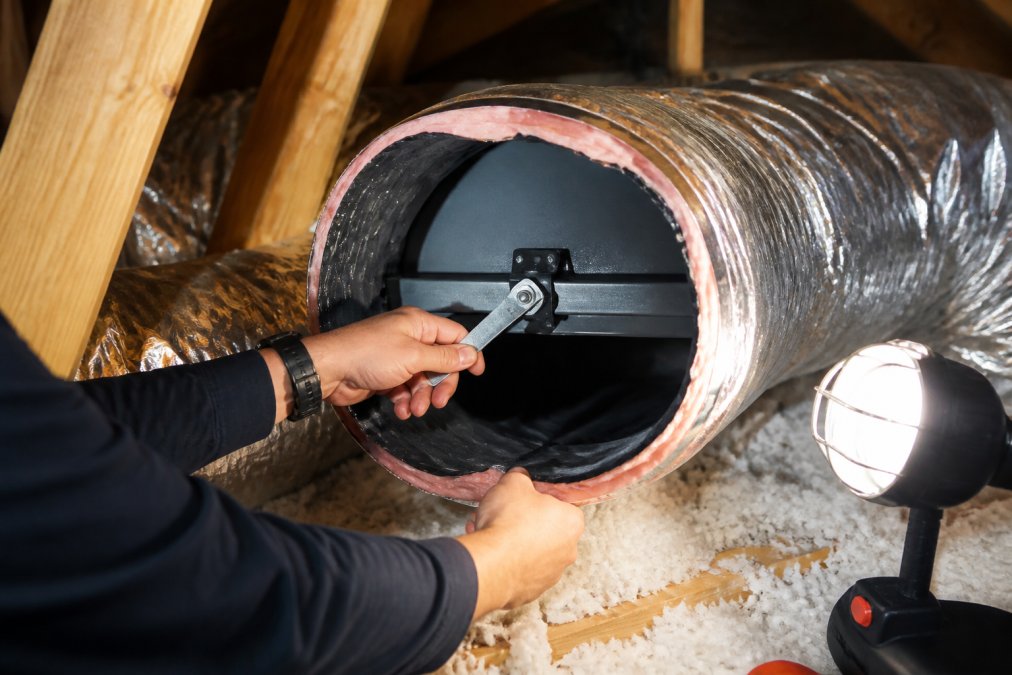
If you have an unfinished basement, attic, or crawlspace, you can locate your ductwork and inspect dampers yourself. Look for small levers or handles attached to the ducts. A damper pointing along the duct direction means it’s fully open; perpendicular means it’s closed or partially closed.
Identify which rooms run too hot and which run too cold. Close dampers partially on ducts feeding hot rooms and open dampers fully on ducts feeding cold rooms. Make small adjustments, don’t fully close any damper, and wait 24 hours to see how temperatures stabilize.
If your home has sealed ductwork in walls or attics you can’t access, you’ll need professional help. A licensed HVAC technician from Anthony & Son Indoor Air Quality, LLC can locate your dampers, adjust them properly, and ensure balanced air circulation throughout your home.
Step 2: How to Balance Air Vents in Your House
Balancing air vents is something every homeowner can do right now. Supply registers (where air comes out) and return air vents (where air gets pulled back) have adjustable dampers built directly into them.
Walk through your home and locate all supply registers. Fully open registers in rooms that feel too cold. Partially close registers in rooms that feel too hot. Avoid fully closing any register, as this restricts airflow and creates static pressure problems.
Pay special attention to return air vents, typically larger and located on walls or in hallways. Make sure all return vents have at least 12 inches of clear space around them.
A common mistake is closing vents completely in unused rooms. This increases static pressure in your ductwork, forcing air out through other vents and potentially damaging your blower motor. Instead, keep all vents at least partially open.
Step 3: Inspect and Clean Your Air Ducts for Leaks
Leaky ductwork causes significant air loss in many homes. If supply ducts leak, conditioned air escapes into unconditioned spaces instead of reaching your rooms, directly causing uneven temperatures.
Visually inspect accessible ductwork in your attic, basement, or crawlspace. Look for visible gaps, disconnected sections, or obvious damage. Flex ducts are especially prone to developing tears and holes.
For minor leaks, duct tape provides temporary sealing, though professional-grade duct sealant works better. For larger gaps or disconnected ducts, professional help is necessary. A technician can use specialized equipment to identify leaks you can’t see and seal them properly.
Over time, dust and debris accumulate inside ducts, restricting airflow and contributing to uneven temperatures. If you notice dust around supply vents or musty smells, ductwork cleaning may be warranted. Anthony & Son Indoor Air Quality, LLC offers professional duct inspection and cleaning services that identify leaks and restore airflow.
Step 4: Switch Your HVAC Fan from Auto to On
Your thermostat’s fan setting has two options: Auto and On. Auto means the blower runs only during active heating or cooling. On means the blower runs continuously.
When your fan is set to Auto, it cycles on and off throughout the day. During off cycles, air stops moving through your ducts. Hot air naturally rises, so upstairs rooms get hotter and downstairs rooms get cooler. Switching the fan to On keeps air in motion and distributes heat and cold more evenly.
The trade-off is energy consumption. Running your fan continuously uses more electricity than running it only during heating and cooling cycles. However, many homeowners find the comfort improvement justifies the modest increase in energy costs.
Some thermostats have a "circulate" setting, which runs the fan for short intervals throughout the day without actually heating or cooling. This middle-ground option improves circulation without running the fan constantly.
Step 5: Use Window Treatments and Insulation to Control Heat Gain
Thermal stratification, hot air rising and cold air sinking, creates natural temperature differences between upper and lower floors. You can’t eliminate this physics, but you can reduce its impact by controlling heat gain and loss through windows and exterior walls.
Windows are a major source of unwanted heat gain in summer and heat loss in winter. Direct sunlight through south-facing windows can heat a room by 10-15 degrees above the rest of your home.
Install thermal curtains or cellular shades in rooms that experience extreme temperatures. Thermal curtains have reflective backing that blocks solar gain in summer and traps warm air in winter. Close them during the hottest parts of the day in summer and open them during the day in winter.
Check weatherstripping around windows and exterior doors. Gaps allow conditioned air to escape and outdoor air to infiltrate. Replacing worn weatherstripping is inexpensive and noticeably improves room temperature balance.
Inadequate insulation in your attic, walls, and basement means your system works harder to maintain consistent temperatures. If your home was built before the 1990s, your insulation levels may be below current standards. A professional energy audit can identify insulation gaps and recommend upgrades.
Step 6: Install a Smart Thermostat with Room Sensors
Smart thermostats with remote room sensors represent a significant upgrade in temperature control. Unlike traditional thermostats that measure temperature in one location, smart systems with multiple sensors detect temperatures in different rooms and adjust your HVAC system accordingly.
You place wireless sensors in rooms that typically run too hot or too cold. The smart thermostat collects this data and adjusts when your system cycles on and off. If your upstairs is running hot, the system reduces heating or increases cooling.
Smart thermostats also offer scheduling, remote control via smartphone, and integration with other smart home devices. Many homeowners report improved comfort and modest energy savings after switching.
For homes with significant room-to-room temperature variations, this is often a more practical solution than installing a full zoning system.
Step 7: Consider an HVAC Zoning System to Solve Temperature Problems Permanently
If the adjustments above don’t fully resolve your uneven room temperature problems, an HVAC zoning system offers a permanent solution. Zoning divides your home into separate temperature zones, each with its own thermostat and dampers controlled by your HVAC system.
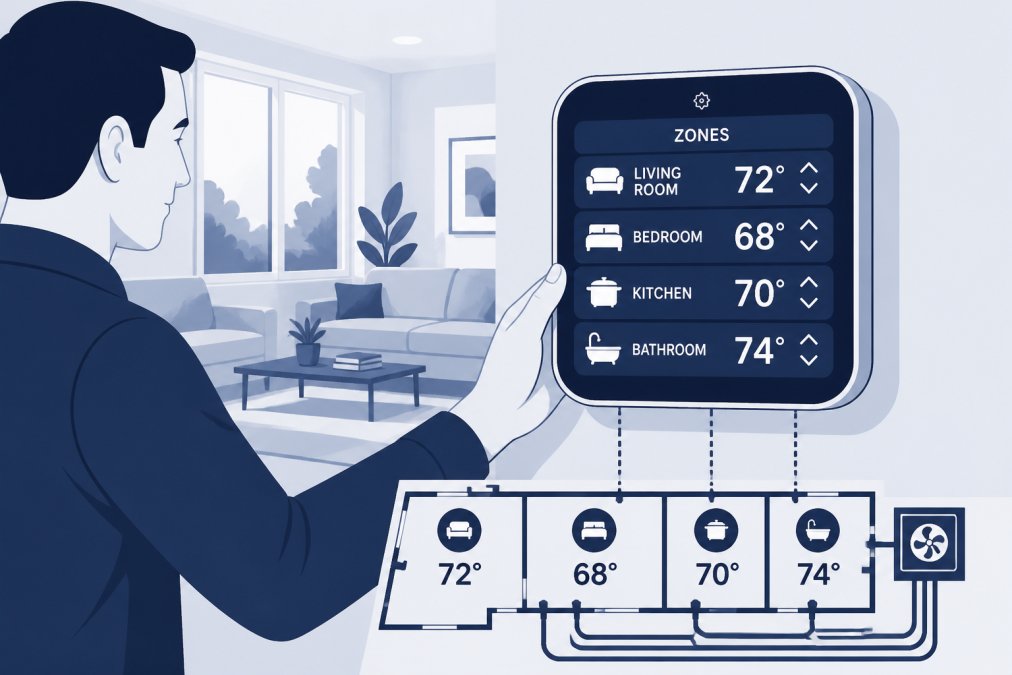
A typical zoning system retrofits your existing ductwork with motorized dampers and a control panel that manages airflow to each zone independently. You might create zones like "master bedroom," "guest bedrooms," "living areas," and "basement." Each zone has its own sensor and can be set to a different temperature.
Zoning systems work particularly well in multi-story homes where natural temperature differences between floors are significant. They also benefit homes with large open spaces, significant solar gain on certain sides, or where family members prefer different temperatures.
Installation requires professional HVAC work. A technician evaluates your ductwork, determines the best zone configuration, installs motorized dampers, runs sensor wiring, and programs the control panel. Your HVAC system actively manages temperature differences rather than you manually adjusting vents and dampers. The system runs more efficiently and energy bills typically decrease.
At Anthony & Son Indoor Air Quality, LLC, we design and install custom zoning systems tailored to your home’s specific layout and your family’s comfort needs. Our certified technicians evaluate your current HVAC system, identify the best zoning approach, and handle complete installation with minimal disruption.
| Solution | Best For | Difficulty | Cost Impact |
|---|---|---|---|
| Air damper adjustment | Quick rebalancing without equipment | Very Easy | None |
| Vent register balancing | Immediate temperature control | Very Easy | None |
| Duct leak repair | Restoring lost airflow | Moderate | Professional service needed |
| Fan setting change | Improving circulation | Very Easy | Small increase in electricity |
| Window treatments | Reducing heat gain/loss | Easy | Moderate one-time cost |
| Smart thermostat | Better temperature control with sensors | Moderate | Moderate equipment cost |
| Zoning system | Permanent multi-zone control | Complex | Significant installation cost |
Getting Professional Help When You Need It
Some solutions you can implement immediately: adjusting dampers and vents, changing your fan setting, and installing window treatments require no special equipment or expertise. However, diagnosing ductwork leaks, determining whether your system needs zoning, and designing a custom zoning solution requires professional evaluation.
If you’ve tried basic adjustments and uneven room temperatures persist, professional help becomes worthwhile. A licensed HVAC technician can perform a complete system evaluation, identify the root causes of your specific temperature problems, and recommend the most cost-effective solution.
Uneven room temperatures don’t have to be a permanent frustration. Whether your solution is as simple as adjusting vents or as comprehensive as installing a zoning system, the goal is consistent comfort throughout your home. Contact Anthony & Son Indoor Air Quality, LLC today for a professional evaluation of your HVAC system. Our certified technicians will diagnose your temperature problems, explain your options, and help you choose the solution that delivers the comfort and efficiency your home deserves.
Frequently Asked Questions
Why is one room in my house always hotter than the others?
Uneven room temperatures usually result from air circulation problems within your HVAC system. Common causes include closed or restricted supply registers, blocked return air vents, leaky ductwork, or air dampers set unevenly across zones. Rooms farther from the furnace or air handler often receive less conditioned air. Additionally, solar gain through windows, poor insulation, or an undersized HVAC system can create hot spots. A professional HVAC technician can diagnose whether your issue stems from ductwork leakage, balancing problems, or system limitations.
Can a dirty air filter cause uneven temperatures?
Yes, a clogged air filter restricts airflow through your HVAC system, reducing the blower motor's ability to distribute conditioned air evenly to all rooms. This creates cold spots in distant rooms and hot spots near the furnace or air handler. Check your air filter monthly and replace it every 1-3 months, depending on household dust levels and pet hair. A clean filter maintains consistent air circulation and helps prevent thermal stratification where hot air settles at the ceiling while cold air pools at floor level.
How do I know if my HVAC ductwork has leaks?
Signs of ductwork leakage include rooms that won't reach the set temperature, hissing sounds near ducts, visible dust around duct seams, and higher energy bills. To check for leaks, inspect accessible ducts in the basement, attic, or crawl space for gaps, holes, or disconnected sections. Professional HVAC technicians use pressure testing equipment to measure static pressure and pinpoint leaks you can't see. Sealing leaks with mastic sealant or metal tape restores airflow and improves temperature balance throughout your home.
What is the average cost of an HVAC zoning system?
HVAC zoning system costs vary based on your home's size, ductwork layout, and the number of zones you want to create. Retrofit zoning systems, which add dampers and a new thermostat to your existing HVAC system, typically require professional installation. For exact pricing and a customized quote for your home's specific needs, contact Anthony & Son Indoor Air Quality, LLC. Our licensed technicians will assess your current system and provide transparent pricing for zoning installation that fits your budget.
This article was written using GrandRanker