
Table of Contents
- Why Your HVAC System Needs a Whole House Air Purifier
- Whole House Air Purifiers vs. Portable Units: What Changes
- MERV Rating Explained for Residential HVAC
- The Real Impact on Allergies, Asthma, and Airborne Contaminants
- Installation, Static Pressure, and Smart Thermostat Compatibility
- How Often to Change HVAC Air Purifier Filters
- How Long Does Indoor Air Quality Testing Take?
- Is a Whole House Air Purifier Worth the Investment?
- Frequently Asked Questions
Last Updated: September 8, 2026
Why Your HVAC System Needs a Whole House Air Purifier
Most homeowners treat air quality as a portable appliance problem, buying standalone units room by room. That approach misses where the air actually moves. A whole house air purifier integrates directly with your forced-air system, treating every room through the same ductwork that delivers heating and cooling. We explain how this integration changes the math on indoor air quality.
The core advantage is reach. A portable unit cleans roughly one room. A whole house air purifier cleans the entire living space because your HVAC blower already circulates air continuously. The EPA notes that indoor air can contain pollutant levels several times higher than outdoor air, making whole-home treatment a practical upgrade rather than a luxury EPA indoor air quality guidance.
The 6 key benefits we cover below range from filtration efficiency to long-term cost. The strategies outlined can help homeowners reduce visible dust and seasonal allergy triggers, and the real value is consistency: the system works whether you remember to turn it on or not.
Whole House Air Purifiers vs. Portable Units: What Changes
Portable purifiers serve a purpose, but they solve a single-room problem. Whole house air purifiers address the entire home in three distinct ways: coverage, maintenance burden, and noise footprint.
| Feature | Portable Unit | Whole House Air Purifier |
|---|---|---|
| Coverage | Single room | Entire home via ductwork |
| Filter changes | Per unit, multiple rooms | One central location |
| Noise | Audible in living space | Located in HVAC system |
| Air exchange | Localized | Continuous circulation |
A portable unit in the bedroom does nothing for the kitchen or the home office. Whole-home systems treat all zones because the blower motor moves air through the filter whenever the system runs. For allergy relief, this means consistent particulate removal across every room, not just where you spend the most time.
MERV Rating Explained for Residential HVAC
The Minimum Efficiency Reporting Value, or MERV rating, is the industry standard for measuring a filter’s ability to capture particles between 0.3 and 10 microns. Residential systems typically use filters rated between MERV 8 and MERV 13, but the real-world performance depends on a factor most guides ignore: your blower motor’s capacity.
A MERV 8 filter captures particles larger than 3 microns, which includes most visible dust and pollen. A MERV 13 filter captures particles down to 0.3 microns, including mold spores, bacteria, and smoke (ashrae.org). The trade-off is airflow resistance, measured as static pressure. A higher-rated filter is denser, which increases static pressure and forces the blower motor to work harder to push air through the ductwork.
Here is where system compatibility becomes critical. Most residential blower motors are designed for a maximum static pressure of 0.5 inches of water column (in. w.c.) (energy.gov). A standard MERV 8 filter adds roughly 0.1 in. w.c. of resistance. A MERV 13 filter can add 0.3 to 0.4 in. w.c., and a MERV 16 or HEPA-rated filter can push resistance past 1.0 in. w.c., well beyond what a standard PSC (permanently split capacitor) motor can handle.
Upgrading to a MERV 16 or HEPA filter in a standard residential unit without verifying blower motor capacity often restricts airflow by 30% to 50%. The increased static pressure reduces system efficiency, can cause the evaporator coil to freeze in summer, and may lead to premature blower motor failure. Check your HVAC manufacturer’s specifications for the maximum recommended MERV rating before upgrading.
If you need higher filtration than your system can handle, you have three options:
- Use a MERV 13 filter with a fan circulation schedule. Run the blower on a timed cycle (e.g., 20 minutes per hour) to increase air changes per hour without overworking the motor.
- Install a media filter cabinet. This is a larger housing that holds a thicker filter (4 to 5 inches) with more surface area, which reduces resistance compared to a standard 1-inch filter of the same MERV rating.
- Upgrade to an ECM (electronically commutated motor). These variable-speed motors adjust their output to maintain consistent airflow even with higher-resistance filters, making them the only safe choice for MERV 16 or HEPA filtration in a residential system.
Consult the manufacturer’s documentation or a certified technician to measure static pressure before and after any filter upgrade. The goal is not to buy the most restrictive filter available, it is to match filtration efficiency to what your blower motor can actually deliver without sacrificing airflow or equipment life.
The Real Impact on Allergies, Asthma, and Airborne Contaminants
Whole-home filtration directly targets the airborne contaminants that trigger respiratory symptoms. Pollen, pet dander, dust mites, and mold spores all circulate through ductwork and settle into furniture and airways.
For asthma management, continuous filtration matters more than occasional treatment. Running the HVAC fan regularly, even between heating and cooling cycles, keeps air moving through the filter. This continuous circulation reduces the concentration of volatile organic compounds (VOCs) from cleaning products and furnishings, though carbon filtration is needed for effective VOC removal.
A common mistake is assuming one technology handles everything. Electrostatic precipitators capture particles but produce ozone. UV light purification kills biological contaminants but does nothing for dust. Most homeowners benefit from a layered approach: a high-MERV filter for particulates, plus targeted technology for specific concerns like VOCs or mold.
Installation, Static Pressure, and Smart Thermostat Compatibility
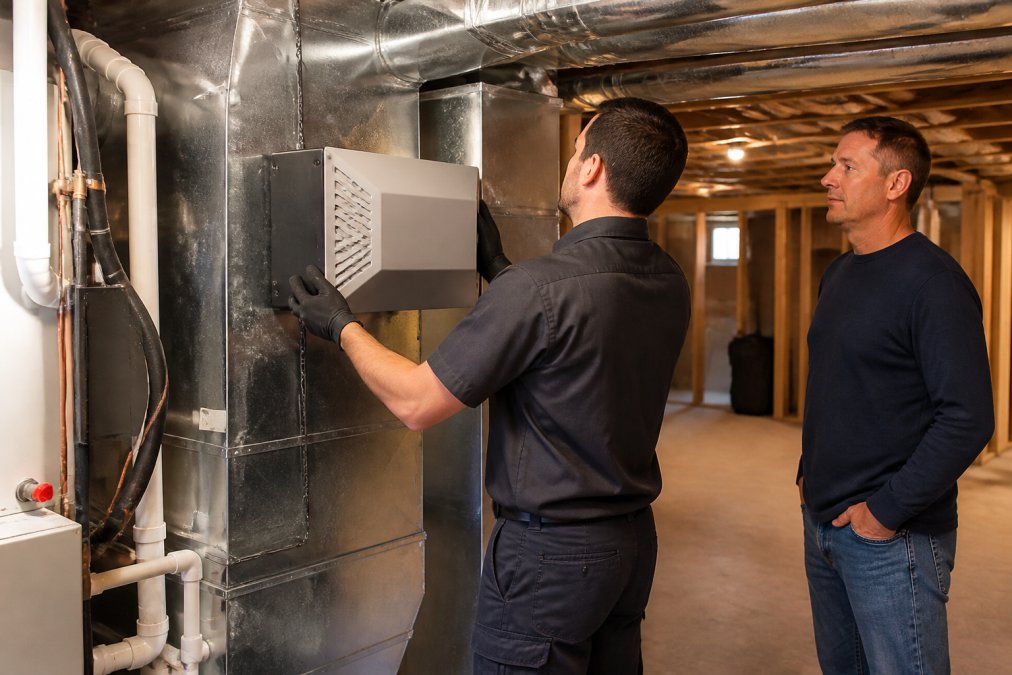
Proper installation requires more than mounting a filter housing. The technician must measure static pressure before and after installation to confirm the system still moves adequate air. An oversized or overly restrictive filter creates resistance that reduces airflow and increases energy consumption.
Smart thermostat compatibility is an overlooked advantage. Most modern thermostats include a fan circulation setting that runs the blower periodically without heating or cooling. This feature maximizes the air purifier’s effectiveness by moving air through the filter on a schedule, not just when the temperature demands it.
For older homes, ductwork condition matters. Leaky or undersized ducts undermine the best filtration equipment because unfiltered air bypasses the system. A professional assessment should include a ductwork check before committing to an upgrade.
How Often to Change HVAC Air Purifier Filters
Filter replacement frequency depends on three factors: the MERV rating, the number of occupants, and the presence of pets. A general rule is every three months, but homes with shedding pets or high pollen exposure may need monthly changes. preventing home dust.
Signs a filter needs replacement include visible dust accumulation, reduced airflow from vents, and rising energy bills. A clogged filter forces the blower motor to work harder, increasing energy consumption and shortening equipment life.
Set a calendar reminder for the same day each season. Aligning filter changes with the start of winter and summer cooling seasons ensures the system runs clean when demand peaks. Check the filter monthly during high-pollen spring months.
How Long Does Indoor Air Quality Testing Take?
Indoor air quality testing typically takes one to two hours for a standard residential assessment. The technician places monitoring equipment in key living areas to measure particulate levels, humidity, and VOC concentrations.
Baseline testing answers a specific question: what is actually in your air? This data guides the right solution rather than guessing. Testing results can reveal whether your primary problem is fine particulates, biological growth, or chemical off-gassing, each requiring a different filtration strategy.
The test results provide a measurable starting point. After installing a whole-home system, a follow-up test confirms the equipment is performing as expected.
Is a Whole House Air Purifier Worth the Investment?
The value calculation goes beyond the purchase price. To answer this honestly, you need a long-term ROI breakdown that accounts for equipment, filter replacement, energy consumption, and health-related savings. Here is how the math typically plays out for a 2,500-square-foot home.
Equipment and installation. Pricing for a professionally installed whole-house air purifier (media filter cabinet or electronic unit) depends on the specific unit and installation requirements. This is a one-time cost that replaces the need for multiple portable units.
Filter replacement costs. Filter replacement costs vary depending on the MERV rating and filter type. For comparison, covering a 2,500-square-foot home with three portable HEPA purifiers requires filter replacements, plus the upfront cost for the units themselves.
Energy consumption. A whole-house system uses the existing HVAC blower, which draws 300 to 500 watts when running. If you run the fan 20 minutes per hour (8 hours per day), the additional energy cost is roughly $5 to $15 per month, depending on your electricity rate. Portable HEPA purifiers draw 50 to 100 watts each; three units running continuously cost $10 to $25 per month. The whole-house system is typically more energy-efficient because it moves more air per watt.
HVAC protection. Cleaner air means less dust accumulation on the blower motor, evaporator coil, and ductwork. A dirty evaporator coil can reduce system efficiency by up to 30%, which translates to higher cooling costs. Annual coil cleaning costs $150 to $300 if you hire a professional. Preventing that buildup alone can offset a significant portion of the purifier’s cost over a 5-year period.
Health-related savings. For households with allergies or asthma, reduced particulate exposure can mean fewer doctor visits and less reliance on over-the-counter antihistamines. While individual results vary, the EPA and the American Lung Association both recognize that reducing indoor particulate matter improves respiratory health outcomes. Reduced particulate exposure can lead to potential savings in medication and symptom-related costs for a household with an allergy sufferer.
The 5-year total cost comparison:
| Cost Category | Portable Units (3) | Whole-House System |
|---|---|---|
| Upfront equipment | $500 – $1,500 | $800 – $2,500 |
| Annual filters | $150 – $300 | $40 – $160 |
| Annual energy | $120 – $300 | $60 – $180 |
| 5-year total | $1,850 – $4,500 | $1,300 – $4,200 |
The whole-house system is not always cheaper upfront, but it breaks even within 2 to 4 years in most scenarios, and it delivers consistent filtration across every room, not just the ones where you place a portable unit.
The strongest financial case for a whole-house air purifier comes from households with allergies, asthma, or pets, where health-related savings and reduced HVAC maintenance costs accelerate the payback period. For homes with older ductwork, factor in a professional duct sealing or repair cost before installation, which can extend the payback timeline but still delivers proportionally greater air quality improvements.
The decision ultimately comes down to how much you value consistent indoor air quality across your entire home. Run the numbers for your specific square footage, electricity rate, and filter replacement schedule, the math will tell you whether the investment makes sense for your household.
Frequently Asked Questions
Is an air purifier attached to the HVAC worth it?
Yes, for most homeowners. A whole house air purifier treats the air in every room using your existing ductwork, unlike a portable unit that only cleans one space. It continuously filters airborne contaminants like pollen, pet dander, and mold spores whenever your system runs. The main advantages are whole-home coverage and quiet operation since the equipment sits in your HVAC system. The value depends on your indoor air quality concerns, your system’s compatibility, and whether you choose to install it yourself or hire a licensed HVAC professional.
How does a whole house air purifier differ from a standard HVAC filter?
A standard HVAC filter primarily protects your equipment from large debris. A whole house air purifier actively targets the smaller particles that affect indoor air quality, such as particulate matter, VOCs, and airborne pathogens. Many units use technologies like electrostatic precipitation or carbon filtration in addition to high-efficiency media. The result is a significantly higher filtration efficiency, often capturing particles that a standard one-inch filter would let pass through. The MERV rating explained for residential HVAC systems usually tops out around 13 for standard filters, while dedicated purifiers can perform better.
How do I know if my current HVAC system is compatible with an air purifier?
Compatibility depends on your system type, ductwork size, and available space near the blower motor. For example, a 4-inch media cabinet can usually accommodate a high-MERV filter, while a 1-inch slot may limit your options. You should also check the static pressure of your system; a high-efficiency purifier can restrict airflow if the ductwork is undersized. A licensed HVAC technician can assess your setup, measure static pressure, and recommend the right unit. This assessment is often part of a broader indoor air quality testing process.
Can a whole house air purifier help with seasonal allergies?
Yes, it can reduce the triggers that cause seasonal allergy symptoms. A whole house air purifier filters out pollen, pet dander, and mold spores before you breathe them in. Because it integrates with your HVAC system, it provides continuous circulation and filtration throughout your entire home, not just one room. This makes it a more effective solution for allergy relief than running several portable units. For best results, pair the purifier with a MERV 13 or higher filter and maintain the recommended filter replacement schedule.