
Table of Contents
- 24/7 HVAC Repair Maryland: What to Expect When You Call
- Signs You Need Emergency HVAC Repair Services in Maryland
- HVAC Troubleshooting Emergency Maryland: DIY Checklist Before the Tech Arrives
- Common HVAC System Failures and What Causes Them
- Emergency AC Repair Maryland: Residential and Commercial HVAC Repair
- HVAC Emergency Cost Maryland: What Affects Your Bill
- HVAC Safety Protocols and Seasonal Preparation Every Maryland Homeowner Should Know
- Why Choose Anthony & Son for Emergency HVAC Repair in Maryland
Last Updated: August 1, 2026
Maryland homeowners know the feeling: it’s 11 p.m. in January, the furnace has gone silent, and the temperature inside is dropping fast. Finding reliable emergency hvac repair services maryland at that hour is a safety issue. At Anthony & Son Indoor Air Quality, LLC, we’ve responded to hundreds of these calls across Maryland, DC, and Northern Virginia. Below, we’ll walk you through what to expect when you call, how to spot a genuine emergency, and what you can do before the technician arrives.
24/7 HVAC Repair Maryland: What to Expect When You Call
Emergency HVAC repair is the rapid diagnosis and restoration of a heating or cooling system that has failed outside normal business hours or poses an immediate safety or comfort risk.
Here’s what a professional response typically looks like:
- Live answer or immediate callback, A qualified dispatcher takes your call, gathers system details, and confirms your location.
- Technician dispatch, A licensed technician with a fully stocked service vehicle is routed to your address.
- On-site HVAC diagnostics, The tech performs a full inspection: checking electrical connections, thermostat calibration, refrigerant levels, airflow, and safety controls.
- Transparent repair estimate, Before any work begins, you receive a clear explanation of the issue and cost. No surprise bills.
- Repair or temporary stabilization, Most failures are resolved in a single visit. If a part must be ordered, the technician stabilizes the system and schedules a return.
Response time varies dramatically based on actual service area coverage. Verify service area before a crisis hits.
Keep your HVAC model number, filter size, and last service date written near the unit. Dispatchers can pre-stage parts before arrival, cutting repair time significantly.
Signs You Need Emergency HVAC Repair Services in Maryland
Not every HVAC issue warrants an after-hours call, but some absolutely do. Misreading the situation costs you in unnecessary fees or real property damage and health risk.
Heating System Warning Signs
Aheating emergency is not just "the house feels cold." Watch for these specific signals:
- No heat at all with outdoor temperatures below 32°F, Maryland winters regularly dip well below freezing, and interior temperatures can drop to dangerous levels within hours.
- Gas odor near the furnace, Evacuate the home and call your gas utility and emergency services first, then your HVAC technician.
- Carbon monoxide alarm activation, A cracked heat exchanger can release CO without visible sign. Treat this as a life-safety emergency.
- Furnace cycling on and off every few minutes, Short cycling indicates a pressure, sensor, or overheating problem that will worsen rapidly.
- Banging, screeching, or grinding from the furnace, These sounds typically signal a failing blower motor, loose component, or ignition issue.
According to U.S. Consumer Product Safety Commission guidance on carbon monoxide safety, CO poisoning sends thousands of Americans to emergency rooms each year, with faulty heating equipment among the leading causes.
Cooling System Warning Signs
Summer emergencies are equally serious. Maryland’s humid summers make a failed air conditioning system a health hazard for elderly residents, infants, and anyone with respiratory conditions.
- Complete loss of cooling during a heat advisory, Maryland summers regularly produce heat indices above 100°F. A failed system is a medical risk.
- Ice forming on the indoor coil or refrigerant lines, Indicates a refrigerant leak or severely restricted airflow. Running the system can destroy the compressor.
- Electrical burning smell from the air handler, Shut the system off at the breaker immediately and call for emergency service.
- Water actively pooling around the indoor unit, A blocked condensate drain can flood a utility room in hours.
HVAC Troubleshooting Emergency Maryland: DIY Checklist Before the Tech Arrives
A common mistake is assuming there’s nothing you can do before the technician arrives. A few quick checks often resolve the issue or provide critical diagnostic information.
Work through this checklist systematically:
- Check the thermostat, Confirm it’s set to the correct mode and that the temperature setpoint is above (for heat) or below (for cool) the current room temperature. Replace batteries if the display is dim.
- Inspect the circuit breaker, Check whether the breaker for the air handler or furnace has tripped. Reset it once. If it trips again immediately, stop and call for service.
- Check the filter, A clogged air filter is one of the most common causes of HVAC shutdowns. If visibly gray or blocked, replace it before the tech arrives.
- Verify the condensate drain line, On cooling systems, locate the white PVC drain line near the air handler. Clearing a clog may restore operation.
- Check the outdoor unit, Confirm the condenser is not buried under snow, ice, or debris.
- Confirm gas supply, If you have a gas furnace, verify the gas shutoff valve is in the open position.
- Check the power switch, HVAC air handlers have a dedicated power switch that gets switched off accidentally more often than you’d think.
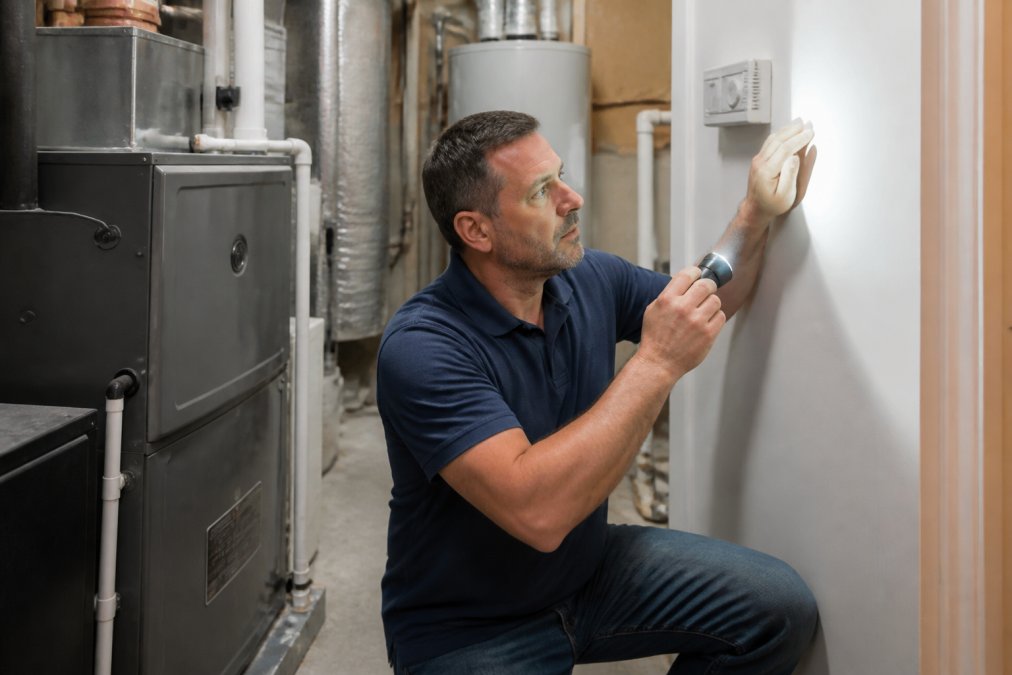
Never reset a tripped breaker more than once. A breaker that trips repeatedly is protecting you from an electrical fault. Forcing it back on can cause an electrical fire or destroy expensive HVAC components.
Common HVAC System Failures and What Causes Them
Understanding why systems fail helps you make smarter decisions when a technician presents repair options.
Furnace and Heat Pump Diagnostics
Furnace failures typically trace back to a handful of root causes:
- Ignition failure, Hot surface igniters are consumable components with a finite lifespan.
- Pressure switch failure, These safety switches confirm proper draft before allowing ignition. A failed inducer motor or blocked flue pipe triggers lockout.
- Flame sensor fouling, A dirty flame sensor causes the furnace to light briefly, then shut off. Cleaning or replacing the sensor is straightforward.
Heat pump service calls often involve reversing valve failure, defrost board malfunctions, and low refrigerant charge from slow leaks. Heat pump diagnostics require understanding the refrigeration cycle in both directions. A technician who primarily services gas furnaces may misdiagnose a heat pump in heating mode.
Compressor Failure and Refrigerant Leaks
Compressor failure is the most expensive single-component failure in a cooling system. It typically results from loss of lubrication due to refrigerant leaks, electrical failure from power surges, or overheating from restricted airflow.
A refrigerant leak, left unaddressed, almost always leads to compressor failure. The refrigerant carries lubricating oil through the system; as charge drops, oil circulation decreases, and the compressor runs dry.
As documented in EPA guidance on refrigerant regulations and Section 608, only certified technicians are legally permitted to purchase and handle refrigerants. Any HVAC company offering refrigerant service should hold current EPA Section 608 certification.
| Failure Type | Common Cause | Repair vs. Replace Threshold |
|---|---|---|
| Igniter failure | Age, normal wear | Repair (low cost) |
| Flame sensor fouling | Dust accumulation | Repair (low cost) |
| Pressure switch | Blocked flue or inducer | Repair (moderate cost) |
| Refrigerant leak | Coil corrosion, vibration | Repair if system is under 10 years |
| Compressor failure | Low refrigerant, electrical | Replace if system is over 12 years |
| Heat pump reversing valve | Solenoid failure | Repair or replace based on system age |
| Blower motor failure | Bearing wear, electrical | Repair or replace based on motor type |
Emergency AC Repair Maryland: Residential and Commercial HVAC Repair
Emergency AC repair calls come from two different client types with different response requirements. For residential clients, the priority is restoring climate control quickly and safely. A family with young children or elderly members cannot wait 48 hours for a standard appointment.
Commercial HVAC failures introduce additional stakes. A failed system in a mixed-use building, office space, or retail environment affects tenants, employees, and customers simultaneously. Facility managers need a contractor who understands commercial system architecture: multi-zone configurations, rooftop units, building automation system integration, and HVAC ductwork spanning multiple floors.
For HVAC ductwork issues in older Maryland buildings, both residential and commercial clients benefit from a thorough HVAC airflow assessment. Rooms that are perpetually too hot or too cold often have duct leakage, undersized branches, or damper failures that equipment replacement alone won’t fix.
Commercial HVAC emergencies require a technician certified for commercial equipment and familiar with multi-zone systems. Confirm these credentials before an emergency occurs.
HVAC Emergency Cost Maryland: What Affects Your Bill
Several factors influence what you’ll pay for emergency HVAC repair in Maryland:
- Time of service, After-hours, weekend, and holiday calls typically carry a higher service fee than standard business-hour calls.
- System type and age, Older systems often require parts no longer stocked on service vehicles. Systems over 15 years old may present a repair-versus-replace decision.
- Failure complexity, A thermostat calibration is a fraction of the cost of a compressor replacement.
- Refrigerant type, Systems using older refrigerant types being phased out under EPA regulations carry higher material costs.
- Permit requirements, Some HVAC work in Maryland requires permits, particularly for system replacements.
Because pricing depends on diagnosis and system specifics, request a written estimate before authorizing any repair. Contact Anthony & Son Indoor Air Quality, LLC directly for current pricing and a transparent estimate for your specific situation.
A well-maintained system under an HVAC maintenance plan almost always costs less to repair when it does fail, because technicians already have a service history.
HVAC Safety Protocols and Seasonal Preparation Every Maryland Homeowner Should Know
Before any HVAC emergency call, follow these safety protocols:
- If you smell gas, do not operate electrical switches. Leave the home and call your gas utility from outside.
- If you suspect CO exposure (headache, nausea, dizziness near the furnace), exit immediately and call 911.
- If the outdoor unit is sparking or smoking, shut off power at the disconnect box before calling for service.
- Never cover a running condenser unit or block return air vents. This causes rapid system damage.
Seasonal HVAC preparation reduces emergency calls significantly. Maryland’s climate creates two distinct high-demand periods: summer cooling season (June through September) and heating season (November through March).
A practical seasonal checklist:
- Spring (April-May): Replace filters, clear debris from the condenser, test cooling operation, check refrigerant charge, inspect condensate drain.
- Fall (September-October): Replace filters, inspect the heat exchanger, test ignition and safety controls, check thermostat calibration, inspect ductwork for leaks.
According to [U.S. Department of Energy guidance on HVAC maintenance and(/hvac-installation-maintenance-and-repair/) energy efficiency | energy.gov], regular preventative maintenance is one of the most cost-effective ways to extend HVAC system lifespan. Systems that receive annual inspections consistently outperform neglected equipment on both reliability and energy savings.
A well-maintained furnace typically runs 18 to 25 years; central air conditioning systems, 15 to 20 years. Skipping annual maintenance compresses those timelines meaningfully.
Why Choose Anthony & Son for Emergency HVAC Repair in Maryland
The question worth asking before any HVAC emergency: do you already know who you’re calling?
Anthony & Son Indoor Air Quality, LLC is a family-owned and operated HVAC company serving Maryland, Washington DC, and Northern Virginia. The company’s technicians are fully certified and extensively trained across residential and commercial systems.
What separates a family-owned operation from a large regional chain is accountability. When you call Anthony & Son, you’re dealing with a company whose reputation lives in the same communities where it works.
Specific capabilities that matter in an emergency:
- Furnace repair and heat pump service across all major brands and system types
- Emergency AC repair for both residential and commercial properties
- Indoor air quality diagnostics alongside mechanical repair
- HVAC installation and replacement with honest guidance on repair versus replacement
- Preventative maintenance plans that reduce the likelihood of emergency calls
A contractor with integrity explains the repair cost, replacement cost, and system age, then lets you decide. That’s the standard Anthony & Son Indoor Air Quality, LLC holds itself to.
Maryland’s climate doesn’t give homeowners a grace period when an HVAC system fails. Anthony & Son Indoor Air Quality, LLC provides certified emergency hvac repair services maryland homeowners can count on, with licensed technicians, transparent pricing, and honest assessments for both residential and commercial properties. Contact us today to schedule service or establish a maintenance plan before the next seasonal demand spike arrives.
Frequently Asked Questions
What qualifies as an HVAC emergency in Maryland?
An HVAC emergency is any situation that poses a safety risk or causes extreme indoor discomfort. This includes complete heating failure during freezing temperatures, suspected gas or refrigerant leaks, burning smells from the unit, electrical issues causing the system to shut off, or air conditioning failure during a dangerous heat wave. If your home's indoor temperature reaches unsafe levels for children, elderly residents, or pets, that also qualifies as an emergency requiring immediate HVAC repair services in Maryland.
How quickly can emergency HVAC services respond in Maryland?
Response times for emergency HVAC repair in Maryland vary by provider and time of day. Companies offering true 24/7 emergency dispatch typically aim to reach residential customers within a few hours of the initial call. Having your system's make, model, and a description of the problem ready when you call can help technicians arrive prepared with the right parts, reducing the total time your system is down. Always confirm response time estimates when you call.
What should I do before an emergency HVAC technician arrives in Maryland?
Before your technician arrives, check your thermostat settings and replace the batteries if needed. Inspect your air filter and swap it out if it is visibly clogged. Reset the circuit breaker for the HVAC unit once to rule out a tripped breaker. Check that all supply and return vents are open and unobstructed. If you smell gas, leave the home immediately and call your gas utility. Document any unusual noises, smells, or error codes to share with the technician during HVAC diagnostics.
How much does emergency HVAC repair cost in Maryland?
Emergency HVAC repair costs in Maryland depend on factors like the type of failure, parts required, time of service, and system age. After-hours and weekend calls typically carry higher service fees than standard business-hour visits. Repairs involving major HVAC components such as a compressor or heat exchanger generally cost more than thermostat calibration or filter replacement. Because pricing varies widely, contact Anthony & Son Indoor Air Quality, LLC directly for a transparent estimate before any work begins.
Are emergency HVAC repair services available 24/7 in Maryland?
Yes, 24/7 emergency HVAC repair services are available throughout Maryland, including Montgomery County, Prince George's County, Germantown, Rockville, and the broader DC metro area. Anthony & Son Indoor Air Quality, LLC provides emergency dispatch for both residential heating and commercial cooling failures. When calling after hours, be prepared to describe your system type, the symptoms you are experiencing, and any error codes displayed on your thermostat or control panel to speed up the diagnostic process.
What are the most common causes of HVAC emergencies in Maryland?
Maryland's humid summers and cold winters put significant strain on HVAC systems. The most common causes of emergency HVAC repair calls include refrigerant leaks, compressor failure, clogged air filters restricting airflow, frozen evaporator coils, faulty thermostat calibration, HVAC electrical issues such as blown capacitors, and cracked heat exchangers in furnaces. Deferred preventative maintenance is a leading contributor to these failures. Scheduling seasonal HVAC inspections can catch developing problems before they become after-hours emergencies.
This article was written using GrandRanker