
Table of Contents
- Quick Comparison: Air Quality Monitors Worth Considering
- What to Look For in an Air Quality Monitor
- Common Indoor Air Pollutants to Monitor
- Portable vs. Stationary: Matching the Device to Your Space
- How Long Does Indoor Air Quality Testing Take?
- Benefits of Professional HVAC Air Quality Inspections
- Common Mistakes When Choosing an Air Quality Monitor
- Frequently Asked Questions
Last Updated: September 16, 2026
Quick Comparison: Air Quality Monitors Worth Considering
Choosing an air quality monitor starts with matching sensor technology to the pollutants you actually care about. A $90 handheld unit and a $330 professional-grade device both measure particles, but they answer different questions. This guide from Anthony & Son Indoor Air Quality, LLC walks through sensor types, placement, connectivity, and the maintenance issues most buyers only discover after the return window closes.
Here is how the main options stack up before we get into the technical detail.
| Monitor | Starting Price | Sensors | Best For |
|---|---|---|---|
| Temtop LKC-1000S | $89 | PM2.5, PM10, TVOC | Quick spot-checks on a budget |
| Qingping Air Quality Monitor Pro (Gen 2) | $129 | PM2.5, PM10, CO2, temp, humidity | All-in-one home dashboard |
| Aranet4 HOME | $179 | CO2, temp, humidity, pressure | Portable CO2 tracking |
| Atmotube Pro | $189 | VOCs, PM1, PM2.5, PM10 | Commuters and travel |
| PurpleAir PA-II | $259 | Dual laser particle counters | Wildfire smoke tracking |
| IQAir AirVisual Pro | $330 | PM2.5, CO2, temp, humidity | Indoor vs. outdoor comparison |
Prices reflect manufacturer listings and shift with sales, so confirm current figures before buying.
What to Look For in an Air Quality Monitor
An air quality monitor is a device that samples airborne particles and gases continuously and converts those readings into a usable index or concentration value. The sensor inside determines what it can detect, how accurate it stays over time, and what you will pay.
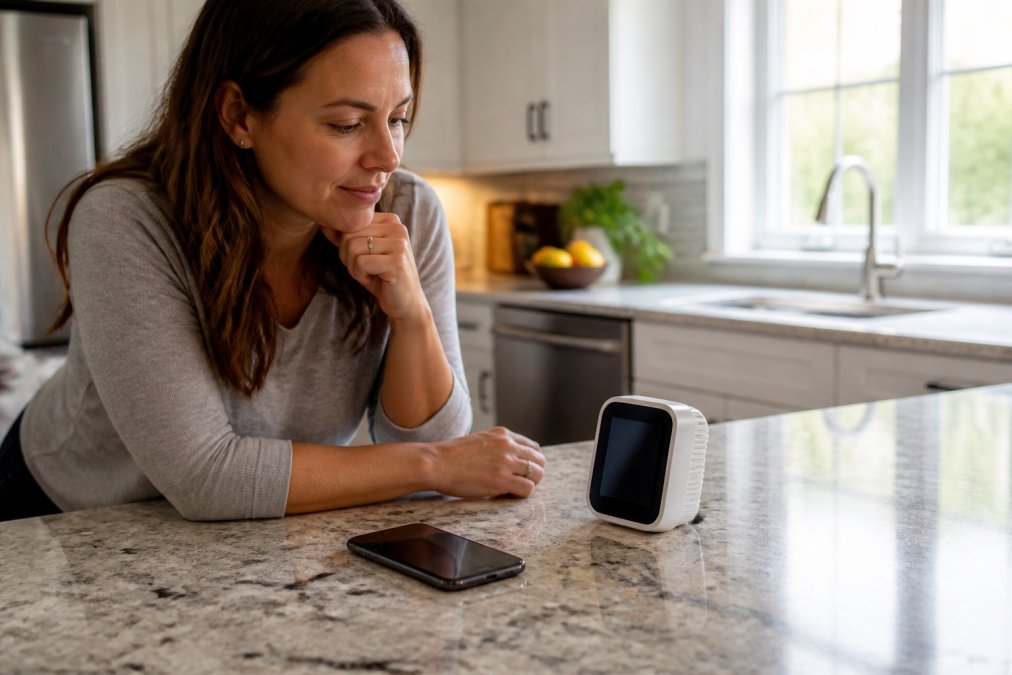
Three specifications decide most purchases:
- Measurement range and resolution. A CO2 sensor reading 400-5,000 ppm tells you far more about ventilation than one capped at 2,000 ppm.
- Response time. Laser particle counters react in seconds; metal oxide VOC sensors can take minutes to stabilize.
- Calibration method. Manual calibration against outdoor air or a reference gas is more reliable than automatic baseline correction alone.
Sensor Technology: NDIR, Laser Particle Counters, and Metal Oxide Sensors
Each sensor type detects a different class of pollutant, and no affordable consumer device does all three well.
Non-dispersive infrared (NDIR) sensors measure carbon dioxide by calculating how much infrared light the gas absorbs across a known path. They are the standard for CO2 accuracy and drift slowly. Laser particle counters scatter light off individual particles to count and size PM2.5 and PM10. Metal oxide semiconductor sensors respond to volatile organic compounds by measuring a resistance change across a heated tin oxide surface; they are cheap and sensitive but struggle to identify which VOC triggered the reading.
A device advertising “VOC detection” with a metal oxide sensor gives you a relative trend, not a concentration. That is useful for spotting a new furniture or paint smell, not for diagnosing a specific chemical.
Connectivity, Data Logging, and Smart Home Integration
Connectivity separates a gadget from a monitoring system. Bluetooth-only devices require you to stand nearby to pull data. Wi-Fi models push readings to a cloud dashboard, which is what makes historical trends and threshold alerts possible.
What most guides miss is that cloud logging is where the privacy questions live. A monitor that records occupancy patterns through CO2 and humidity can reveal when a building is empty. Check whether the vendor encrypts data in transit, where it stores records, and whether you can export or delete them. For commercial properties, that detail matters during any security review.
Smart home integration is a bonus, not a baseline. Some monitors expose readings to platforms like Home Assistant or Apple Home, which lets you trigger a ventilation fan when CO2 crosses a set point. Others lock data inside a proprietary app.
Common Indoor Air Pollutants to Monitor
Indoor air carries pollutants that outdoor air quality reports never capture. Four categories cover most residential and commercial concerns.
Particulate matter (PM2.5 and PM10) comes from cooking, candles, and outdoor infiltration. Fine particles penetrate deep into the lungs and are the pollutant most strongly linked to health effects. Volatile organic compounds (VOCs) off-gas from paint, adhesives, cleaning products, and new furniture; formaldehyde is the most discussed member of this group. Carbon dioxide is not toxic at typical indoor levels, but rising concentrations signal that a space is not exchanging air, and occupants report drowsiness and reduced focus well before any regulatory threshold. Relative humidity and temperature are not pollutants, but they govern mold growth and how much formaldehyde off-gasses from pressed-wood products.
A monitor that tracks only PM2.5 will miss a stuffy, poorly ventilated room entirely. If you want one device to cover the basics, prioritize CO2 and PM2.5 together.
Portable vs. Stationary: Matching the Device to Your Space
Portable monitors run on battery and travel between rooms; stationary monitors plug in and stay put. The right choice depends on whether you are diagnosing a problem or watching a space over time.
- Portable (Aranet4 HOME, Atmotube Pro, Temtop LKC-1000S): ideal for checking a bedroom, a basement, and a home office in one afternoon, or for carrying into a hotel or office.
- Stationary (IQAir AirVisual Pro, Qingping Pro Gen 2, PurpleAir PA-II): better for continuous logging, alerting, and comparing indoor readings against outdoor conditions.
A common mistake is buying a stationary unit and placing it on a shelf near the floor. Particles and CO2 stratify, so a reading taken at knee height tells you little about what occupants breathe. Place monitors at breathing zone height, roughly 1 to 1.5 meters off the floor, away from doors, windows, and direct sunlight. Avoid the kitchen and bathroom unless you are specifically testing those rooms.
Run a portable monitor through a full day in each room before buying a second stationary unit. The room with the worst readings is the one that justifies permanent monitoring, and you will have the data to prove it.
How Long Does Indoor Air Quality Testing Take?
Indoor air quality testing takes 30 minutes to several days, depending on what you are measuring. A handheld spot-check of PM2.5 and TVOC settles in a few minutes once the sensor stabilizes. Meaningful CO2 and humidity readings need at least a full occupied day, because ventilation patterns change with occupancy.
For a defensible picture of a home or commercial space, plan on continuous logging for 3 to 7 days, including at least one weekday and one weekend.
Benefits of Professional HVAC Air Quality Inspections
The practical benefits stack up:
- Source identification. Technicians trace pollutants to filtration, ductwork, or ventilation shortfalls rather than guessing.
- Air exchange rate verification. Measuring how often a space turns over its air volume shows whether ventilation is adequate for occupancy.
- Filtration and purification alignment. Filter ratings and purifier placement get matched to the pollutants your monitor actually flags.
- Documentation for commercial properties. Written findings support tenant communication and compliance records.
Skipping sensor maintenance is the fastest way to get false confidence. Metal oxide VOC sensors drift as the element ages, and laser counters lose accuracy as dust coats the optical chamber. A monitor that reads low because it is dirty is worse than no monitor at all.
Common Mistakes When Choosing an Air Quality Monitor
The most expensive mistake is buying on display quality rather than sensor quality.
Mistake 1: Assuming a new monitor stays accurate
Long-term sensor degradation is the gap almost every buying guide ignores.
Mistake 2: Letting the monitor sit as a dashboard instead of a control input
Most buyers install a monitor, watch the numbers, and never connect it to anything.
Mistake 3: Panicking at every spike
False positives erode trust in a monitor faster than any hardware flaw.
Mistake 4: Ignoring where the data goes
Cloud-connected monitors collect a surprising amount of information.
Smaller mistakes worth avoiding
- Trusting an uncalibrated unit indefinitely. Follow the manufacturer’s schedule; some sensors need periodic outdoor-air baselining.
- Placing the monitor in the wrong spot. Near a vent, in direct sun, or at floor level produces readings that do not represent the breathing zone.
- Expecting one device to do everything. No affordable monitor combines accurate CO2, speciated VOCs, and particle counting in one box.
- Buying for the app, not the sensor. A polished app on top of a cheap metal oxide VOC sensor still gives you a trend line, not a measurement.
Match the sensor to the pollutant, place the device in the breathing zone, keep it calibrated, and wire it into something that acts on the data. Those four choices decide whether your monitor gives you useful information or comfortable-looking numbers.
Frequently Asked Questions
Which air quality monitor is the most accurate?
Accuracy depends on the sensor type. NDIR sensors are the gold standard for carbon dioxide, while laser particle counters deliver the best PM2.5 readings. The IQAir AirVisual Pro and PurpleAir PA-II both use high-quality sensors and are widely trusted. For VOCs, metal oxide semiconductor sensors are common but can drift over time. No consumer monitor matches a professional-grade instrument, so look for devices with published accuracy specs and calibration options.
Do I need a professional air quality test or a home monitor?
A home monitor gives you continuous, real-time data on particulate matter, volatile organic compounds, and carbon dioxide, which helps you spot patterns and respond quickly. A professional HVAC air quality inspection goes deeper: it measures air exchange rate, checks ductwork for leaks, and identifies pollutant sources a consumer device cannot detect. Many homeowners start with a monitor, then schedule a professional inspection if readings stay elevated or symptoms persist.
What pollutants should a home air quality monitor detect?
At minimum, look for fine particulate matter (PM2.5), carbon dioxide, and volatile organic compounds. Formaldehyde detection is a bonus, especially in newer homes with pressed-wood furniture. Temperature and relative humidity matter too, since high humidity encourages mold and dust mites. If you live near heavy traffic or wildfire zones, prioritize PM2.5 accuracy. For homes with gas appliances, CO2 tracking helps you know when ventilation is inadequate.
Are air quality monitors worth buying?
They are worth it if you want to understand what you are breathing and act on it. Real-time data helps you ventilate when CO2 climbs, run an air purifier when PM2.5 spikes, and track whether HVAC changes actually improve your indoor environment. Monitors do not fix air quality on their own. Pair them with proper ventilation, filtration, and periodic professional HVAC inspections for the best results.