
Table of Contents
- Repair vs Replace HVAC: A Quick-Reference Comparison Table
- How HVAC Lifespan Shapes Your Decision
- The $5,000 Rule and the 50% Rule Explained
- Understanding HVAC Repair Cost vs. Full Replacement
- Energy Efficiency of New HVAC Systems: The Savings Math
- Warning Signs Your HVAC System Needs Replacement Now
- The Hidden Cost of Inaction, Plus Rebates and Financing
- Repair vs Replace HVAC: A Step-by-Step Decision Framework
Last Updated: August 2, 2026
Deciding whether to repair or replace your HVAC system is one of the most financially significant choices a homeowner makes. This repair vs replace hvac system guide from Anthony & Son Indoor Air Quality, LLC cuts through the noise with a structured, honest framework built for homeowners in Maryland, DC, and Northern Virginia. The decision hinges on system age, energy efficiency, maintenance history, and regional climate. Below, we’ll walk you through every variable that matters, the math behind the two most widely used decision rules, and a step-by-step framework you can apply to your own system today.
Most guides treat the $5,000 Rule as a verdict when it’s really just a starting point. A repair vs replace HVAC decision made without accounting for utility bill savings, available rebates, and your system’s remaining lifespan will almost always cost you more money in the long run.
Repair vs Replace HVAC: A Quick-Reference Comparison Table
| Scenario | System Age | Repair Cost Signal | Recommended Action | Priority Factor |
|---|---|---|---|---|
| Minor repair, young system | Under 8 years | Low, under warranty | Repair | Warranty coverage |
| Aging system, moderate repair | 10-15 years | Approaching 50% of replacement | Evaluate efficiency gains | Energy savings potential |
| Old system, major repair | 15+ years | Compressor failure or refrigerant | Replace | Cost-benefit analysis |
| Frequent breakdowns | Any age | Multiple repairs per year | Replace | Breakdown frequency |
| Low SEER rating, high bills | 10+ years | Any repair cost | Replace | Utility bill savings |
| Recent installation, isolated fault | Under 5 years | Single component failure | Repair | Equipment lifespan remaining |
This table is a starting point, not a verdict. The sections below explain the reasoning behind each recommendation.
How HVAC Lifespan Shapes Your Decision
System age is the single most reliable predictor of whether repair makes financial sense. An HVAC technician can diagnose a failing component, but the age of the equipment tells you whether fixing that component buys you meaningful time or just delays an inevitable replacement.
Expected Lifespan by System Type
Different HVAC equipment ages at different rates:
- Central air conditioners: 15-20 years with consistent preventative maintenance
- Gas furnaces: 20-30 years, though heat exchanger cracks can shorten that significantly
- Heat pumps: 15-20 years, faster in climates with heavy heating demand
- Boilers: 20-35 years
- Ductless mini-splits: 20+ years when properly maintained
If your air conditioner is 17 years old and needs a compressor replacement, you’re spending significant money to extend a system that has already delivered most of its useful life.
Many homeowners don’t know their system’s installation date. Check the manufacturer’s label on the outdoor unit or indoor air handler. The first four digits of the serial number often encode the manufacture year and week. Your HVAC technician can decode this during a diagnostic visit.
How Maintenance History Affects Remaining Life
A well-maintained 14-year-old system can outperform a neglected 8-year-old one. Systems that received annual tune-ups, regular filter changes, and coil cleaning tend to run closer to the top of their expected lifespan range. Systems that ran without service for years accumulate problems: refrigerant leaks go undetected, ductwork deteriorates, and components wear unevenly. According to U.S. Department of Energy guidance on HVAC maintenance, regular maintenance can improve system efficiency and extend equipment life measurably.
The $5,000 Rule and the 50% Rule Explained
Two heuristics dominate the repair vs replace hvac system guide conversation. Both are useful. Neither is sufficient on its own.
Applying the $5,000 Rule to Your System
The $5,000 Rule works like this: multiply your system’s age in years by the estimated repair cost. If the result exceeds $5,000, replacement is generally the smarter financial move.
Example: A 12-year-old air conditioner needs a $450 repair. 12 x $450 = $5,400. The rule suggests replacement is worth evaluating seriously.
Example: A 6-year-old system needs the same $450 repair. 6 x $450 = $2,700. The rule suggests repair is the right call.
The $5,000 Rule is a quick filter, not a financial plan. It doesn’t account for energy efficiency gains from a new system, available tax credits, or the cost of financing a replacement. Use it to frame the conversation, then apply the additional factors below.
The 50% Rule: When Repair Costs Cross the Line
The 50% Rule is simpler: if a repair costs more than half the price of a comparable new system, replace rather than repair. This rule is particularly useful for major component failures like compressor failure or heat exchanger cracks.
Neither rule accounts for refrigerant type. Systems still running on [R-22 refrigerant](/homeowners-guide-to-the-2025-new-refrigerant-transition/) face a compounding problem: R-22 has been phased out under EPA regulations, making it increasingly expensive and scarce. A refrigerant recharge on an R-22 system can cost significantly more than the same service on a modern R-410A or R-32 system. Factor this in before committing to a repair.
Understanding HVAC Repair Cost vs. Full Replacement
Contact Anthony & Son Indoor Air Quality, LLC directly for accurate estimates, since repair costs vary widely based on equipment type, component failure, and labor in the DC Metro market.
Common Repairs and What They Signal
Repairs that generally favor continuing to repair:
- Capacitor or contactor replacement
- Thermostat replacement or recalibration
- Minor refrigerant recharge on a younger system with no leak history
- Blower motor replacement on a system under 10 years old
Repairs that should trigger a replacement conversation:
- Compressor failure on a system over 10 years old
- Heat exchanger crack in a furnace (also a safety concern)
- Evaporator or condenser coil replacement on an aging system
- Repeated refrigerant leaks indicating systemic deterioration
| Factor | Repair | Replace |
|---|---|---|
| Upfront cost | Lower | Higher |
| Long-term cost | Higher if breakdowns continue | Lower with efficient new system |
| Energy efficiency | No improvement | Significant improvement possible |
| Indoor air quality | Unchanged | Can improve with new filtration |
| Disruption | Minimal | Requires installation day |
| Warranty | Existing coverage only | New manufacturer warranty |
| Risk | Another failure possible | Known performance from day one |
Repair wins on upfront cost and convenience. Replacement wins on long-term economics, energy efficiency, and peace of mind.
Energy Efficiency of New HVAC Systems: The Savings Math
Modern air conditioners carry SEER ratings significantly higher than equipment installed 15 years ago. SEER, or Seasonal Energy Efficiency Ratio, measures how efficiently a system converts electricity into cooling. The ENERGY STAR program guidelines on HVAC efficiency provides benchmarks for what qualifies as efficient equipment in different climate regions.
An older system running at a low SEER rating is costing you money every month in inflated utility bills. A new system with a substantially higher SEER rating can reduce cooling costs meaningfully over its lifespan. When evaluating repair vs replace HVAC, factor in the estimated monthly utility bill savings over a 5-year horizon, not just the immediate repair cost.
The cumulative utility bill savings from a high-efficiency replacement can offset a significant portion of the installation labor and equipment cost within a few years, particularly in the DC Metro area where summer cooling loads are substantial.
Warning Signs Your HVAC System Needs Replacement Now
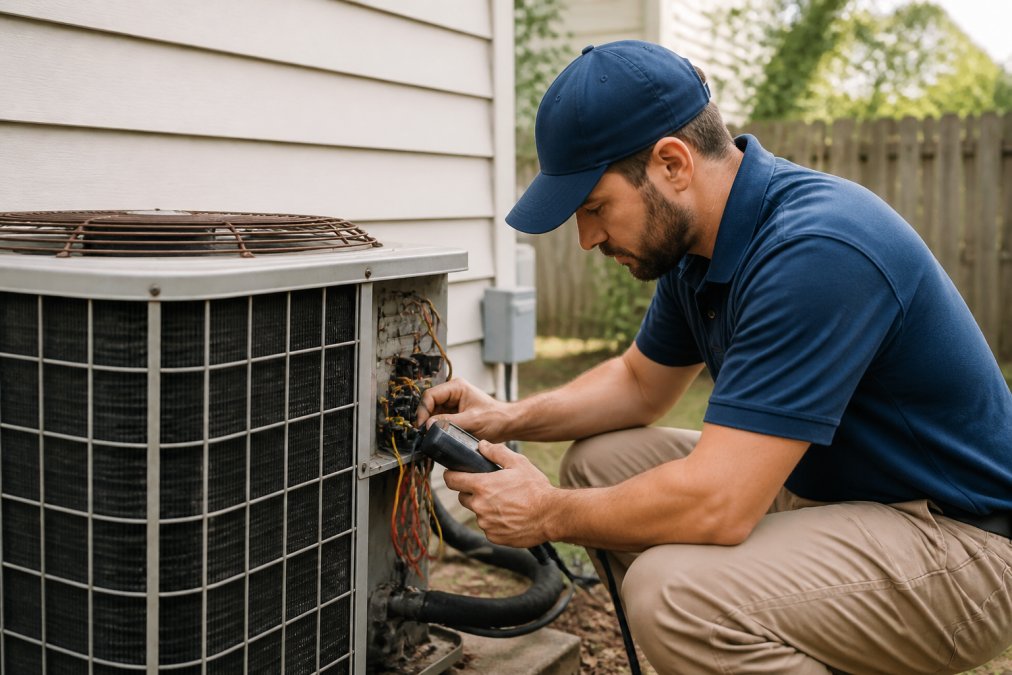
Replace now if you’re seeing any of these:
- Compressor failure on a system over 10 years old. The compressor is the most expensive component in an air conditioner.
- Refrigerant leaks that recur. A single recharge can be justified. Repeated leaks indicate systemic coil deterioration.
- Uneven temperatures throughout the home. This signals the system has lost capacity or ductwork has deteriorated significantly.
- Breakdown frequency increasing. One repair per season is a warning. Two or more repairs per season is a pattern that will continue.
- System age past 15 years with no recent major service. The equipment lifespan math rarely favors continued repair.
- Visible rust, corrosion, or unusual noises. These are physical signs of internal deterioration, not isolated component failures.
The strongest signal for replacement isn’t any single repair cost. It’s the combination of system age, increasing breakdown frequency, and rising utility bills happening at the same time. When all three converge, replacement is almost always the better financial decision.
The Hidden Cost of Inaction, Plus Rebates and Financing
Delaying a replacement decision on a failing system means continued high utility bills, ongoing repair costs, and the real risk of a complete system failure during peak summer heat or winter cold. Emergency HVAC replacement typically costs more and offers fewer options than a planned replacement.
Over 12-18 months, the total cost of excess utility spending and reactive repair costs can easily rival or exceed the cost of a planned replacement.
Federal Tax Credits and Utility Rebates in 2026
The Inflation Reduction Act created federal tax credits for qualifying high-efficiency HVAC equipment, including heat pumps and high-efficiency air conditioners and furnaces. Homeowners may be eligible for credits that offset a meaningful portion of replacement costs.
Check the current credit amounts and qualifying equipment specifications through IRS guidance on energy efficient home improvement credits. Many utility companies in Maryland, DC, and Northern Virginia also offer rebates for replacing older equipment with high-efficiency systems. These rebates stack with federal credits in many cases, improving the return on investment for replacement substantially.
Climate-Specific Considerations for the DC Metro Region
The DC Metro area is a mixed-humidity climate with hot, humid summers and cold winters. Systems here work harder than in milder climates, which accelerates wear and makes energy efficiency more valuable.
Heat pumps are particularly well-suited to this region. Modern cold-climate heat pumps maintain efficiency at lower outdoor temperatures, making them viable for DC Metro winters. System capacity matters here too: an undersized replacement will short cycle in summer humidity, while an oversized one will struggle to control indoor humidity effectively.
Repair vs Replace HVAC: A Step-by-Step Decision Framework
Step 1: Establish system age.
Find the manufacture date on the equipment label. If the system is under 8 years old and under manufacturer warranty, repair is almost always the right call.
Step 2: Apply the $5,000 Rule.
Multiply system age by the quoted repair cost. If the result is under $5,000, repair is likely justified. If it’s over $5,000, proceed to the next steps.
Step 3: Apply the 50% Rule.
Get a replacement quote. If the repair cost exceeds 50% of replacement cost, lean toward replacement.
Step 4: Assess breakdown frequency.
Has the system required repair more than once in the past 12 months? If yes, factor in the likely cost of the next failure.
Step 5: Calculate the efficiency gap.
Compare your current system’s SEER rating to what a new system would deliver. Estimate the monthly utility bill savings and project over 5 years.
Step 6: Check available incentives.
Research federal tax credits and utility rebates for qualifying replacement equipment. Subtract available incentives from the net replacement cost.
Step 7: Consider the hidden cost of inaction.
Estimate what 12-18 more months of current utility bills and likely repair costs will total. Compare that to the net replacement cost after incentives.
Step 8: Get a second opinion from a certified HVAC technician.
A diagnostic fee paid to a qualified technician is the best investment in this process. An honest assessment of your system’s actual condition will make every other step more accurate.
A trustworthy HVAC contractor will tell you when repair is the right answer, even when replacement would be more profitable for them. If a technician recommends full replacement on a 6-year-old system with a single failed capacitor, get a second opinion.
| Decision Step | Key Question | Repair Signal | Replace Signal |
|---|---|---|---|
| System age | How old is the equipment? | Under 10 years | Over 15 years |
| $5,000 Rule | Age x repair cost | Under $5,000 | Over $5,000 |
| 50% Rule | Repair vs replacement cost | Under 50% | Over 50% |
| Breakdown frequency | How often does it fail? | First failure | Recurring failures |
| Efficiency gap | What’s the SEER difference? | Minimal | Significant |
| Incentives | Are credits available? | Irrelevant if repairing | Reduces net replacement cost |
| Inaction cost | What does delay cost? | Low | High |
This repair vs replace hvac system guide framework structures the variables so you’re comparing the right numbers rather than reacting to a single repair quote in isolation.
Facing a failing HVAC system without a clear framework leads to expensive reactive decisions. Anthony & Son Indoor Air Quality, LLC serves homeowners and property managers across Maryland, DC, and Northern Virginia with honest, certified HVAC assessments, transparent pricing, and the technical expertise to tell you truthfully whether repair or replacement makes more financial sense for your specific system. Our fully certified technicians specialize in HVAC repair, system replacement, and preventative maintenance built to extend equipment lifespan. Contact us today for a diagnostic assessment and a straight answer on whether your system is worth repairing or ready to replace.
Frequently Asked Questions
What is the $5,000 rule for HVAC repair vs. replacement?
The $5,000 rule multiplies your system's age (in years) by the estimated repair cost. If the result exceeds $5,000, replacement is generally the smarter financial move. For example, a 12-year-old furnace facing an $800 repair scores 9,600 on this scale, pointing strongly toward replacement. Both Trane and Lennox use this heuristic in their own repair-or-replace guides as a starting point for homeowners weighing costs.
What is the 50% rule for HVAC repair vs. replacement?
The 50% rule states that if a single repair quote exceeds 50% of the cost of a new replacement system, you should replace rather than repair. This rule is especially relevant for older systems nearing the end of their expected lifespan. Spending half the price of a new unit on aging equipment rarely delivers good return on investment, particularly when energy efficiency losses and future breakdown frequency are factored in.
How long do HVAC systems typically last?
Most central air conditioners last 15 to 20 years, furnaces 15 to 30 years, and heat pumps 10 to 15 years, depending on usage, climate, and maintenance history. Systems that receive annual preventative maintenance consistently reach the upper end of these ranges. In humid Mid-Atlantic climates like Maryland and the DC metro area, heat pumps working year-round may age faster without regular servicing.
Are new HVAC systems more energy-efficient than older ones?
Yes, significantly. Modern air conditioners carry SEER ratings of 16 or higher, while units manufactured before 2006 often rate at 10 or below. That gap can translate to 30% to 50% lower energy consumption for cooling alone. When utility bill savings are calculated over 10 to 15 years, a new high-efficiency system frequently offsets much of the upfront installation cost, making replacement financially competitive even when repairs seem affordable.
Is it worth repairing a 15-year-old HVAC system?
A 15-year-old system is at or near the end of its expected lifespan for most equipment types. Minor repairs like a thermostat replacement or a capacitor swap can still make sense. However, major repairs such as compressor failure or refrigerant leaks on a system this age rarely justify the cost. Run the $5,000 rule calculation and get a full diagnostic assessment from a certified HVAC technician before committing to any significant repair expense.
What signs indicate an HVAC system needs replacement rather than repair?
Key indicators include: the system is over 15 years old, repair costs trigger the $5,000 or 50% rule, you're experiencing frequent breakdowns within a single season, rooms have inconsistent temperatures pointing to lost system capacity, utility bills are climbing without a usage change, or the unit uses R-22 refrigerant, which is no longer manufactured in the US. Any combination of two or more of these signs is a strong signal to replace rather than repair.
This article was written using GrandRanker