
Table of Contents
- Safety First: Before You Touch Your Furnace
- Quick Checks: Power, Thermostat, and Gas Supply
- How to Reset a Furnace (And When Not To)
- Furnace Air Filter Replacement and Airflow Problems
- Ignition, Flame Sensor, and Error Code Diagnostics
- Condensate Drain and Vent Blockage Issues
- When to Call an HVAC Professional
- Frequently Asked Questions
Last Updated: September 15, 2026
Safety First: Before You Touch Your Furnace
When a furnace stops working in a cold snap, it’s an emergency, but safety comes before troubleshooting. If you smell gas, hear hissing near the furnace or a gas line, or see soot on the cabinet, leave immediately and call your gas utility or 911 from outside (ready.gov). Do not flip a single switch on the way out.
Carbon monoxide is the other silent risk. This odorless gas forms when combustion isn’t venting properly, and a cracked heat exchanger or blocked flue is a common culprit. The EPA’s guidance on carbon monoxide and combustion appliances makes clear that any fuel-burning appliance needs proper ventilation to operate safely. If anyone in the home develops headaches, dizziness, or nausea while the heat is running, treat it as a CO event and get everyone outside.
Never tape over, block, or “temporarily” remove a furnace door safety switch to keep the blower running. That switch exists to prevent flame rollout and CO exposure. Bypassing it can turn a stalled furnace into a life-safety emergency.
Once you’ve confirmed there’s no gas smell and no CO symptoms, you can move on to the checks below.
Quick Checks: Power, Thermostat, and Gas Supply
The most common reason a furnace stops working is simple: a tripped breaker, a thermostat in the wrong mode, or a closed gas valve. Check these before assuming mechanical failure.
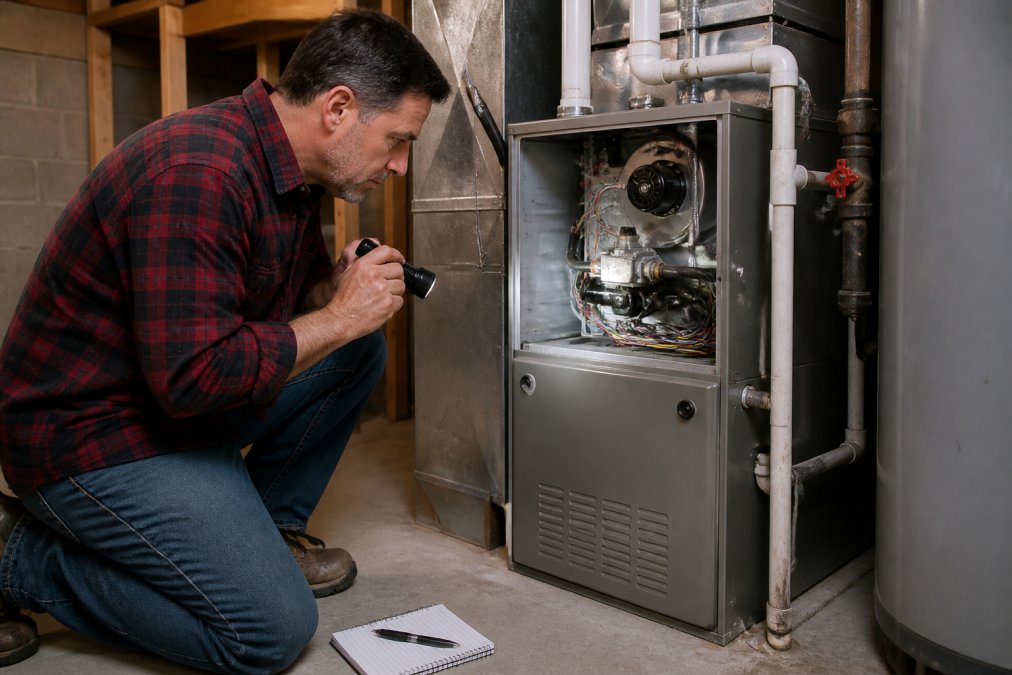
Start with the thermostat. Confirm it’s set to “Heat,” not “Cool” or “Fan Only,” and at least three degrees above room temperature. In “Auto” fan mode, the blower won’t run until the furnace fires, so a dead blower is sometimes just a wrong setting. On a smart thermostat, check the app for a schedule override or “hold.”
Next, inspect the air filter. A dust-clogged filter restricts airflow enough to trip the high-limit safety switch and shut the furnace down. Hold the filter up to a light; if you can’t see through it, replace it.
Then check the breaker labeled for the furnace (often “Furnace,” “HVAC,” or “Air Handler”). If tripped, reset it once. If it trips again immediately, stop and call a professional, a recurring trip points to a shorted motor or wiring fault.
Finally, verify the gas supply. The valve on the furnace line should be parallel to the pipe (open, not perpendicular). Check whether your gas range or water heater works too, if everything gas-fed is out, the problem is upstream with your utility.
How to Reset a Furnace (And When Not To)
Resetting a furnace cycles its power so the control board clears a lockout fault and restarts the ignition sequence. There are two kinds of reset, and knowing which you need saves you from cycling a unit that’s trying to tell you something.
A soft reset is done from the thermostat: set it to “Off,” wait a minute, then back to “Heat.” This clears a thermostat-side hold or schedule conflict. A hard reset cuts power to the control board entirely, clearing a lockout fault stored in its memory.
Here is the hard-reset sequence:
- Turn the thermostat to “Off.”
- Flip the furnace power switch (the light-switch-style toggle on or near the unit) to off.
- Wait a full 30 seconds. This lets the control board discharge and clears the fault.
- Flip the switch back on and set the thermostat to “Heat.”
- Listen for the inducer motor to spin up, then the igniter to glow, then the burners to light.
If the furnace fires and runs, you’re done. If it locks out again within minutes, stop resetting it. Repeated limit-switch or flame-sensor trips mean something is genuinely wrong, and every reset pushes more unburned gas or heat through a failing system.
Reset button location varies by model. Most modern furnaces have one behind the blower access panel, and many reset when you flip the power switch off for 30 seconds. Older units may have a red button on the burner compartment cover; high-efficiency condensing models often have no physical button, the board clears the fault when power is cycled. Check the wiring diagram inside the blower door for the reset location and LED layout.
Count your resets. If a furnace locks out three times in a row, the fault is almost never intermittent. It’s a specific component (flame sensor, pressure switch, or control board) that needs testing with a multimeter, not another reset. Write down the LED blink code before each reset, because the board clears its memory when you cycle power.
One more caution: never reset a furnace showing flame rollout, soot, or a CO alarm. Those are safety events, not lockout faults, and a reset can restart a unit actively venting combustion gases into the home.
Furnace Air Filter Replacement and Airflow Problems
Airflow is the most underrated factor in furnace reliability. A furnace air filter replacement is the cheapest maintenance you can do, and skipping it is the fastest way to trigger a limit-switch lockout.
Swap most residential filters every one to three months, more often in heavy heating season with pets or nearby construction. The arrow on the frame should point toward the blower; a backward filter cuts airflow and defeats its purpose.
Beyond the filter, check for blocked vents and returns. Furniture against a return grille, a closed register, or a rug over a floor vent all choke the system. When airflow drops, the heat exchanger overheats, the limit switch opens, and the burner shuts off.
If you’ve replaced the filter and cleared the vents but the furnace still short-cycles, the problem may be a failing blower motor, a dirty blower wheel, or undersized ductwork. That’s a job for a technician with airflow measurement tools.
Ignition, Flame Sensor, and Error Code Diagnostics
Modern furnaces use a hot surface igniter or spark ignition, and both rely on a flame sensor to confirm the burners lit. A dirty or failing flame sensor makes the furnace light, run a few seconds, then shut down as a safety measure.
The ignition sequence runs in a fixed order:
- Thermostat calls for heat
- Inducer motor starts and proves draft through the pressure switch
- Igniter heats or sparks
- Gas valve opens and burners light
- Flame sensor confirms flame within a few seconds
- Blower starts after a delay
If any step fails, the control board locks out and flashes a diagnostic code, a pointer to which step failed. “Pressure switch open” points to a blocked flue, failed inducer, or cracked hose. “Flame sensed when no flame present” points to a stuck gas valve. “Limit circuit open” points to airflow or a failed limit switch.
How to read the code. Older and mid-range boards blink a single LED in a repeating pattern (two blinks, a pause, two more means “code 2”); newer boards show an alphanumeric code like “E2” or “F5.” Either way, the code is a pointer, not a diagnosis, it names the safety circuit that opened, not the failed part, and one code can have three or four causes.
Where to find the code chart. The legend is usually on a sticker inside the blower compartment door, on the lower access panel, or in the installation manual. If it’s missing, use the model and serial number on the rating plate to pull the manual from the manufacturer’s site.
Do not clear a rollout or flame-present code and walk away. Those codes point to combustion problems that can produce carbon monoxide. If you see either one, shut the furnace down at the power switch and call a technician.
Condensate Drain and Vent Blockage Issues
When to Call an HVAC Professional
For less urgent problems, call a technician when:
A furnace that stops working is usually one of five things: power, thermostat, airflow, ignition, or drainage. Work the list in order, and you’ll solve the simple problems yourself and recognize the dangerous ones fast enough to call for help.
Frequently Asked Questions
Why would a furnace suddenly stop working?
A furnace can stop working for several reasons: a tripped circuit breaker, a clogged air filter restricting airflow, a faulty flame sensor, a blocked condensate drain line, or a gas supply interruption. In cold weather, the condensate line can freeze and trigger a shutdown. Check your thermostat settings and power supply first, then inspect the air filter. If those are fine, the issue may involve the ignition system or limit switch, which requires a diagnostic check by an HVAC professional.
Should I reset my furnace if it stops working?
Yes, resetting is a reasonable first step if your furnace has a reset button. Press it once and wait 30 minutes. If the furnace starts and runs normally, the issue may have been a temporary lockout. If it shuts off again, do not keep pressing reset. Repeated resets can damage the ignition system or mask a deeper problem like a cracked heat exchanger. At that point, call an HVAC professional for a proper diagnosis.
How do I keep my house warm if the furnace stops working?
Close off unused rooms and seal gaps under doors with towels. Use space heaters in occupied rooms, but keep them at least three feet from curtains and furniture. Never use a gas oven or grill indoors because of carbon monoxide risk. If you have a fireplace, use it with the damper open. Layer clothing and blankets, and consider staying with a neighbor if indoor temperatures drop below 55°F, especially if you have young children or elderly residents.
When is it time to call a professional HVAC technician?
Call a professional if you smell gas, see soot or corrosion on the furnace, hear unusual banging or screeching noises, or if the furnace repeatedly trips the circuit breaker. Also call if you have completed basic checks (thermostat, filter, power, reset) and the furnace still will not run. Technicians have diagnostic tools to read error codes and test components like the flame sensor and limit switch safely. Attempting those repairs without training risks electrical shock or carbon monoxide exposure.
When the heat goes out, the difference between a quick fix and a costly mistake often comes down to knowing when to stop. Anthony & Son Indoor Air Quality, LLC is a family-owned, certified HVAC team serving Maryland, DC, and Northern Virginia with honest furnace repair, preventative maintenance, and indoor air quality service. We diagnose the real fault, explain your options, and stand behind the work. Contact us today to schedule service and get your heat back on.