
Table of Contents
- Signs of High Humidity in Basement
- Improve Ventilation and Air Circulation
- Control Outdoor Moisture Sources
- Seal Foundation Cracks and Walls
- Use Natural Moisture Absorbers for Basements
- How Long Does Indoor Air Quality Testing Take
- Seasonal Maintenance Schedule to Reduce Humidity
- Frequently Asked Questions
Last Updated: September 22, 2026
Signs of High Humidity in Basement
High humidity in your basement creates uncomfortable conditions and damages your home, which is why learning how to reduce humidity in basement naturally is essential. The first step to fixing it is recognizing the warning signs.
Look for these indicators:
- Musty smell that lingers even after cleaning
- Visible condensation on pipes, windows, or walls
- Water stains or discoloration on concrete or drywall
- Peeling paint or wallpaper
- Mold or mildew growth (black spots on surfaces)
- Sticky feeling in the air
- Rust on metal items stored downstairs
A hygrometer is an inexpensive tool that measures relative humidity. Most basements should stay between 30-50% humidity. Anything above 60% indicates a serious problem that needs attention.
Check your basement humidity on a humid summer day and again during winter. Seasonal changes affect moisture levels differently, so you need both readings to understand your specific problem.
Improve Ventilation and Air Circulation
Poor air circulation traps moisture in your basement. Moving air helps water vapor escape before it condenses on surfaces. However, not all ventilation is equally effective, understanding when and how to ventilate naturally is key to success.
Why Natural Ventilation Often Fails in Summer
The biggest mistake homeowners make is opening basement windows on hot, humid days expecting relief. This actually worsens the problem. Here’s why: outdoor air during summer typically carries more absolute moisture than your basement air, even if your basement feels “stuffy.” When that warm, moist outside air enters your cool basement, it cools down, and cool air cannot hold as much moisture. The result is condensation on walls, pipes, and windows.
This is governed by the relationship between temperature and relative humidity (dew point). A practical example: if outdoor air is 85°F and 70% relative humidity, it contains about 0.018 pounds of water per pound of dry air. When that air enters your 65°F basement, the same moisture now represents roughly 90% relative humidity, triggering condensation.
When to Open Windows (and When Not To)
Natural ventilation works best when outdoor air is both cool and dry. This typically occurs:
- Early morning hours (5-8 a.m.) in spring and fall
- After rain has passed and the sun has dried surfaces
- On days when outdoor relative humidity is below 50%
Avoid opening windows when:
- Outdoor relative humidity exceeds 60% (especially in summer afternoons)
- It has rained recently
- Dew point is above your basement temperature (a simple check: if condensation forms on outdoor metal surfaces, dew point is too high)
A practical rule: if your basement feels cooler than outside, and the air outside feels sticky, keep windows closed. If outside air feels crisp and dry, open windows for 15-20 minutes to exchange stale air.
Active Air Circulation with Fans
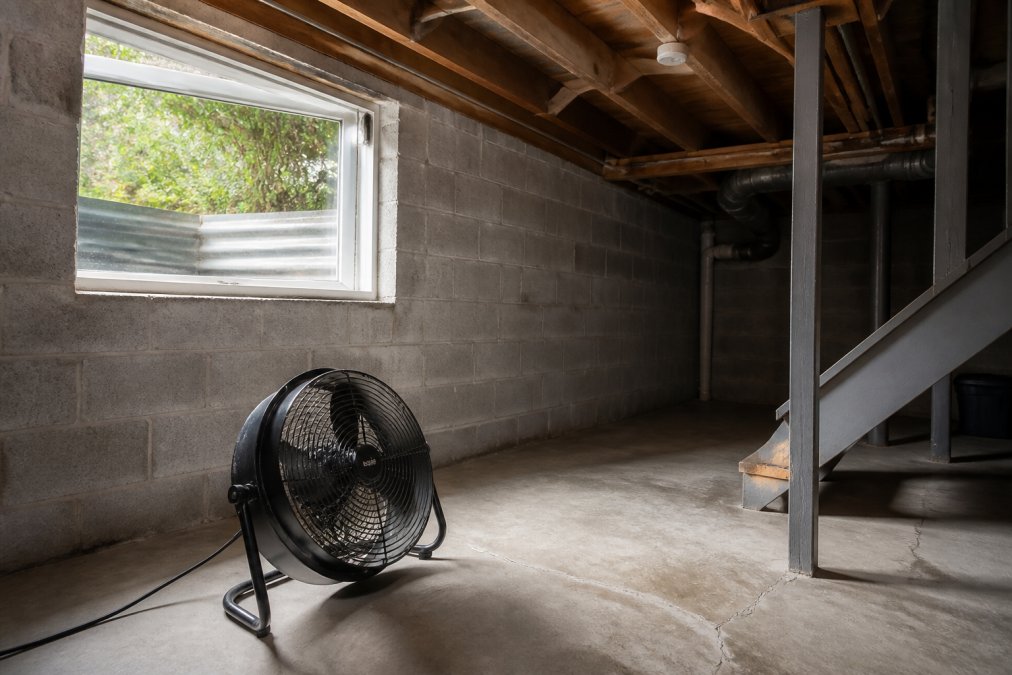
Fans are more reliable than passive ventilation because they move air regardless of outdoor conditions. Portable box fans are affordable and effective. Point them toward windows or doors to push humid air outside. Run fans for 2-4 hours daily during humid months, especially in the morning when outdoor humidity is lowest.
For year-round basement humidity, consider a whole-house ventilation system (such as an energy recovery ventilator, or ERV). These systems continuously exchange stale indoor air with fresh outdoor air while recovering heat or cooling energy, making them more efficient than simply opening windows. ERVs are particularly valuable in climates with high summer humidity, as they can condition incoming air before it enters your basement.
Exhaust Appliance Venting
Ensure dryer vents, bathroom exhaust fans, and kitchen range hoods all vent to the outside, not into your basement. Improperly vented appliances dump 1-2 gallons of moisture per load (dryers) or per shower (bathroom fans) directly into the space you’re trying to dry. Check that vent dampers close when appliances are off, preventing outdoor humid air from flowing back inside.
Invest in a basic hygrometer ($15-30) and place it near a basement window. Track readings at the same time each day for one week. If outdoor humidity consistently exceeds indoor humidity in the morning, natural ventilation will help. If outdoor humidity is always higher, rely on fans and mechanical ventilation instead.
Control Outdoor Moisture Sources
Water entering from outside is the biggest cause of basement humidity. Controlling moisture at the source prevents problems before they start inside.
Check your gutters and downspouts first. Clogged gutters overflow, dumping water near your foundation. Downspouts should extend at least 4-6 feet away from your house. Water pooling near the foundation seeps through cracks and creates hydrostatic pressure against basement walls.
Regrade the soil around your foundation. Soil should slope away from your house at least 6 inches over the first 10 feet. This simple step prevents rainwater from pooling against your foundation.
Seal gaps where water enters. Look for:
- Cracks in foundation concrete
- Gaps around pipes or utilities
- Deteriorating mortar between bricks
- Separation between foundation and sill plate
Even small openings allow soil saturation and seepage. Water vapor from damp soil beneath your basement creates constant moisture problems.
Install a sump pump if water collects in your basement. This removes standing water before it evaporates and increases humidity. Make sure the discharge pipe carries water away from your foundation.
Seal Foundation Cracks and Walls
Cracks in your foundation allow water and moisture to enter. Sealing them stops the problem at its source.
Small hairline cracks can be sealed with hydraulic cement. Clean out loose debris first, then apply the cement according to package directions. This hardens and creates a waterproof barrier.
Larger cracks need professional repair. Epoxy injection fills deep cracks and prevents future water penetration. This is where professional HVAC and moisture specialists become valuable; they can assess whether cracks indicate structural issues or simple moisture entry points.
Apply a waterproof sealant to your basement walls. Basement wall permeability varies by construction type. Concrete block absorbs moisture more readily than poured concrete. Vapor barriers and sealants reduce moisture movement through walls.
Paint basement walls with moisture-resistant paint. This creates a barrier that slows water vapor transmission.
Use Natural Moisture Absorbers for Basements
Natural desiccants pull moisture from the air without electricity, offering one approach to how to reduce humidity in basement naturally. They’re affordable and safe, but their effectiveness depends on space size, humidity severity, and proper deployment. Understanding their limitations prevents wasted effort.
How Desiccants Work
Calcium Chloride
Charcoal Briquettes
Rock Salt
Baking Soda
Houseplants and Transpiration
Realistic Capacity and When to Use Desiccants
Desiccants are not a replacement for addressing water intrusion, poor ventilation, or high outdoor humidity. They work best when you’ve already sealed foundation cracks, extended downspouts, and improved air circulation. Using desiccants without fixing these root causes is like bailing water from a boat without plugging the leak.
How Long Does Indoor Air Quality Testing Take
Understanding your basement humidity requires proper testing. The timeline depends on the testing method and what you’re measuring.
Seasonal Maintenance Schedule to Reduce Humidity
Your basement humidity changes with the seasons. A maintenance schedule keeps problems under control year-round.
Spring (March-May):
- Clear gutters and downspouts of winter debris
- Check foundation for new cracks
- Inspect basement walls for water stains or mold
- Test humidity levels
- Open windows on dry days to ventilate
- Run fans to move air
Summer (June-August):
- Monitor humidity daily, this is peak season for moisture problems
- Empty desiccant containers frequently
- Ensure exhaust fans vent outside
- Check downspout extensions after heavy rain
- Inspect for new mold growth
- Keep basement windows closed on humid days
Fall (September-November):
- Regrade soil if water pooled near foundation during summer
- Seal any cracks found during inspections
- Clean gutters before winter
- Test humidity as outdoor moisture decreases
- Prepare dehumidification equipment for winter if needed
Winter (December-February):
- Monitor for condensation on pipes and windows
- Ensure cold water pipes are insulated to reduce thermal bridging
- Keep basement ventilated even in cold months
- Check sump pump operation
- Inspect for ice dams that might cause water intrusion
Consistent seasonal maintenance is cheaper than emergency repairs. Spending 30 minutes each season checking your basement saves thousands in potential damage.
Frequently Asked Questions
What is the cheapest way to reduce humidity in a basement?
The most affordable approach combines natural ventilation and DIY moisture control. Open windows when outdoor humidity is lower, use portable fans to improve air circulation, and place natural desiccants like calcium chloride or silica gel in problem areas. These methods cost little to nothing upfront. For persistent moisture, extending downspouts away from your foundation and improving soil grading around the perimeter are inexpensive long-term solutions. If humidity remains above 60%, professional indoor air quality testing can identify the specific moisture source, helping you target solutions effectively.
Is 50% relative humidity too high for a basement?
Relative humidity between 30% and 50% is ideal for most basements. At 50%, you’re at the upper edge of acceptable, mold and dust mites thrive above 60%. If your basement consistently reads 50% or higher, take action to reduce humidity further. Use a hygrometer to monitor levels regularly. Natural approaches like ventilation, air circulation with fans, and moisture absorbers can bring levels down without expensive equipment. If readings stay above 55% despite these efforts, professional indoor air quality testing can reveal whether foundation leaks, poor drainage, or condensation on cold water pipes are the culprits.
What pulls moisture out of a basement most effectively?
Air circulation and ventilation pull moisture out fastest. Running exhaust fans continuously and opening windows during dry conditions exchanges humid indoor air with drier outdoor air, reducing water vapor buildup. Natural desiccants like calcium chloride absorb moisture from the air in sealed areas. Insulating cold water pipes prevents condensation that adds moisture. Extending downspouts at least 4 to 6 feet from your foundation stops rainwater from saturating soil around basement walls, which eliminates seepage and dampness. For comprehensive results, combine multiple approaches: improve drainage, seal foundation cracks, ventilate appliances like dryers and stoves, and maintain air circulation year-round.
Can poor ventilation cause basement mold?
Yes. Poor ventilation traps moisture-laden air, creating conditions where mold thrives. Without adequate air exchange, water vapor condenses on cold surfaces like pipes and walls, raising relative humidity above 60%, the threshold where mold growth accelerates. Musty smells in basements signal stagnant air and high moisture. Improving ventilation by opening windows, installing exhaust fans, and using portable fans to keep air moving reduces humidity and prevents mold. Pair ventilation improvements with foundation sealing and proper drainage to address moisture at its source. If mold already appears, professional indoor air quality testing can assess spore levels and help determine whether ventilation alone will resolve the problem or if additional moisture control is needed.