
Table of Contents
- Why Airflow Matters in Your Home
- Signs of Restricted HVAC Airflow You Shouldn’t Ignore
- Step 1: Check and Replace Your Air Filter Regularly
- Step 2: Open Windows and Doors for Cross-Ventilation
- Step 3: Clean and Clear Your Air Registers and Vents
- Step 4: Use Fans Strategically to Boost Air Circulation
- How to Fix Poor Airflow in One Room
- Step 5: Schedule HVAC System Maintenance and Duct Inspection
Last Updated: August 22, 2026
Why Airflow Matters in Your Home
Poor airflow is one of the most common complaints we hear from homeowners. It’s also one of the easiest problems to overlook because it develops gradually. You notice one room feels stuffy. Then another. Before long, your HVAC system is running constantly but your home still doesn’t feel comfortable.
The real issue isn’t always your equipment. Often, it’s how air moves through your home. When airflow is restricted, your HVAC system has to work harder to maintain temperature, which drives up energy costs and puts strain on components. At Anthony & Son Indoor Air Quality, LLC, we’ve found that many homeowners can significantly improve comfort and efficiency by addressing airflow problems directly.
Think of your HVAC system like a circulatory system. The equipment is the heart, but the ductwork, vents, and air registers are the arteries. If any part of that system gets blocked or restricted, the whole thing suffers. The good news is that improving airflow often doesn’t require expensive repairs. Many solutions are straightforward enough to tackle yourself, while others benefit from professional assessment.
Signs of Restricted HVAC Airflow You Shouldn’t Ignore
Before you can fix an airflow problem, you need to recognize one. Some signs are obvious. Others are subtle enough that you might attribute them to something else entirely.
Hot and cold spots are the most common indicator. If one room stays warm while another stays cold, you’re experiencing uneven air distribution. This typically means air isn’t reaching certain areas effectively, or return vents aren’t pulling air back to the system properly. The problem compounds over time because your thermostat tries to compensate, cycling the system more frequently than necessary.
Weak airflow from your vents is another clear signal. Place your hand near a supply register. You should feel consistent, moderate pressure. If you feel barely any air movement, or if the airflow is inconsistent, something is blocking the path between your equipment and that vent.
Listen to your HVAC system. A unit that runs constantly but doesn’t seem to reach your set temperature is working against restricted airflow. The system cycles on and off more frequently, which wastes energy and causes unnecessary wear. You might also notice higher-than-usual energy bills without any change in your usage patterns.
Dust accumulation around vents and registers suggests air pressure imbalances. When your system can’t move air efficiently, it takes longer for dust to settle, and you’ll see more of it collecting around openings. This is also a sign that your air filters may need more frequent attention.
Stuffiness or stale air feeling is harder to quantify, but it’s real. Poor air circulation means contaminants, odors, and moisture linger longer. Your home might feel humid even when the AC is running, or you might notice cooking smells persisting longer than they should.
Step 1: Check and Replace Your Air Filter Regularly
This is the simplest and most overlooked fix. Your air filter is the first line of defense against dust, pollen, and debris entering your system. When it gets clogged, airflow drops immediately.
A dirty filter forces your HVAC system to work harder to pull air through. The system compensates by running longer, which increases energy consumption and generates more heat. That heat can actually damage internal components over time. More importantly, a clogged filter means your system is pushing less air into your home, which directly impacts comfort.
Checking your filter takes two minutes. Open your furnace or air handler cabinet and slide out the filter. Hold it up to light. If you can’t see light through it clearly, it’s time for a replacement. Don’t wait for visible dirt to decide. A filter can be partially clogged and still look relatively clean.
How Often to Change HVAC Air Filters
The standard recommendation is every 30 days, but that’s not universal. Your actual replacement frequency depends on several factors.
If you have pets, allergies, or live in a dusty area, change your filter every 20 days (the EPA). Homes with multiple pets or smokers should check every 15 days. In cleaner environments with no pets or allergies, you might stretch it to 60 days, though 30 days remains the safer default.
The type of filter matters too. Basic fiberglass filters (the cheap ones) should be replaced every 30 days (the CDC). Higher-efficiency MERV 11-13 filters can last 60-90 days. HEPA filters and specialty filters designed for allergies have their own schedules, which manufacturers usually specify.
A practical approach: set a phone reminder for 30 days after installation. Check the filter when the reminder comes up. If it’s still relatively clean, note it and check again in another month. You’ll quickly learn your home’s pattern. Keep spare filters on hand so you’re never tempted to run the system with a missing filter (which completely bypasses filtration and damages your system).
Step 2: Open Windows and Doors for Cross-Ventilation
Your HVAC system can only recirculate air that’s already inside. To introduce fresh air and improve overall air circulation, you need cross-ventilation.
Open windows on opposite sides of your home. If you have a north-facing window and a south-facing window, open both. The temperature difference and air pressure between exterior and interior creates natural air movement. This approach works best on mild days when you’re not running your AC at full capacity.
The timing matters. Early morning and evening typically offer the best conditions. During midday heat, opening windows can actually work against your cooling system. In spring and fall, cross-ventilation can reduce your reliance on mechanical cooling entirely.
For homes with interior layouts that don’t allow opposite windows, use doors. An open front door and a patio door create the same effect. Position a box fan in one opening facing outward to push stale air out, which pulls fresh air in through the other opening.
This isn’t a year-round solution in most climates, but it’s free and effective when conditions allow. It also gives your HVAC system a break, reducing energy consumption on moderate days.
Step 3: Clean and Clear Your Air Registers and Vents
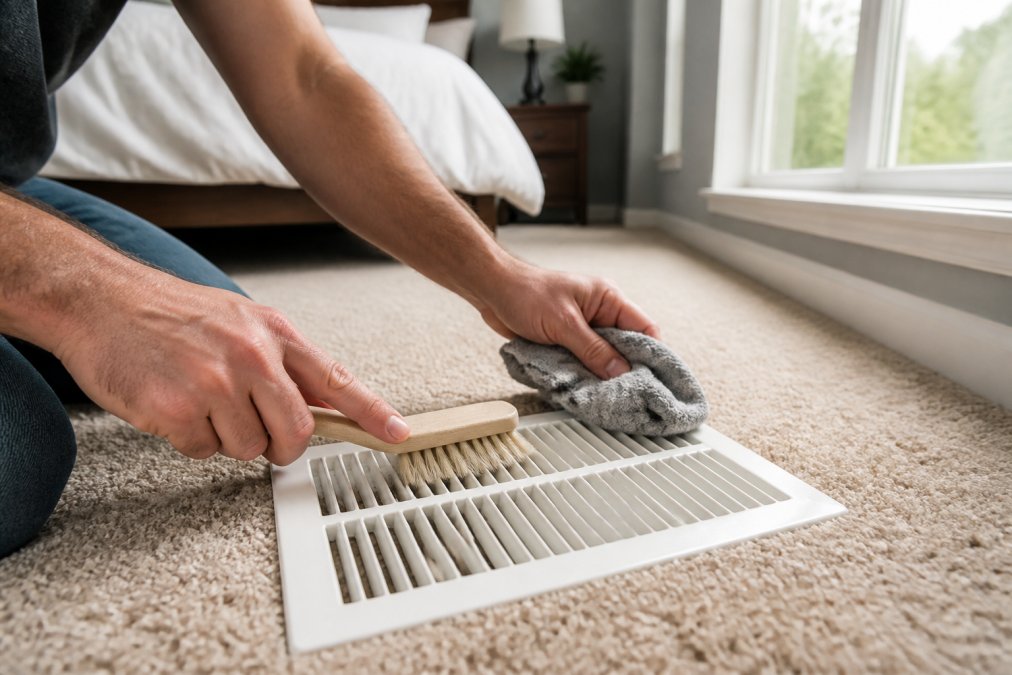
Dust accumulation inside your vents and registers blocks airflow directly. Over months, dust, pet hair, and debris build up inside the ductwork and around vent openings, restricting air movement.
Start with the visible parts. Remove the register cover (most simply pull out or unscrew) and vacuum the interior with a brush attachment. Use a damp cloth to wipe down the fins. For deeper cleaning, you can use a straightened wire coat hanger with a cloth attached to reach further into the duct opening.
Check that nothing is blocking your vents from the other side. Furniture, curtains, or storage items pushed against a register reduce airflow significantly. Even partially blocked registers matter. A sofa pulled three feet away from a wall vent can reduce that vent’s effectiveness by 40 percent (ashrae.org).
If you have a basement or crawlspace with exposed ductwork, check for disconnected sections or crushed ducts. These are common in older homes and create major airflow problems. A professional can assess this, but even visually inspecting what’s accessible can reveal obvious issues.
For return air vents (the larger openings that pull air back to your system), make sure they’re completely clear. Return vents are often overlooked because they’re less visible, but they’re critical to system balance. A blocked return vent creates negative pressure in your home, which forces the system to work harder. keep dust out.
Step 4: Use Fans Strategically to Boost Air Circulation
Fans don’t cool your home, but they move air more effectively than your HVAC system alone. Strategic placement amplifies the impact of your existing airflow.
Ceiling fans should rotate counterclockwise in summer (pushing air down) and clockwise in winter (pulling air up and pushing it along the ceiling). This creates circulation that helps your HVAC system distribute conditioned air more evenly.
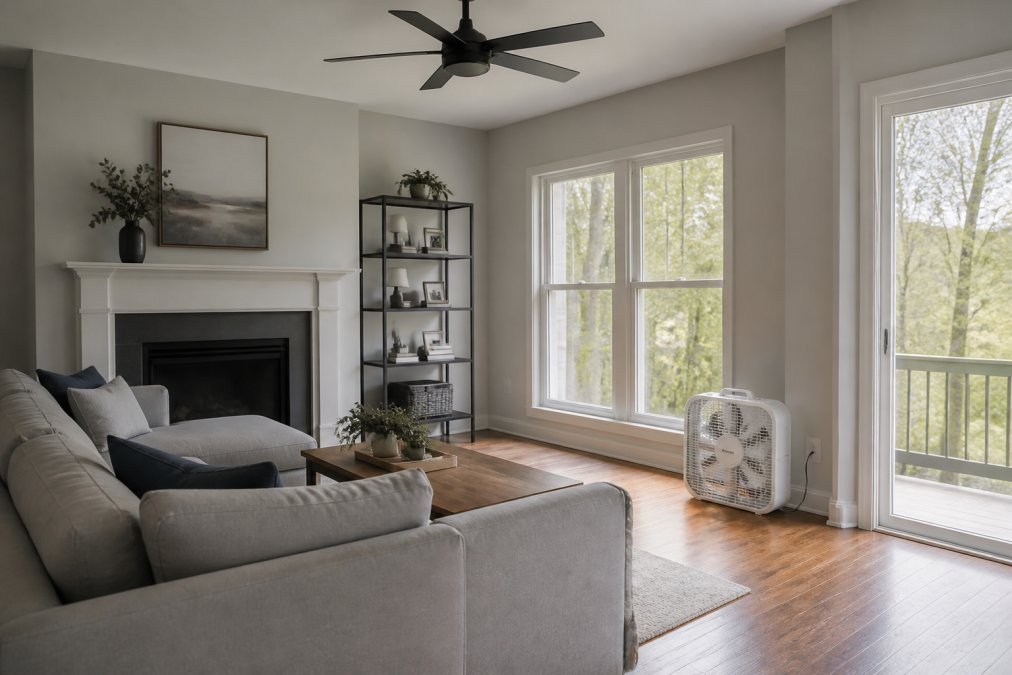
Box fans are underrated. Position a box fan in a window facing outward to pull hot air out during evening hours. This creates negative pressure that draws cooler outside air in through other openings. In winter, reverse the direction to push warm air from one room to another.
For rooms with poor airflow, a tower fan or pedestal fan in the corner creates circulation that your vents alone might not achieve. The key is positioning. Place fans where they can move air across the room, not just in a small radius. A fan in the corner of a large room will circulate air much more effectively than one in the center.
Portable air cleaners with built-in fans also improve circulation while filtering air simultaneously. These work well for rooms that consistently feel stuffy or have poor duct connections.
How to Fix Poor Airflow in One Room
Single-room airflow problems are frustrating because they often resist simple solutions. A bedroom that’s always too warm or a home office that never quite feels comfortable requires a different approach than whole-home issues.
Start by confirming the problem isn’t just a closed vent or blocked register in that room. Open all vents fully and clear any obstructions. If the problem persists, the issue is likely inadequate air supply or return.
Many rooms have only a supply vent and no dedicated return vent. Air flows in but struggles to return to the system, creating pressure imbalance. This is especially common in bedrooms and bathrooms. The solution is either adding a return vent (professional work) or creating passive return paths by leaving doors cracked open.
If the room is far from your furnace or air handler, ductwork length and layout might be restricting flow. A professional HVAC contractor can assess this and recommend solutions like adding a booster fan or adjusting dampers in the ductwork to prioritize that room.
For immediate improvement, use a portable fan to move air from the supply vent across the room. Combine this with cross-ventilation if weather permits. These temporary fixes often reveal whether the problem is truly a system limitation or something simpler like a closed vent you missed.
Step 5: Schedule HVAC System Maintenance and Duct Inspection
Professional maintenance catches problems that DIY approaches miss. A qualified technician can identify restrictions in your ductwork, assess your system’s overall balance, and recommend targeted improvements.
During a maintenance visit, a technician checks airflow at multiple points in your system using specialized tools. They measure pressure drop across your filter, test airflow at individual registers, and inspect accessible ductwork for leaks or damage. This diagnostic data reveals exactly where your system is losing efficiency.
Duct leaks are a major source of airflow problems that homeowners can’t easily spot. Unsealed joints and small tears allow conditioned air to escape into attic or crawlspace areas instead of reaching your living spaces. Sealing ducts with mastic or metal tape improves airflow and reduces energy waste significantly.
Your air filter isn’t the only filtration point. Your HVAC system itself may have internal restrictions that require professional cleaning. Coils, blower wheels, and other components accumulate dust over time, reducing airflow. A thorough cleaning during maintenance restores system performance.
If your home has persistent hot and cold spots despite filter changes and vent clearing, consider a professional air balancing service. Technicians adjust dampers in your ductwork to redistribute airflow, ensuring even temperature throughout your home. This is particularly valuable in multi-story homes where upper floors often run warmer than lower floors.
At Anthony & Son Indoor Air Quality, LLC, we recommend annual maintenance before your heating or cooling season begins. This ensures your system starts at peak efficiency and catches problems early, before they impact comfort or drive up energy bills.
Improving airflow doesn’t always require expensive equipment or major system changes. Many homeowners see significant improvement by addressing the fundamentals: clean filters, clear vents, strategic fan placement, and proper ductwork maintenance. When these basic steps don’t fully solve the problem, professional assessment reveals what’s actually restricting your system’s performance. The investment in a maintenance visit or duct inspection typically pays for itself through energy savings and improved comfort. Contact Anthony & Son Indoor Air Quality, LLC today to schedule a system evaluation and discover how to optimize airflow throughout your home.
=== FAQ ANSWERS (audit these too, same rules) ===
[1] Q: How can I tell if my home has poor airflow?
A: Poor airflow shows up in several ways: rooms that feel stuffy or stagnant, uneven temperatures where some rooms are hot and others cold, weak air coming from registers, higher energy bills, or dust buildup around vents. You might also notice your HVAC system running constantly without reaching the desired temperature. If multiple rooms feel uncomfortable despite your thermostat settings, restricted airflow is likely the culprit.
[2] Q: How often should I change my HVAC air filter?
A: Most standard 1-inch air filters need replacement every 1 to 3 months, depending on your home’s conditions. If you have pets, allergies, or live in a dusty area, change filters monthly. Thicker filters (4-5 inches) may last 6 to 12 months. Check your filter monthly by holding it to a light; if you can’t see through it, replace it immediately. A clogged filter severely restricts airflow and forces your system to work harder.
[3] Q: Can I improve airflow in just one room without upgrading my whole system?
A: Yes. Start by ensuring that room’s registers and vents are clean and fully open. Add a box fan or portable air cleaner to boost circulation in that specific space. If the problem persists, check for blocked return air vents or furniture blocking airflow paths. For persistent issues, a professional HVAC technician can assess whether adding a return air vent or adjusting ductwork dampers would help balance air distribution to that room.
[4] Q: Will cleaning my air ducts improve airflow?
A: Professional air duct cleaning can improve airflow if dust, debris, or mold buildup is restricting air movement through the ductwork. It also removes allergens and contaminants, improving indoor air quality. However, if your airflow problem stems from closed registers, a clogged filter, or ductwork design issues, duct cleaning alone won’t solve it. A professional inspection can determine whether cleaning will benefit your specific situation.
Frequently Asked Questions
How can I tell if my home has poor airflow?
Poor airflow shows up in several ways: rooms that feel stuffy or stagnant, uneven temperatures where some rooms are hot and others cold, weak air coming from registers, higher energy bills, or dust buildup around vents. You might also notice your HVAC system running constantly without reaching the desired temperature. If multiple rooms feel uncomfortable despite your thermostat settings, restricted airflow is likely the culprit.
How often should I change my HVAC air filter?
Most standard 1-inch air filters need replacement every 1 to 3 months, depending on your home's conditions. If you have pets, allergies, or live in a dusty area, change filters monthly. Thicker filters (4-5 inches) may last 6 to 12 months. Check your filter monthly by holding it to a light; if you can't see through it, replace it immediately. A clogged filter severely restricts airflow and forces your system to work harder.
Can I improve airflow in just one room without upgrading my whole system?
Yes. Start by ensuring that room's registers and vents are clean and fully open. Add a box fan or portable air cleaner to boost circulation in that specific space. If the problem persists, check for blocked return air vents or furniture blocking airflow paths. For persistent issues, a professional HVAC technician can assess whether adding a return air vent or adjusting ductwork dampers would help balance air distribution to that room.
Will cleaning my air ducts improve airflow?
Professional air duct cleaning can improve airflow if dust, debris, or mold buildup is restricting air movement through the ductwork. It also removes allergens and contaminants, improving indoor air quality. However, if your airflow problem stems from closed registers, a clogged filter, or ductwork design issues, duct cleaning alone won't solve it. A professional inspection can determine whether cleaning will benefit your specific situation.
This article was written using GrandRanker