
Table of Contents
- Why Newborns Are More Vulnerable to Indoor Air Pollution
- Common Indoor Air Pollutants in the Nursery
- Health Risks: Respiratory Development and Long-Term Effects
- Best Practices for Nursery Air Quality
- How Long Does Indoor Air Quality Testing Take
- Monitoring and Smart Home Integration
- Frequently Asked Questions
Last Updated: September 20, 2026
Why Newborns Are More Vulnerable to Indoor Air Pollution
Indoor air quality newborns need is critical because their developing bodies cannot yet handle the pollutants that adults tolerate routinely. A newborn’s respiratory system is fundamentally different from an adult’s, it’s still forming, still learning to filter and process air efficiently. This vulnerability window is critical. The first months and years of life shape lifelong respiratory health, which is why what happens in your nursery matters far more than most parents realize.
At Anthony & Son Indoor Air Quality, LLC, we work with families throughout the region who want to understand the science behind clean air for infants. The stakes are real: poor indoor air quality during these formative months can set the stage for respiratory issues that persist into childhood and beyond.
Respiratory System Development in Infants
A newborn’s lungs are not fully developed at birth. The respiratory system continues to mature throughout infancy and early childhood, with critical growth happening in the first few years of life. Alveoli, the tiny air sacs in the lungs where oxygen exchange occurs, are still forming. This ongoing development means that exposure to pollutants during this window can disrupt normal pulmonary growth and compromise long-term respiratory function.
The breathing pattern itself differs too. Newborns are obligate nasal breathers for the first few months, meaning they cannot efficiently switch to mouth breathing if their nasal passages become irritated or blocked. Any inflammation from air quality issues creates a direct problem with oxygen intake.
Newborns breathe through their noses exclusively for roughly the first three months of life. Nasal congestion from indoor air irritants can be more serious for them than for older children or adults.
Breathing Rates and Metabolic Demands
Newborns breathe much faster than adults. While an adult at rest takes 12-20 breaths per minute, a newborn typically breathes 30-60 times per minute. This higher respiratory rate means infants move more air through their lungs in the same amount of time. That increased volume also means increased exposure to whatever pollutants exist in that air.
Combined with a faster metabolic rate, newborns extract and process more oxygen per pound of body weight than adults do. Their bodies are working harder, breathing harder, and pulling in more of whatever is floating in your nursery’s air. A pollutant that might barely affect an adult becomes a significant dose for an infant.
Immune System Maturity and Chemical Sensitivity
A newborn’s immune system is not fully mature. The protective barriers that develop over time, in the respiratory tract, the gut, and elsewhere, are still forming. This means irritants and allergens that an adult’s body would quickly neutralize can trigger inflammation in an infant.
Chemical sensitivity is especially pronounced. Newborns lack the metabolic capacity to process and eliminate certain compounds efficiently. Their liver and kidneys are still developing. A volatile organic compound that an adult’s body breaks down and excretes might accumulate or cause prolonged irritation in an infant’s body.
Common Indoor Air Pollutants in the Nursery
Most nurseries contain multiple sources of air pollution that parents don’t immediately recognize. Understanding what’s actually in the air is the first step toward improving it.
Volatile Organic Compounds from Furniture and Paint
Volatile organic compounds, or VOCs, are gases released from certain materials at room temperature. New furniture, carpeting, paint, and adhesives are major sources. When you bring a new crib, dresser, or changing table into the nursery, off-gassing begins immediately. This process can continue for weeks or months.
Common VOCs include formaldehyde, benzene, and toluene. Formaldehyde, used in many wood products and adhesives, is a respiratory irritant that can trigger coughing, wheezing, and inflammation in airways. For a newborn with a developing respiratory system, even low-level exposure creates ongoing stress.
Paint is another significant source. Even low-VOC paints release compounds during and after application. The “new paint smell” is actually a mixture of VOCs being released into the air. A freshly painted nursery looks clean and fresh but may contain elevated concentrations of irritating compounds.
Painting a nursery while pregnant or shortly before bringing a newborn home exposes the infant to peak VOC concentrations during the most vulnerable window. If painting is necessary, do it well in advance and ensure thorough ventilation for at least two weeks before occupancy.
Particulate Matter, Mold Spores, and Secondhand Smoke
Particulate matter, dust, skin cells, pet dander, textile fibers, circulates constantly in indoor air. For a newborn, these particles can lodge in developing airways and trigger inflammation. Dust also carries other pollutants and allergens, making it a vector for secondary contamination.
Mold spores are another concern, especially in humid environments. Bathrooms connected to nurseries, basements with moisture issues, or rooms with poor ventilation create conditions where mold thrives. Mold spores in the air can irritate respiratory tissue and, in some cases, trigger allergic responses even in very young infants.
Secondhand smoke is among the most serious indoor air pollutants. Even if no one smokes inside the nursery, smoke residue can be tracked in on clothing and settle on surfaces. A newborn exposed to secondhand smoke has increased risk of respiratory infections, ear infections, and developmental complications.
Health Risks: Respiratory Development and Long-Term Effects
The connection between early indoor air quality and lifelong health is not theoretical. Poor air quality during infancy creates measurable risks.
Newborns exposed to high levels of indoor air pollution show increased rates of respiratory infections, wheezing, and coughing. These acute problems are concerning enough, but the longer-term effects matter more. Early respiratory inflammation can alter how lungs develop. Airways that should grow normally may instead develop with structural changes that persist into adulthood.
Asthma risk increases significantly with early air pollution exposure. A child whose nursery had poor indoor air quality is more likely to develop asthma in childhood and adolescence. The mechanism appears to be that early inflammation and irritation sensitize the respiratory system, making it hyperresponsive to triggers later.
Allergic responses also become more likely.
Best Practices for Nursery Air Quality
Improving indoor air quality in a nursery requires a multi-layered approach. No single strategy solves the problem completely, but combining several strategies creates a meaningfully cleaner environment.
Ventilation Strategies for Healthier Indoor Air
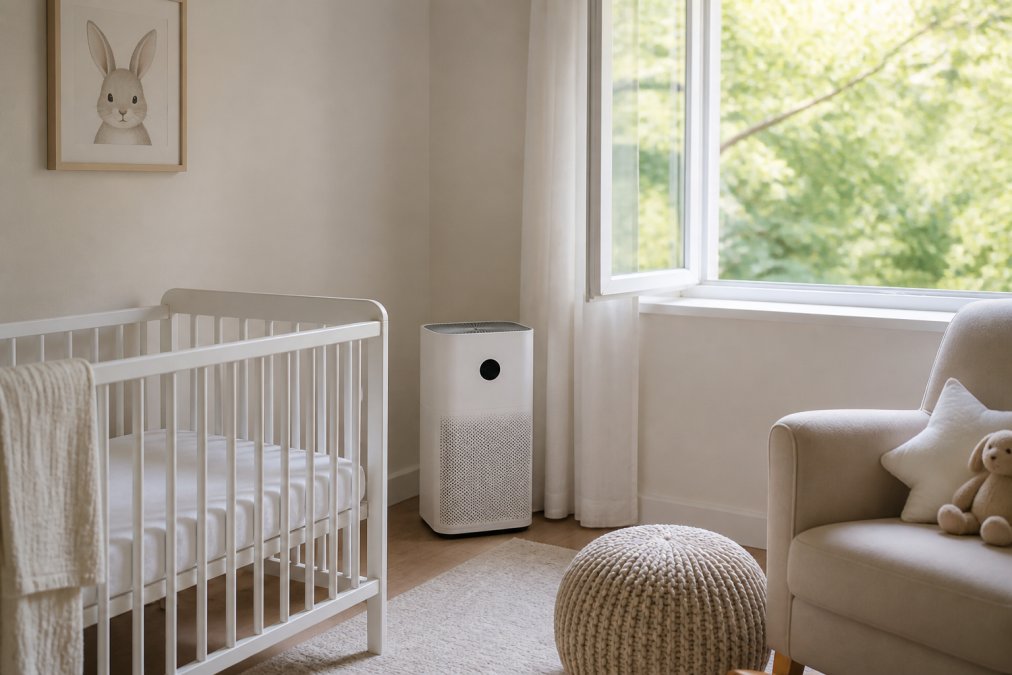
Fresh outside air is the most effective way to dilute indoor pollutants. Opening windows when weather permits introduces clean air and removes stale, pollutant-laden air. Even 10-15 minutes of open-window ventilation can significantly reduce indoor pollutant concentrations.
The ideal nursery air exchange rate is 4-6 complete air changes per hour. This means the entire volume of air in the room is replaced 4-6 times hourly, ensuring pollutants don’t accumulate.
Air Purifiers and HEPA Filtration Systems
HEPA filters capture particulate matter, dust, pollen, mold spores, and pet dander, with exceptional efficiency. A true HEPA filter removes 99.97% of particles 0.3 micrometers and larger from the air passing through it. For a nursery, a HEPA-equipped air purifier reduces particulate load significantly.
Humidity Control and Seasonal Air Quality Management
Relative humidity in the nursery should stay between 30-50%. Below 30%, air becomes dry, which irritates respiratory tissue. Above 60%, humidity creates conditions for mold and dust mite proliferation. Maintaining this range supports respiratory health.
How Long Does Indoor Air Quality Testing Take
Testing indoor air quality provides concrete data about what’s actually in your nursery’s air. The testing process itself is straightforward and non-invasive.
Monitoring and Smart Home Integration
Continuous monitoring of nursery air quality removes guesswork from your maintenance routine. Smart air quality monitors display real-time readings of particulate matter, humidity, temperature, and sometimes CO2 and VOC levels. You can see exactly how your ventilation and filtration strategies are performing.
| Strategy | Implementation Time | Ongoing Effort | Effectiveness for Particles | Effectiveness for Gases |
|---|---|---|---|---|
| Open window ventilation | Immediate | Daily | Moderate | High |
| HEPA air purifier | 1-2 hours setup | Weekly filter checks | High | Low |
| Activated carbon filtration | 1-2 hours setup | Monthly replacement | Low | High |
| ERV/HRV system | Professional installation | Quarterly maintenance | High | Moderate |
| Humidity control | 1-2 hours setup | Weekly monitoring | Low | Low |
| VOC source elimination | Varies (weeks) | Minimal | Low | High |
EPA indoor air quality standards for residential spaces
ASHRAE ventilation standards for healthy indoor environments
Frequently Asked Questions
How does poor indoor air quality affect newborn respiratory health?
Poor indoor air quality exposes newborns to pollutants during a critical developmental window. Infants breathe 30-40 times per minute compared to adults’ 12-20, drawing more air, and pollutants, into developing lungs. Exposure to volatile organic compounds, particulate matter, and combustion pollutants can impair pulmonary growth, increase asthma and allergy risk, and potentially affect respiratory development for years. The immature immune system cannot filter these threats effectively, making early exposure particularly concerning.
What are the most common indoor air pollutants in a nursery?
Common nursery pollutants include volatile organic compounds (VOCs) off-gassing from new furniture, paint, and flooring; secondhand smoke; mold spores from high humidity; dust and particulate matter; carbon monoxide from combustion appliances; nitrogen dioxide from gas stoves; and formaldehyde from synthetic materials. Many parents don’t realize new cribs, dressers, and mattresses release VOCs for weeks or months. Identifying and addressing these sources is essential for indoor air quality that protects newborn respiratory health.
How long does indoor air quality testing take?
Professional indoor air quality testing typically takes 30 minutes to 2 hours, depending on the scope. A basic assessment checks humidity, temperature, carbon monoxide, and particulate matter levels. More comprehensive testing may include VOC sampling, mold spore analysis, or allergen detection, which can extend the process. Some tests require samples to be analyzed in a lab, adding 3-7 days for results. A certified HVAC professional can recommend the right testing approach based on your nursery’s specific concerns.
Do air purifiers help improve air quality for newborns?
HEPA filtration systems and air purifiers can significantly reduce airborne pollutants when properly sized and maintained. They capture 99.97% of particulate matter 0.3 microns or larger, removing dust, mold spores, and some allergens. However, air purifiers alone cannot eliminate all indoor air quality risks, they don’t address VOCs effectively, and they work best alongside ventilation and source control. For newborns, combining air purification with good ventilation habits, humidity management, and non-toxic nursery materials creates the most effective protection.