
Table of Contents
- What Counts as a Heat Pump Emergency Breakdown?
- Step-by-Step Diagnostic Checklist for a Heat Pump Emergency
- How to Reset Heat Pump Thermostat (and When Not To)
- Heat Pump Emergency Heat Setting Cost: What You Need to Know
- Signs of Heat Pump Compressor Failure
- When to Call an HVAC Professional Immediately
- Post-Emergency Maintenance and Prevention
- Frequently Asked Questions
Last Updated: September 11, 2026
What Counts as a Heat Pump Emergency Breakdown?
A heat pump emergency breakdown is any failure that leaves your home without reliable heat during cold weather, or that triggers a safety risk like burning smells, tripped breakers, or a system that will not restart. Knowing how to handle a heat pump emergency breakdown starts with one distinction: is your system actually broken, or is it doing exactly what it was designed to do in cold weather?
System Failure vs. Normal Cold-Weather Behavior
Heat pumps move heat rather than generate it, so their output drops as outdoor air gets colder. Below a certain ambient temperature, a properly working system leans on a backup heat source, often electric resistance heat strips, to keep up. That is normal. What is not normal is a system that blows cold air indefinitely, short-cycles every few minutes, or refuses to respond to the thermostat at all. The U.S. Department of Energy guide to heat pump systems explains that heat pump performance varies with outdoor temperature, which is why the equipment includes supplemental heating in the first place.
Here is the practical test. If your system is running, the outdoor unit is humming, and the air from your vents is warm but not hot, you likely have a capacity issue, not a breakdown. If the air is cold, the outdoor unit is silent, or the thermostat is blank, treat it as an emergency.
Step-by-Step Diagnostic Checklist for a Heat Pump Emergency
Work through this checklist before you call anyone. It takes about ten minutes and resolves a surprising share of “emergencies” that turn out to be simple issues.
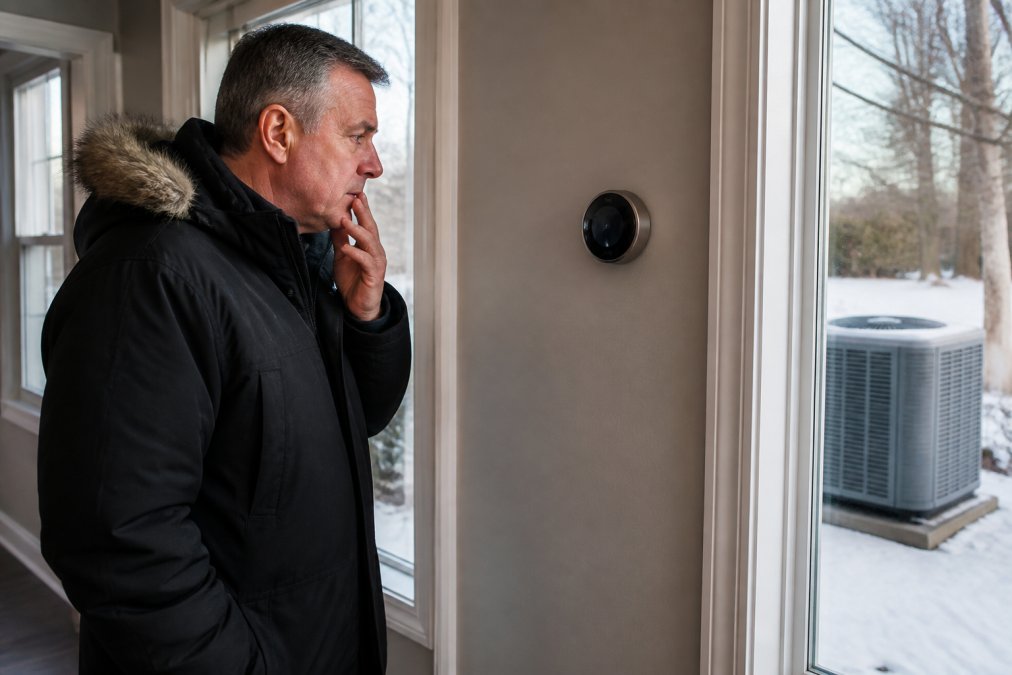
- Check the thermostat batteries and display. A blank or flickering screen usually means dead batteries or a tripped circuit, not a failed compressor.
- Confirm the thermostat is set to HEAT and the setpoint is at least 3 degrees above room temperature. A setpoint too close to room temperature can leave the system idle.
- Inspect the air filter. A clogged filter restricts airflow and can trip a high-limit switch, shutting the system down.
- Check the indoor and outdoor breakers. Reset any tripped breaker once. If it trips again immediately, stop and call a technician.
- Look at the outdoor unit. Clear snow, ice, or leaves from around it. Listen for the fan and compressor.
- Check for a float switch trip. If your system has a condensate pump, a full reservoir can shut the unit off.
- Note the error code. Many thermostats store a fault code. Write it down before you call.
Safety First: What to Check Before Touching the Thermostat
Never open the outdoor unit or remove panels. Capacitors hold a charge that can injure you even with the power off (osha.gov). If you smell burning, see scorch marks, or hear grinding or screeching, cut power at the breaker and call a licensed technician. Voltage fluctuations and voltage surges are common causes of control board failure, and they are not a DIY fix.
Resetting a breaker more than once on a system that keeps tripping can turn a repairable control board fault into a compressor failure. One reset, then call a professional.
How to Reset Heat Pump Thermostat (and When Not To)
Resetting a heat pump thermostat is safe in most cases and takes under five minutes. The method depends on your thermostat type.
For a standard thermostat, switch the system to OFF, wait five minutes, then switch it back to HEAT. For a smart thermostat, use the reset option in the settings menu or pull the unit from its base plate for 30 seconds. After the reset, give the system 10 to 15 minutes to respond. Heat pumps include a built-in delay to protect the compressor, so immediate response is not expected.
Do not reset the thermostat if the outdoor unit is making a loud noise, if you smell gas or burning, or if a breaker keeps tripping. In those cases, a reset just delays the repair and risks further damage.
Heat Pump Emergency Heat Setting Cost: What You Need to Know
Emergency heat is expensive because it usually runs on electric resistance heat strips instead of the heat pump itself. Resistance heat converts electricity directly into heat at roughly one unit of heat per unit of electricity, while a heat pump moves two to four units of heat per unit of electricity in moderate cold (energy.gov). That efficiency gap is why emergency heat can push utility bills sharply higher when it runs for days.
How to Estimate Your Cost Per Hour
You can get a usable number in about two minutes without guessing. Here is the method:
- Find your heat strip wattage. Look at the data plate on the indoor air handler or the nameplate on the heat strip kit. A common residential range is 5 kW to 15 kW, with 10 kW being typical for a single-family home in a cold climate.
- Find your electric rate. Your utility bill lists a price per kilowatt-hour (kWh). Residential rates vary widely by region and season, so use your own bill rather than a national average.
- Do the math. A 10 kW heat strip running continuously for one hour uses 10 kWh. Multiply 10 kWh by your rate per kWh to get the cost of that hour. At a rate of $0.15 per kWh, that is about $1.50 per hour, or roughly $36 per day if it runs nonstop.
- Adjust for duty cycle. Heat strips rarely run 100% of the time unless it is extremely cold or the home is poorly insulated. A 50% duty cycle cuts the estimate in half.
A heat pump running in moderate cold, by contrast, might use a third to a quarter of that electricity to deliver the same heat. That is the real cost of emergency mode: not the hourly rate alone, but the efficiency you give up every hour it stays on.
What Drives the Bill Higher
- Outdoor temperature. The colder it is, the more the strips run and the less the heat pump contributes.
- Heat strip size. A larger strip draws more power per hour.
- Runtime. Days on emergency heat cost far more than hours.
- Home envelope. Air leaks and poor insulation force longer runtimes.
- Rate structure. Time-of-use plans can make evening runtime especially costly.
Run emergency heat only long enough to keep pipes from freezing and the house habitable. Every additional day on emergency mode adds to your utility bill and stresses the heat strips. If you must use it overnight, close off unused rooms and lower the setpoint a few degrees to cut runtime.
When the Cost Signals a Bigger Problem
If emergency heat is running because the heat pump cannot keep up in mild weather, the cost is a symptom, not the disease. A refrigerant charge issue, a failing reversing valve, or a defrost fault can force the strips on far more than they should. Tracking how many hours per day the strips run, many smart thermostats log this, tells you whether you have a cold-weather capacity issue or a repair that is overdue.
Signs of Heat Pump Compressor Failure
Compressor failure is the most serious heat pump problem and the one most likely to require replacement rather than repair. Watch for these signs:
- The outdoor unit hums but the fan does not spin
- A breaker trips repeatedly when the system calls for heat
- The system blows room-temperature or cold air for extended periods
- Grinding, screeching, or clicking from the outdoor unit
- Ice buildup on the outdoor coil that does not clear during the defrost cycle
- The compressor runs briefly, then shuts off and will not restart
A refrigerant leak, a failed capacitor, or a bad contactor can mimic compressor failure, so a proper diagnosis matters. A technician tests voltage, amperage draw, and refrigerant pressure before concluding the compressor is gone.
When to Call an HVAC Professional Immediately
Call a licensed HVAC technician right away if any of the following apply:
- You smell burning or see smoke or scorch marks
- The breaker trips more than once
- The outdoor unit is silent while the thermostat calls for heat
- You hear grinding or screeching from the outdoor unit
- The system has been on emergency heat for more than a day with no improvement
- There is ice on the outdoor coil that will not clear
Anthony & Son Indoor Air Quality, LLC dispatches certified technicians for emergency heat pump repair across Maryland, Washington, DC, and Northern Virginia. We diagnose the actual fault before recommending repair or replacement.
Post-Emergency Maintenance and Prevention
Once the emergency is resolved, the work that keeps it from recurring starts with understanding what actually failed, not just scheduling a tune-up and hoping. The more useful move is a short after-action review plus smart thermostat data, which together catch the failures that a once-a-year visit can miss.
Run a Five-Minute After-Action Review
Before the technician leaves, or within a day of the repair, write down four things:
- The fault code or symptom that triggered the emergency.
- The confirmed cause the technician identified, not the symptom, the cause.
- The part or setting that was changed.
- The conditions when it failed, outdoor temperature, how long the system had been running, and whether emergency heat was already on.
That record turns a one-time repair into a pattern you can act on. If the same fault returns next season under similar conditions, you have evidence for a warranty claim or a replacement conversation instead of starting from scratch.
Use Smart Thermostat Data to Catch the Next Failure Early
Modern smart thermostats handle emergency heat differently than old manual units, and that difference is a diagnostic advantage most homeowners never use. Manual thermostats simply energize the strips when you flip the switch. Smart thermostats often log:
- Auxiliary and emergency heat runtime in hours per day
- Heat pump vs. strip heat ratio over a heating season
- Fault codes and lockout events with timestamps
- Indoor temperature recovery time after a setpoint change
A rising trend in strip-heat runtime is one of the earliest signals that the heat pump is losing capacity, often weeks before a full breakdown. If your thermostat supports it, enable runtime alerts and review the heating report monthly during cold months. If it does not, a basic runtime hour meter on the air handler can serve the same purpose.
Schedule Maintenance Around Your Climate, Not the Calendar
The right timing depends on when your system works hardest. In colder regions, book a tune-up in early fall so the defrost cycle, refrigerant charge, and backup heat staging are verified before the first hard freeze. In milder regions, late fall is usually sufficient. Either way, ask the technician to specifically test:
- Defrost cycle initiation and termination
- Auxiliary and emergency heat staging and lockout
- Refrigerant charge and superheat/subcooling
- Electrical connections and capacitor condition
- Condensate management and float switch operation
Prevention Checklist Between Visits
- Replace or clean the air filter every one to three months, more often with pets or high dust.
- Keep the outdoor unit clear of snow, leaves, and debris year-round.
- Do not chip ice off the outdoor coil; let the defrost cycle do its job or call for service.
- Watch for rising strip-heat runtime on your thermostat report.
- Log any fault code the moment it appears, even if the system recovers.
| Problem | Likely Cause | Immediate Fix | Prevention |
|---|---|---|---|
| Cold air from vents | Low refrigerant or failed compressor | Call a technician | Annual refrigerant check |
| Breaker trips repeatedly | Electrical fault or failing compressor | One reset, then call | Tighten connections at tune-up |
| Outdoor unit silent | Capacitor, contactor, or control board | Call a technician | Fall preventative maintenance |
| Ice on outdoor coil | Defrost cycle failure | Do not chip ice; call | Test defrost cycle yearly |
| High bills on emergency heat | Heat strips running continuously | Reduce runtime, schedule repair | Address root cause fast |
| Rising strip-heat runtime | Heat pump losing capacity | Schedule diagnostic | Review thermostat runtime monthly |
Frequently Asked Questions
How does a heat pump work in emergency mode?
In emergency mode, your heat pump bypasses the outdoor unit entirely and uses electric resistance heat strips inside your air handler to warm your home. This is similar to how a toaster works. It provides immediate heat but uses significantly more electricity than the heat pump’s normal operation. Emergency mode is designed for short-term use during a breakdown, not as a long-term heating solution.
Is it expensive to run a heat pump on emergency heat?
Yes, emergency heat can be two to three times more expensive than running your heat pump normally. The electric resistance heat strips draw a lot of power to generate heat directly, which can spike your utility bills quickly. If you need to use emergency heat for more than a day or two, call an HVAC technician to diagnose the underlying issue and get your system back to normal operation.
What are the signs of heat pump compressor failure?
Signs of heat pump compressor failure include the outdoor unit making loud grinding or clicking noises, the system blowing warm air in cooling mode or cold air in heating mode, frequent circuit breaker trips, and the compressor not turning on at all. If you notice these signs, turn off the system at the thermostat and call a licensed HVAC professional for a diagnosis.
Should I turn on emergency heat during an ice storm?
No, you should not turn on emergency heat during an ice storm unless your heat pump has completely failed. Emergency heat is meant for system breakdowns, not for extreme weather. During an ice storm, your heat pump may enter a defrost cycle, which is normal. If your system is running but not keeping up, it may be an issue with auxiliary heat, not emergency mode. Call a professional if you are unsure.